


Two suppliers quote the same P2.5 wall, the same 4.8 x 2.7 m size, the same delivered-to-church scope — and the totals differ by forty percent. That figure comes from the quotations our team is asked to compare, so treat it as the typical spread rather than a law. Churches usually conclude that one supplier is overcharging or the other is cutting corners. In reality, both quotes can be accurate and still differ, because “the same screen” is not the same bill of materials. This article breaks the difference into six cost blocks, then gives the comparison table that makes two quotes answerable.
Quick Answer: Six Blocks Account for Almost All of the Gap
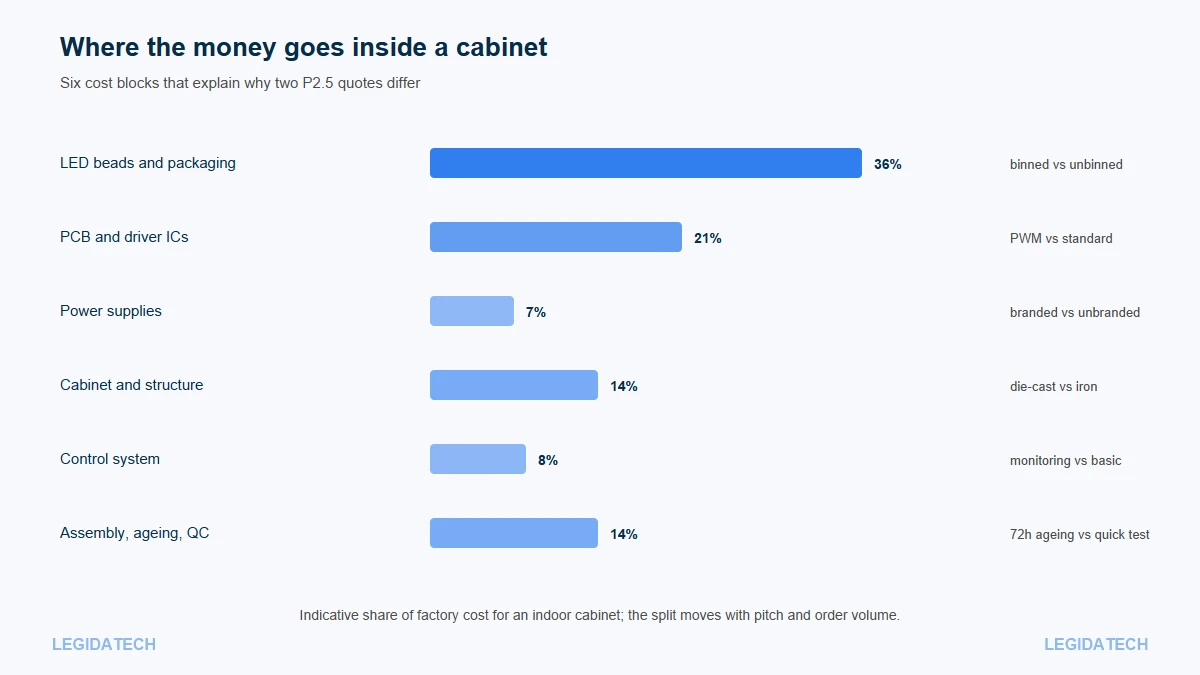
Quick Answer: LED beads and packaging (about 36 percent of factory cost), PCB and driver ICs (21), cabinet and structure (14), assembly and QC (14), control (8) and power supplies (7) are where identical-looking quotes diverge.
Our engineering team uses the same six blocks when costing a church wall, and the shares are indicative for an indoor cabinet; they move with pitch and order volume, but they explain the pattern: two thirds of the cost sits in components a buyer never sees, and those are exactly the components a quote can omit without looking incomplete.
Block 1: The LED Beads and Their Binning
The beads are the largest single cost and the easiest to vary without changing the spec sheet. Two suppliers can both write “SMD 2020, P2.5” while one uses a branded bead binned for colour consistency and the other uses a mixed-bin reel. The difference does not show on day one; it shows in month six as patchy colour across the wall, most visible on white lyric backgrounds and on camera.
Binning also affects yield: tighter bins cost more per bead because fewer pass. That is a real cost, not a markup, and it is one of the reasons a cheaper quote can be legitimate at a lower grade rather than dishonest.
Block 2: Driver ICs and Refresh Behaviour
Driver ICs decide refresh rate and grayscale behaviour at low brightness, and they come in grades that differ by a factor of two in price. A wall specified at 3,840 Hz needs PWM-capable ICs; a wall that only claims “high refresh” may reach it in a narrow condition and lose grayscale when dimmed.
For a church this is the block that decides whether the wall films cleanly and whether it still looks smooth at 30 percent brightness — the level most sanctuaries actually use on Sunday.
Block 3: Power Supplies
Power supplies are the smallest cost block and the most common failure point. A branded 100-240 V wide-input unit rated 200 W and an unbranded equivalent can differ by a few dollars per cabinet, which is invisible in a total but decides how the wall behaves in year three. In our after-sales records, power supplies are the most frequently replaced component in LED walls.
Block 4: Cabinet, Structure and Flatness
The cabinet is mechanical, and the difference between die-cast aluminium and iron shows up as weight, flatness and seam alignment. On a fixed sanctuary wall the seams are the visible quality signal: a wall with inconsistent cabinet flatness shows faint grid lines on white content, and no amount of calibration removes them.
Structure is often quoted separately, or not quoted at all. A steel frame for a 13 m² wall is a real line item; a quote that omits it is not cheaper, it is incomplete.
Block 5: Control System and Processing
Control ranges from a basic sending card to a processor with input switching, scene presets and monitoring. For a church the processor is what volunteers touch, so the practical question is not which brand but whether it accepts your existing presentation output and stores the scenes your team needs.
Two quotes can both say “NovaStar controller” and still differ: one may include a processor with presets, the other only a sending card that expects a processor you already own. Ask for the input list and the preset count.
Block 6: Assembly, Ageing and QC
This is where the invisible difference becomes a schedule risk. A factory that runs a 72-hour ageing test, brightness-uniformity checks and per-point inspection spends more labour per cabinet than one that ships after a power-on test. The church sees the difference as failure rate in the first year, not as a line on the quote.
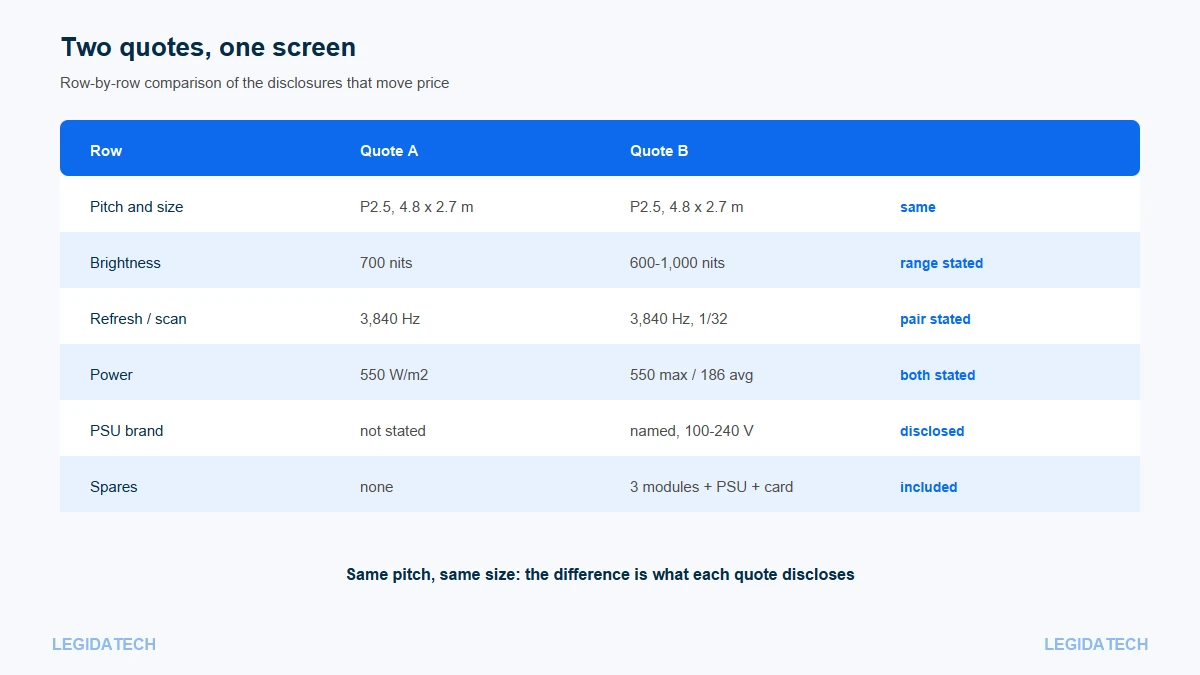
The Comparison Table That Makes Two Quotes Answerable
Rather than comparing totals, send both suppliers the same eleven rows and ask for them in writing. The point is not to catch anyone out; it is to make the two documents describe the same object.
| Row | What to ask | Why it changes price |
|---|---|---|
| 1 | Pitch, width, height and pixel count | Confirms the walls are the same object |
| 2 | LED bead brand and bin | Largest single cost, invisible in photos |
| 3 | Driver IC model and refresh with scan mode | Decides camera behaviour and dimmed quality |
| 4 | Power supply brand and rating | Most frequent failure point |
| 5 | Cabinet material and weight per m² | Structure cost and seam quality |
| 6 | Control system model and inputs | Volunteer usability; often under-specified |
| 7 | Structure included or excluded | Can be 15 percent of the project |
| 8 | Freight term (FOB, CIF, delivered) | Quotes are not comparable across terms |
| 9 | Duty and clearance responsibility | The classic post-signature surprise |
| 10 | Commissioning and volunteer training | Either included, quoted, or assumed |
| 11 | Spares and warranty terms | Changes five-year cost, not purchase price |
Visible Versus Hidden: Where the Forty Percent Comes From
In practice, most of the gap appears in the hidden column rather than the visible one.
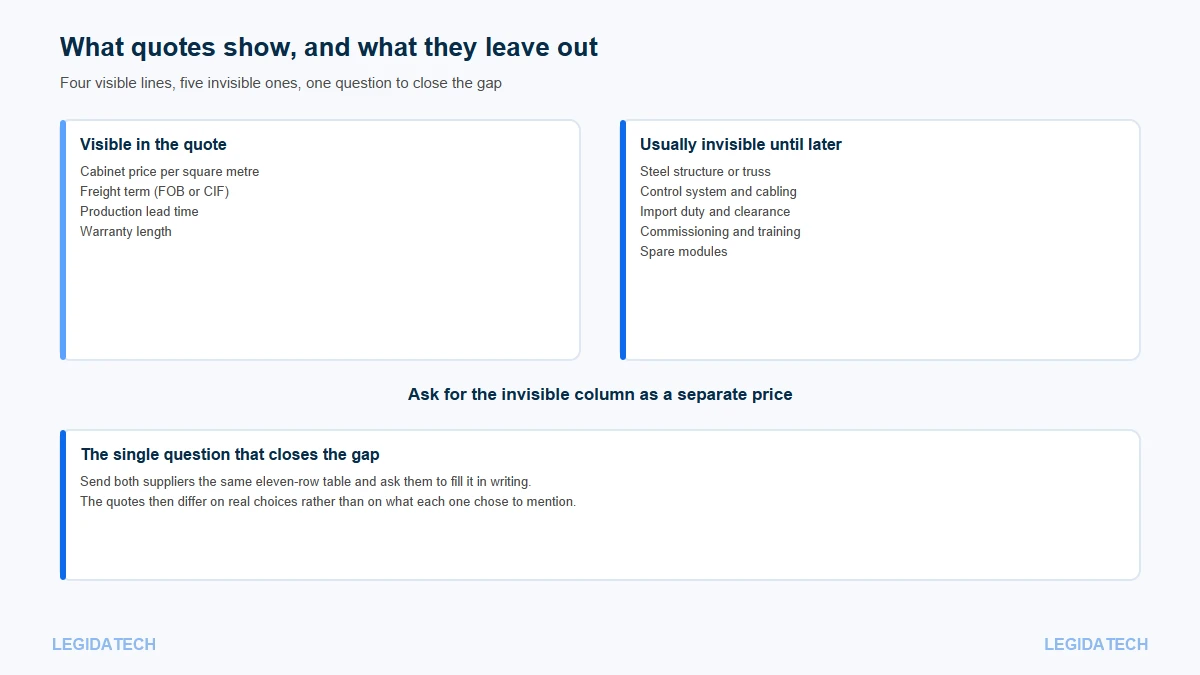
- Visible: cabinet price per square metre, freight term, lead time, warranty length.
- Hidden: steel structure or truss, control and cabling, import duty and clearance, commissioning and training, spare modules.
A quote that omits four of the five hidden items can look forty percent cheaper and deliver the same final cost — or more, because the church buys the omitted items later at retail. That is not a pricing strategy unique to LED; it is how capital projects are usually quoted.
How to Compare Two Quotes in One Sitting
- Normalise the delivery term. Convert both to the same Incoterm, or ask both for delivered-to-site pricing.
- Add the omitted items. Price structure, control, duty, commissioning and spares at the same rates for both quotes.
- Compare component rows, not totals. If one quote cannot fill rows 2, 3 and 4, that is the finding.
- Convert to five-year cost. Add expected spares and power-supply replacement so the cheaper purchase is tested against the longer horizon.
Published component definitions and control-system capacity figures from makers such as NovaStar are a useful cross-check on rows three and six. When we review a competing quote for a church, this normalisation typically moves the comparison by 20-40 percent — not because anyone lied, but because the two documents were describing different scopes. Our guide to reading a specification sheet covers the component rows in more depth.
Four Signals That a Quote Is Incomplete
Incomplete is not the same as dishonest, but both cost the church the same money later.
- No units. “Brightness: high, refresh: high” is marketing, not a specification.
- One number where there should be two. Power as a single figure, brightness without a range, lifetime without a failure policy.
- No delivery term. A price without FOB, CIF or delivered is not a price.
- No commissioning line. Someone has to configure the processor and train the volunteers; if the quote is silent, the church will pay for it separately.
Payments, Milestones and What Each One Should Trigger
Payment structure differs between suppliers, and it belongs in the comparison because it changes the church’s cash flow rather than the headline price. Ask each supplier which milestones their schedule follows.
| Milestone | What it should trigger | What to check before paying |
|---|---|---|
| Order confirmation | Fabrication slot reserved | Signed specification with the eleven rows attached |
| Pre-shipment | Ageing test and cabinet inspection complete | Test record plus photos of the wall lit up |
| Shipment | Freight booked on the agreed term | Packing list and bill of lading |
| Delivery | Goods cleared and counted | Cabinet count checked against the grid drawing |
| Commissioning | Wall running with presets and training done | Volunteer sign-off on the preset sheet |
What the Difference Is Worth
Forty percent sounds like a lot until it is attributed. In our experience it usually decomposes into roughly: 10-15 percent component grade, 10 percent scope that one quote omitted, 5-10 percent structure and control, and 5 percent logistics and duty. Once the gaps are named, most churches find the two quotes are closer than the totals suggested — and the conversation moves from “who is cheaper” to “which scope do we actually want”.
Why the difference is worth naming
That is a better conversation, because it can be answered with a budget rather than a suspicion. The church LED screen price guide gives the per-square-metre ranges by pitch, and the buying guide covers the decisions that precede the quote.
Frequently Asked Questions About Comparing LED Screen Quotes
Why is one quote forty percent cheaper than another for the same size?
Usually because the two quotes describe different scopes. Component grade, omitted structure or control, different delivery terms and different duty arrangements can each move the total by 10-15 percent. Normalise both to delivered-to-site with the same scope before deciding which is cheaper. In the quotations we review the gap is usually 20-40 percent and it decomposes into the six blocks below.
Is the lowest-priced quote always cutting corners?
No. A supplier with lower overheads, a larger order volume or a simpler scope can legitimately be cheaper. The test is whether every row can be answered in writing: if pitch, bead grade, driver IC, power supply and warranty are all specified, the price may simply be lower rather than thinner.
What should I ask for in writing?
Eleven rows: dimensions and pixel count, bead brand and bin, driver IC and refresh with scan mode, power supply brand and rating, cabinet material and weight, control system and inputs, structure included or not, freight term, duty responsibility, commissioning, and spares with warranty terms. A supplier who can fill all eleven rows tends to be the one whose quote survives to commissioning.
How much of a church screen quote is structure?
Roughly 15 percent for a typical fixed indoor wall, though it rises with height, access difficulty and any rigging requirement. A quote that omits structure is not cheaper; the church buys it separately at whatever the local fabricator charges, usually after the screen has shipped. On a 13 m² wall the steel can reach 15 percent of screen value, and rigging pushes it higher.
Do freight terms really change the total that much?
They can change who pays and when, which matters more than the number. FOB leaves freight, insurance and clearance to the buyer; delivered pricing folds them in. Two quotes with different terms cannot be compared until both are converted to the same basis. FOB and CIF can differ by the entire freight and insurance cost, which is why the term belongs in row eight.
Should I pay more for branded power supplies?
Yes, because power supplies are the most frequently replaced component in LED walls and the easiest place for a supplier to cut cost invisibly. The premium is small per cabinet and the failure is expensive, since a failed supply usually takes a cabinet block dark mid-service. A branded 200 W unit costs a few dollars more per cabinet and is the part most often replaced in year three.
How do I compare warranties across quotes?
Compare terms rather than years: what is covered, whether replacement ships before the faulty part returns, who pays freight each way, and what voids the warranty. A two-year warranty with advance replacement can be worth more than a five-year warranty with return-to-factory shipping. Compare what is covered, whether replacement ships first, and who pays freight each way.
What is a fair deposit and payment schedule?
Payment terms vary by supplier and country, so ask explicitly rather than assuming a standard. Common structures split the total between order confirmation, pre-shipment inspection and delivery. Whatever the split, tie each payment to a visible milestone rather than to a date. Milestones also give the church a lever if a stage slips, which a date-based schedule does not.
Can I ask a supplier to match a cheaper quote?
You can, and it is more useful to ask them to match the scope than the price. Send the comparison table and ask which rows they can meet at the lower number. The answer tells you whether the cheaper quote was thinner or genuinely more efficient. If they can meet the rows at the lower number the gap was scope; if not, it was specification.
What if the two quotes have different pixel pitches?
Then they are different products and price comparison is meaningless until you decide the pitch from viewing distance. Use the resolution formula, width divided by pitch, to see what each wall actually delivers, then compare the options at the pitch your room needs. A P2.5 and a P3.9 wall of the same width differ by roughly 2.4 times in pixel count.
Next Step: Send Us the Quote You Are Comparing
Two quotes for the same wall are rarely a scandal and usually a scoping problem. If you send us both quotations our engineering team will return them normalised to one basis, with the blank rows marked. The fix is a table with the same eleven rows filled by both suppliers, normalised to the same delivery term, with the hidden items priced in.
Send us the quotation you are comparing and our engineering team will mark which rows are specified, which are vague and which are missing — or request a phone call. For the price ranges behind the numbers, read the price quick guide, and for the component detail see the specification sheet guide.


