


Church LED Screen Price: What One Costs Per Square Metre in 2026The indicative bands by pitch, the three configurations churches actually choose from, whole-screen budgets for four room sizes, and the costs that arrive after the invoice
Get a Costed Quote in 24 Hours
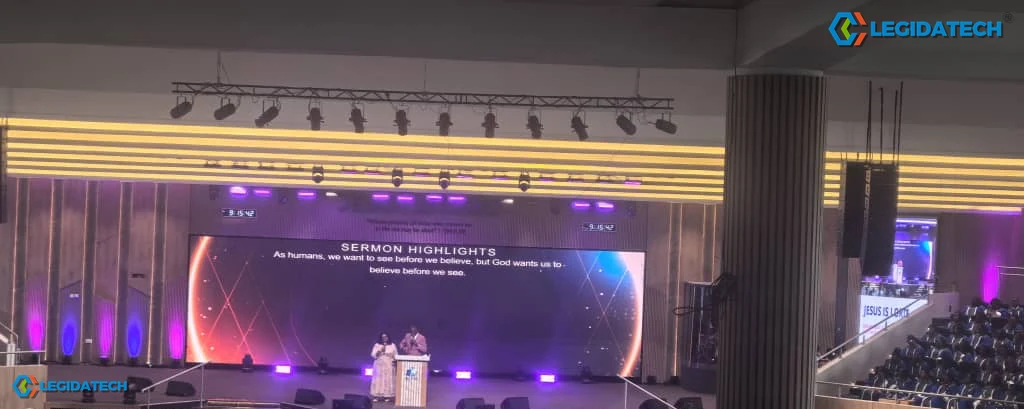
A P2.5 wall across an Accra platform, 12.16 × 3.84 m — 46.7 m², one of the largest church walls in our project archive.
The Short Answer
For a church, indoor LED screen equipment runs from US$400–600 per m² at P3.9 up to US$800–1,200 at COB P1.5, depending on pitch, and outdoor signage about US$200–700. An indoor P2.5 sanctuary wall therefore lands at roughly US$500–800 per m² factory-direct: an 11.5 m² wall is US$5,750–9,200, a 20 × 10 ft wall US$9,300–14,900. Freight, duty, steel, installation and control sit outside that figure, and typically add a third to two thirds of the equipment price again before the screen is on the wall. All figures are indicative planning bands, not a quotation.
A single price per square metre is the number every church asks for and the number that hides the most. Two quotes for the same room at the same pitch can differ by 40% and both can be honest, because the words behind the number — cabinet, encapsulation, control system, redundancy, warranty, freight terms — are different products. This page gives the bands first, then the seven variables that decide where inside the band your building lands.
Price by Pitch, With the Room That Suits It
The pitch — the distance between two LED lamps, in millimetres — is the single biggest price driver. It is chosen by the closest seat that has to read text, not by the size of the room.
| Type | Pitch | Indicative equipment band (US$ / m²) | Best for | Closest comfortable seat |
|---|---|---|---|---|
| Indoor COB | P1.25–P1.5 | 800–1,200 | Camera at the platform edge, front row under 3 m, 4K in a small wall | 1.5–2.5 m |
| Indoor SMD fine pitch | P1.86–P2.0 | 600–900 | Sanctuaries where the front row is 3–5 m out and the stream is close-cropped | 2.5–3.5 m |
| Indoor SMD | P2.5 | 500–800 | The church default: lyrics, scripture, IMAG, a 12–30 m² wall | 3–4.5 m |
| Indoor SMD | P3.0–P3.9 fixed | 400–600 | Longer rooms, balcony-led sightlines, budget-led builds | 4.5–6 m |
| Rental / portable | P3.91 | 550–900 | Church plants in rented halls, conferences, touring crusades | 4–6 m |
| Outdoor | P4 | 450–700 | Street-facing signage read from 8–12 m | 6–8 m |
| Outdoor | P6.67 | 350–550 | Roadside boards read from 12–20 m | 10–12 m |
| Outdoor | P8 | 280–420 | Large facades and compound entrances | 12–16 m |
| Outdoor | P10 | 200–320 | Highway distance, billboard-scale messages | 16–25 m |
The band width inside each pitch is not sales slack. It is the difference between a single-power cabinet and a dual-power cabinet, between a proprietary and a standard control system, between 1,920 Hz and 3,840 Hz refresh, and between an IP65 outdoor cabinet with a proper seal and one without. Those four decisions are where the money in a quote actually moves.
The viewing-distance rule of thumb we quote. A commonly quoted minimum is about 1 m per millimetre of pitch — 2.5 m at P2.5 — but a minimum is not where a congregation reads text from. In a church we plan to the comfortable column in the table: 3–4.5 m at P2.5, 4.5–6 m at P3.9, 1.5–2.5 m only on a sealed COB wall. Buy the coarser pitch your room allows and spend the difference on the control system and the spare kit — that trade is almost always the better five-year decision.
The Three Configurations Churches Choose From
Every church quote we send is built on one of these three. The tier names are ours; the trade-offs are not.
| Essential | Standard | Pro | |
|---|---|---|---|
| Pitch and encapsulation | Indoor SMD P3.0–P3.9 fixed | Indoor SMD P2.5 fixed | COB P1.25–P1.5 fixed |
| Indicative band | US$400–600 / m² | US$500–800 / m² | US$800–1,200 / m² |
| What it is for | Lyrics and scripture from 5 m back, a balcony room, a first screen | The default: lyrics, IMAG, graphics, a livestream camera at 8–15 m | Camera at the platform edge, front row at 2–3 m, 4K in a small wall |
| Service access | Rear or front, room-dependent | Front service, module out from the aisle | Front service, sealed face, washable |
| Redundancy | Single supply, single signal | Dual supply, dual signal | Dual supply, dual signal, sealed modules |
| Refresh | 1,920 Hz and up | 3,840 Hz | 3,840 Hz and up |
| Honest limit | Visible pixel structure on camera close-ups | Lamp grid can moiré when the camera is very close | Pays for resolution the back rows cannot see |
Most churches should be in Standard. Essential is the right answer when the room is deep, the budget is fixed and the camera sits far back — and it is a better buy than a small Pro wall, because screen area matters more than pitch once the closest seat is 5 m away. Pro is the right answer when the livestream is the point and the platform camera is inside 4 m.
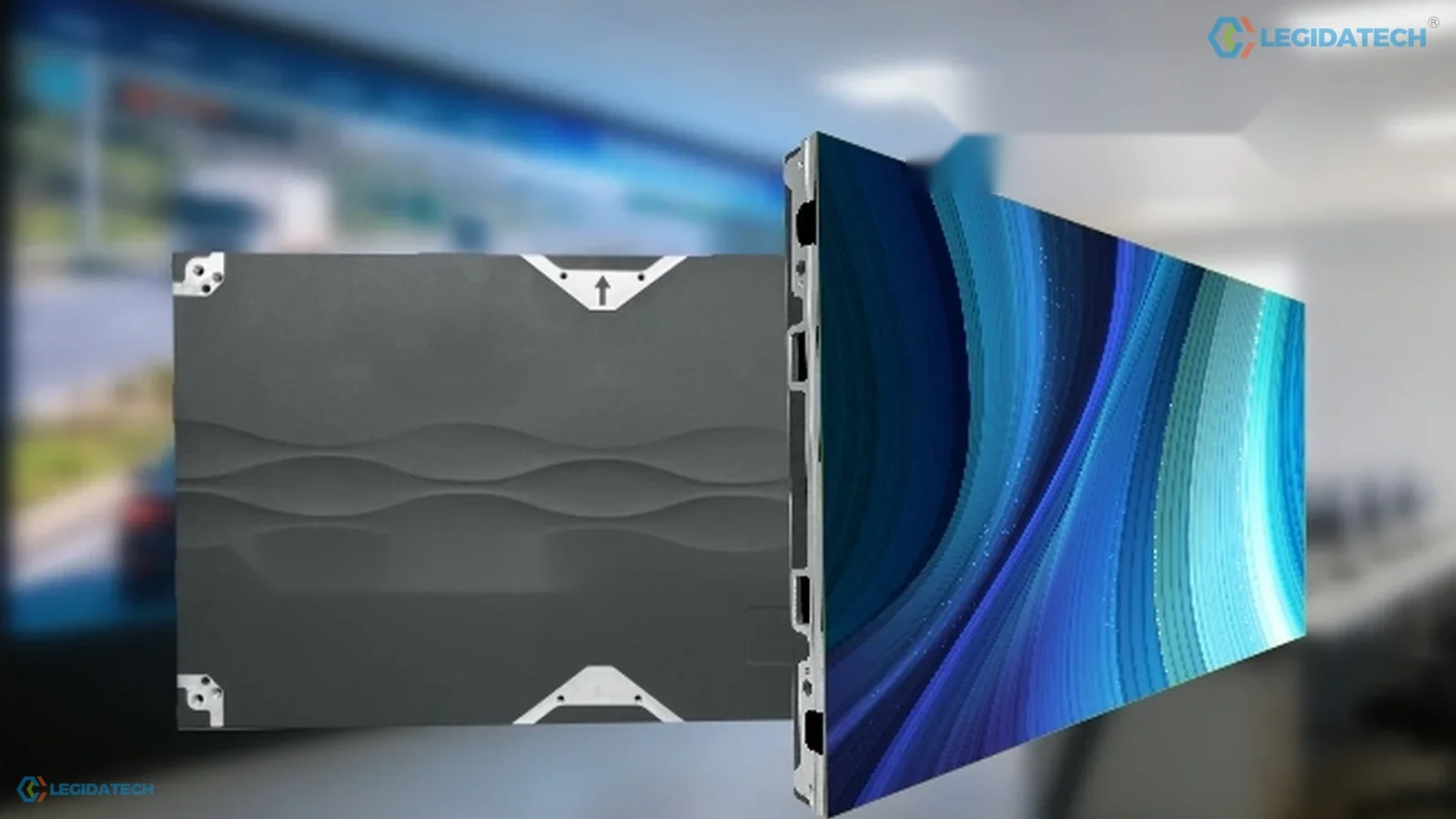
The Pro tier: flip-chip COB panels, sealed face, front service — pitched at rooms where the camera is closer than the front row.
Whole-Screen Budgets for Four Room Sizes
Buyers think in “a 20-foot screen”, not in square metres. These are the equipment totals for the four sizes that cover most church enquiries: the first three at indoor P2.5 (US$500–800 / m²), the 24 ft size at P3.91 fixed (US$400–600). Screen-only, factory-direct, before freight and installation.
| Nominal size | Nominal wall (builds to whole modules) | Area | Equipment (US$) | Seats it serves |
|---|---|---|---|---|
| 10 × 8 ft | 3.05 × 2.44 m | 7.4 m² | 3,700–5,900 | 80–150 |
| 16 × 9 ft | 4.88 × 2.74 m | 13.4 m² | 6,700–10,700 | 150–300 |
| 20 × 10 ft | 6.10 × 3.05 m | 18.6 m² | 9,300–14,900 | 300–500 |
| 24 × 12 ft (P3.91 fixed) | 7.32 × 3.66 m | 26.8 m² | 10,700–16,100 | 500–800 |
The seat column is the honest part: it assumes the screen is the main visual, the back row is within about 25 m, and the room is not relying on side screens. A room that seats 300 in a wide, shallow layout needs less area than one that seats 300 in a narrow nave — the constraint is the furthest seat’s angle to the screen, not the seat count.
Walls are built from whole modules, so the nominal size in a quote is snapped to the module grid: a “20 × 10 ft” screen usually builds at 18.5–19 m² rather than the nominal 18.6, and your quote will show the achieved size and resolution rather than the nominal label. The difference is under 1% and it is stated on the drawing, not buried in it. The 20 × 10 ft case is covered in depth on its own page: how much a 20ft LED screen costs for a church, including what the wall builds to and how far back it stays readable.
What Moves the Price Most
Seven variables account for nearly all of the spread between two quotes for the same room. Each one has a “when it matters” and a “when it does not” — and paying for the ones that do not matter is the most common way churches overspend.
| Driver | When it matters | When it does not |
|---|---|---|
| Pitch | Closest seat under 5 m, or a camera inside 4 m | Deep room, balcony-led sightlines, camera on a long lens |
| Encapsulation (SMD / GOB / COB) | Sealed face needed: heavy cleaning, contact, camera glare, close framing | Wall mounted out of reach and filmed from the back of the room |
| Cabinet and structure | Wall spans a void, needs steel, or must be removable | Solid wall, bolted flat, no rigging |
| Control system | Multi-source (ProPresenter, camera, stage laptop), recording, future expansion | One laptop, one source, no streaming |
| Redundancy | Sunday service cannot be interrupted; remote or storm-prone site | Small secondary room where a 20-minute fix is acceptable |
| Brightness and IP rating | Outdoor, street-facing, direct sun, dust roads | Indoor room with controlled light |
| Freight and duty | Landlocked or high-duty market, sea freight volume, port clearance | Rarely negligible — but it is quoted separately so you can see it |
Two of these deserve a sentence each because they are routinely over-bought. Brightness: indoor church walls are specified at 800–1,500 nits, and 4,500–6,500 nits is outdoor signage territory. Paying for outdoor-grade brightness indoors does not buy visibility — it buys glare in the camera and heat in the cabinet. Pitch: a P1.5 wall in a room whose front row is 6 m back spends money on resolution nobody’s eye can resolve — that money buys more area, which the room can see.
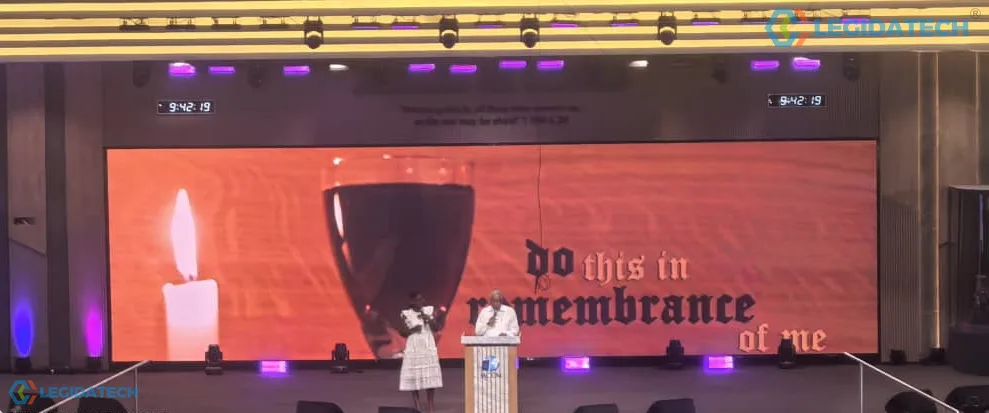
Readability is the spec that matters: lyrics legible from the back row, at the pitch the room allows.
The Invoice After the Invoice
Equipment is typically 60–75% of what a church actually spends to get a screen working on the wall. The rest is not extras — it is the same project, priced later. Ask for all of it in one document before you approve anything.
| Line | Typical basis | How to keep it honest |
|---|---|---|
| Freight | Charged on volume, not weight — a wall is mostly air | Get the cubic metres and the rate separately, port to port, then door |
| Duty and VAT | Set by your country’s tariff code for LED displays | Ask for the code and check it with a local broker before ordering |
| Steel structure or truss | Fabricated locally, priced per project | Get a local fabricator quote; do not accept a lump sum from the screen supplier |
| Installation and rigging | Day rates plus access equipment | Ask how many people, how many days, and who provides the scaffold |
| Electrical works | Circuit, distribution board, surge protection, earthing | Itemise surge protection and earthing — they are the least expensive insurance in the project |
| Control and content hardware | Processor, media player or computer, cabling | Confirm the control system is a standard brand your local technician knows |
| Spare parts kit | 3–5% of the equipment price | Order it with the screen, in the same shipment; the logic is in our five-year maintenance cost breakdown |
| Commissioning and training | One to three days on site, or remote | Get it in writing with the number of sessions and who attends |
Two of these lines are the ones churches regret skipping: the spare kit, and surge protection with proper earthing. Both are small relative to the project and both convert a future outage into a twenty-minute job. Our LED screen maintenance cost guide works through the five-year arithmetic on the same basis used here.
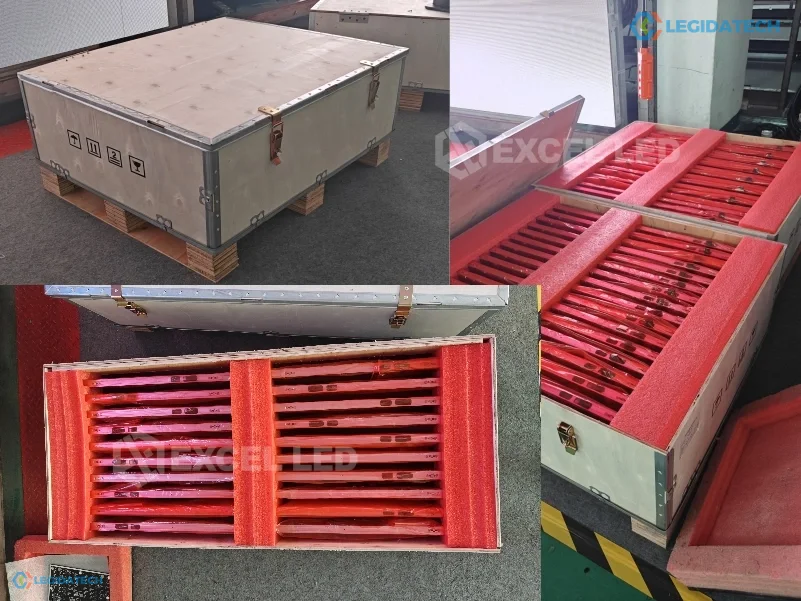
Export packing: freight is charged on the volume of this crate, not on the weight of the screen.
Three Real Walls, and What the Bands Would Price Them At
Our archive holds 44 delivered church installations across twelve countries. Three of them are useful anchors because their sizes span what most enquiries ask for. The areas and pitches are from the delivered projects; the equipment figures are today’s indicative bands applied to those areas, not what those churches paid.
| Project | Wall | Area | Band applied | Equipment today |
|---|---|---|---|---|
| Living Faith Church, Nigeria | 4.8 × 2.4 m, P2.5 | 11.5 m² | US$500–800 | 5,750–9,200 |
| Warriors Chapel, Kumasi | 5.12 × 1.92 m, P2.5 | 9.8 m² | US$500–800 | 4,900–7,840 |
| Accra auditorium, Ghana | 12.16 × 3.84 m, P2.5 | 46.7 m² | US$500–800 | 23,350–37,360 |
Three things are visible in that table. A 10 m² and a 12 m² wall are the same project with different content, and the price difference is smaller than most committees expect. A 47 m² wall is not four times a 12 m² wall in difficulty — the structure and the control system start to dominate, not the panels. And the per-metre band is the same for all three, which is why the band is the useful unit and the total is only the output.
How to Compare Two Quotes Without Being an Engineer
Five lines, read in this order. If a quote cannot answer all five in writing, the price on it is not comparable with the one next to it.
- Achieved size and resolution, not nominal size. “20 ft” means nothing until the drawing shows 6.08 × 3.04 m and 2,432 × 1,216 pixels.
- Encapsulation and pitch, both named. SMD, GOB or COB, and the pitch in millimetres — not “high brightness indoor”.
- Cabinet and service method. Cabinet size, depth, weight, and whether a module comes out from the front or the back.
- Control system, by brand and model. A standard controller your local technician can replace is worth more than a better pitch.
- What is excluded. Freight terms, duty, steel, installation, spares, commissioning, and the warranty’s exact coverage and period — confirmed in the quotation itself.
If two quotes match on all five, the higher one is buying something you can name. If they do not match on all five, the cheaper one is usually cheaper because one of those five is missing.
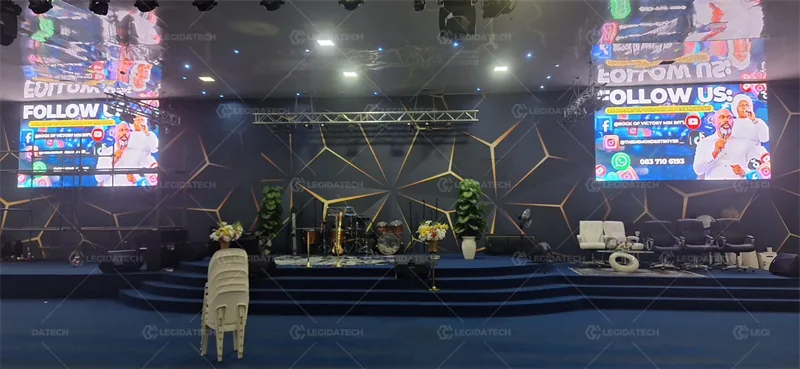
A main wall with flanking side screens — two quotes for the same room can differ simply because one includes the sides.
The same numbers, applied to real markets: Church LED screens in Nigeria · Church LED screens in Ghana · Church LED screens in South Africa. For supplier-by-supplier comparisons, see the Top 10 church LED screen suppliers in Nigeria and the Top 10 church LED screen suppliers in Ghana.
Frequently Asked Questions
Indoor equipment runs from US$400–600 per m² at P3.9 up to US$800–1,200 at COB P1.5: roughly US$5,750–9,200 for an 11.5 m² P2.5 wall, and US$9,300–14,900 for a 20 × 10 ft wall. Budget a further third to two thirds of the equipment price for freight, duty, steel, installation and control before the screen is working.
US$400–600 at P3.0–P3.9 fixed, US$500–800 at P2.5, US$600–900 at P1.86–P2.0, and US$800–1,200 at COB P1.25–P1.5. Outdoor runs from US$200–320 at P10 up to US$450–700 at P4. These are indicative bands for equipment, factory-direct.
Because the pitch, the encapsulation, the cabinet, the control system, the redundancy and the freight terms are different products. A US$120 / m² gap usually traces to one of those six, not to margin. The comparison checklist above names the five things a quote must state before the numbers can be compared.
Not automatically. A P3.9 wall in a room where the closest seat is 6 m back looks the same as a P2.5 wall from that distance, and the saved money buys area or a better control system. A coarser pitch is the wrong choice when the camera frames tight or the front row is inside 3 m.
Freight by volume, duty and VAT, steel or truss, installation and access, electrical works including surge protection and earthing, the control system and content hardware, a 3–5% spare parts kit, and commissioning with training. Equipment is typically 60–75% of the total project cost.
No — the per-metre band is flat, but the structure and control costs are not: a 47 m² wall needs a different frame, more processing capacity and a service plan that a 10 m² wall does not. Below about 8 m² the fixed costs — freight minimum, processor, commissioning — make the per-metre figure rise again.
Yes, and cheaper per square metre at the same visual result: outdoor P8 at US$280–420 and P10 at US$200–320, because the viewing distance is longer and the lamps are larger. The cabinet and seal are more expensive, but the pitch is coarser and the area matters less.
Installation and rigging typically run 10–20% of the equipment price depending on access, and the steel or truss is a separate 10–20% quoted by a local fabricator — the two lines are not the same money. A wall that bolts flat to a solid wall is at the low end; a wall spanning a void or requiring scaffolding at height is at the high end.
You can, but not on the same drawing. The steel is designed around the achieved cabinet grid, so change the wall size later and the frame is remade. Decide the final size before the steel is fabricated — that is the one sequencing mistake that costs real money.
Deposit with the order, balance against the pre-shipment inspection or the bill of lading, and the final balance on arrival or commissioning. Terms, currency and any letter of credit arrangement are confirmed in the quotation — they differ by market and by order size.
Where to go next
The five-year view of what the screen costs to keep running, on the same price basis: church LED screen maintenance cost. The sealed-face option and what it changes: COB church LED screens. A worked example at one size: the same bands applied to an 11.5 m² wall. Our delivered projects by country and pitch: church LED screens.
Indicative planning bands, last reviewed November 2026. Not a formal quotation. Freight, duty, structure, installation and warranty terms are confirmed in the project quotation.