


Church LED Screens in NigeriaPrice bands by pixel pitch, 35 project records for Nigeria of which 16 name the church, and what the equipment costs before freight, duty and installation
What a Nigerian Wall Costs, in One Paragraph
An indoor P2.5 church wall in Nigeria runs about US$500–800 per m² factory-direct, outdoor P4 about US$450–700, and outdoor P10 about US$200–320. Those figures cover the screen and its cabinets, not the ocean freight, the duty assessed at the port, the steel frame or the installation labour. A 10–12 m² sanctuary wall therefore sits in a US$6,000–11,000 equipment band before anything lands in Lagos. Every number on this page is indicative: your quotation is built on the wall you actually have, the pitch you actually need and the cabinet that fits both.
Nigeria is the largest single country in our project records: 35 entries, 16 of which name the church, from a 1.8 m² wall in Apapa to a 33.8 m² stage wall in Port Harcourt. The other twenty are venues recorded without a name or outside the church category, and we count them separately rather than folding them into a church number. This page is what those projects taught us about specifying a screen for a Nigerian sanctuary, in the order a church committee usually needs it: price, room, pitch, delivery, and the questions to ask before signing.
Price Bands by Pitch, Factory-Direct
Most suppliers quote per project and publish nothing, which makes three quotations impossible to compare. These are the bands we work with, quoted in US dollars because the naira moves and a naira quotation goes stale between approval and payment.
| Pixel pitch | Where it is used in a church | Indicative band (US$/m²) | Typical cabinet |
|---|---|---|---|
| Indoor P2.5 | Sanctuary front wall, 15–25 m viewing depth | 500 – 800 | 480×320 mm die-cast, front service |
| Indoor P3.91 | Stage backdrop, mixed seating, tighter budgets | 450 – 700 | 500×500 or 500×1000 mm |
| Outdoor P4 | Street-facing sign viewed from the road edge | 450 – 700 | 960×960 mm, IP65 |
| Outdoor P6.67 | Church frontage, mid-distance reading | 350 – 550 | 960×960 mm, IP65 |
| Outdoor P10 | Highway-facing sign, 30 m and beyond | 200 – 320 | 960×960 mm, IP65 |
Indicative factory-direct ranges for standard configurations, excluding freight, duty, VAT, steel structure, control system and installation. These are our own bands for standard builds, reviewed November 2026; they are not derived from a competitor price list and they are not a quotation.
The full pitch-by-pitch table, with whole-screen budgets for four room sizes and the lines that sit outside the equipment price, is on our church LED screen price guide. For a single 20 ft wall, the 20ft cost page works the same numbers on one size.
Why Nigerian quotation bands differ so much from each other
A naira price list circulating in Lagos and a dollar quotation from a factory are not pricing the same object, which is why the numbers can look far apart and both be honest. Public Nigerian bands — for example the 2026 Nigeria price analysis published by Sostron (sostron.com), a Shenzhen display manufacturer, which lists indoor P2 to P2.5 at roughly ₦380,000–580,000 per m² — are indicative and usually describe an entry-level configuration: SMD lamps, a lower refresh rate, module-only pricing, and no duty. Our band is quoted in dollars against a named cabinet with a stated refresh rate.
Three checks close the gap before you compare money. Ask which cabinet and which module size the price is built on. Ask for the refresh rate in writing; 3,840 Hz is what stops the wall banding on camera. And ask whether the figure is FOB Shenzhen, CIF Lagos or landed. A quote that answers all three can be compared with another quote. A quote that answers none of them cannot, whatever the number says.
What We Have Delivered in Nigeria
Six of the 36, chosen because between them they cover the size range a Nigerian church is likely to fall into. Each row is a project in our files, with the room survey, the pitch decision and the installed result.
| Church | City | Wall size | Pitch | Resolution | Year |
|---|---|---|---|---|---|
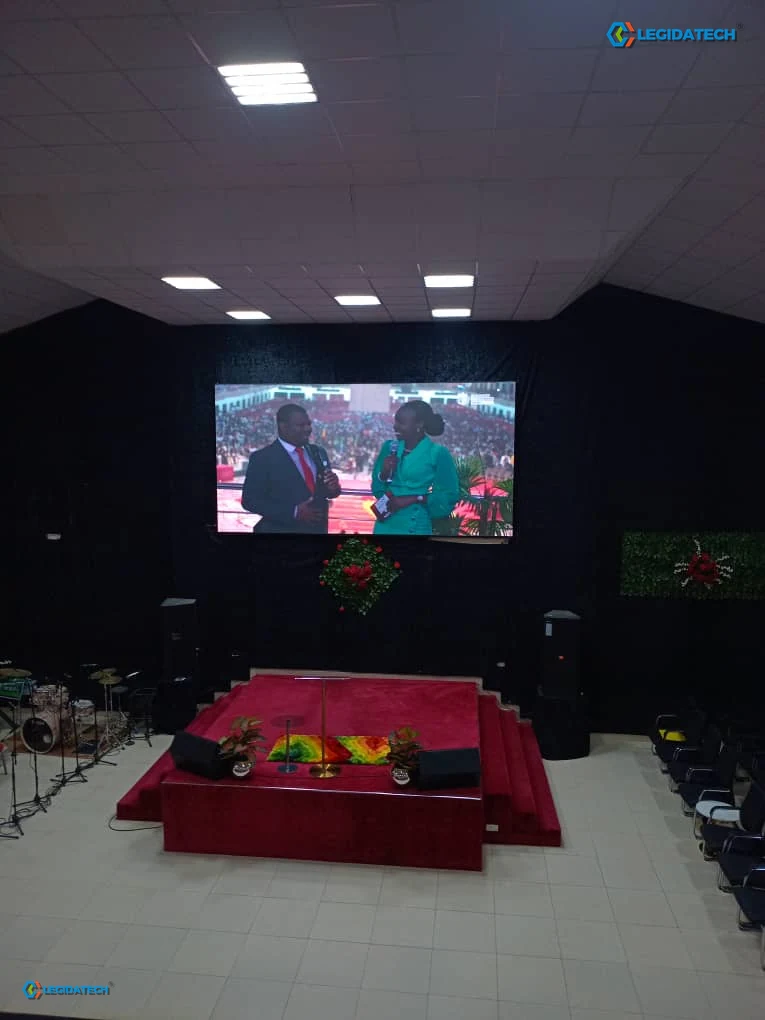
| Living Faith Church (Winners’ Chapel) | Ota / Lagos | 4.8 × 2.4 m (11.5 m²) | P2.5 | 1,920 × 960 | 2024 |
| Port Harcourt stage wall | Port Harcourt | 9 × 3.75 m (33.8 m²) | P3.9 | module-grid design | c. 2021 |
| RCCG Mount Olives | Abuja | 3.52 × 2.4 m (8.4 m²) | P2.5 | 1,408 × 960 | 2026 |
| RCCG Akowonjo | Lagos | 2.88 × 1.92 m (5.5 m²) | P2.5 | 1,152 × 768 | 2025 |
| Salem Christian Ministry | Lekki, Lagos | 4.48 × 2.4 m (10.8 m²) | P2.5 | 1,792 × 960 | 2025 |
| Apostolic Church | Apapa, Lagos | 1.92 × 0.96 m (1.8 m²) | P2.5 | 768 × 384 | 2025 |
Resolutions are calculated on a 320×160 mm module at P2.5 (128×64 pixels per module). Where the original build used a different module size we show the cabinet design rather than guess a pixel count.
The range matters more than any single row. A 1.8 m² wall for a small Apapa congregation and a 33.8 m² stage wall in Port Harcourt come out of the same cabinet system, which is why a church can start small and extend later without changing supplier or spare-parts box.
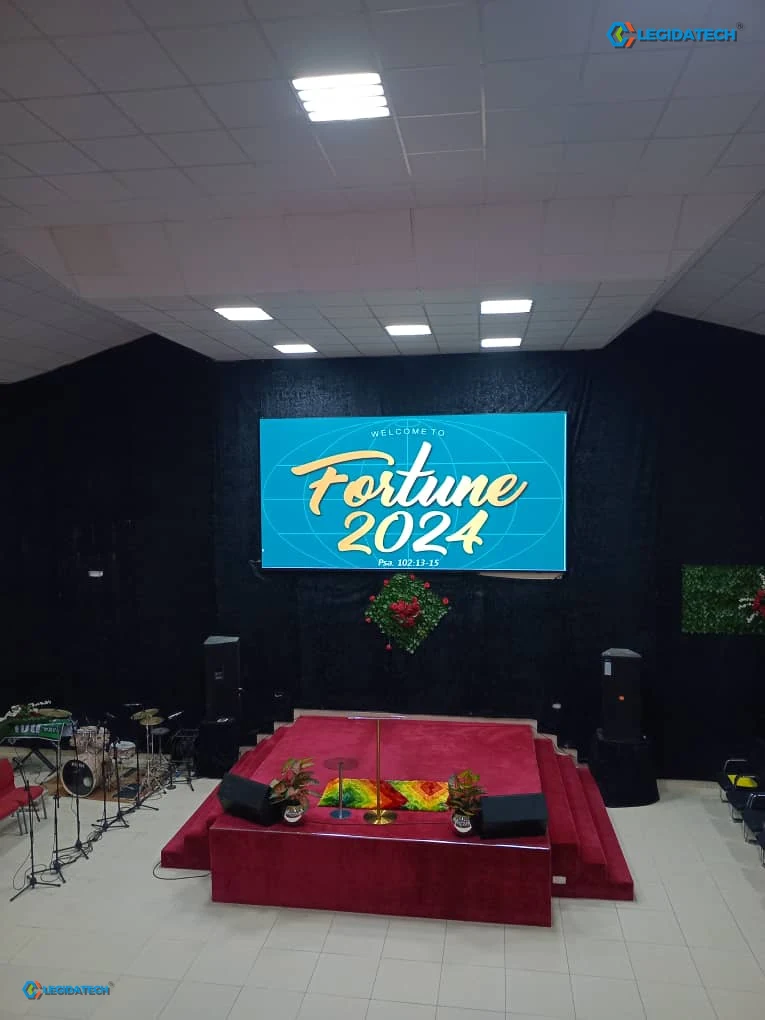
Living Faith Church, 4.8 × 2.4 m at P2.5 — delivered December 2024.
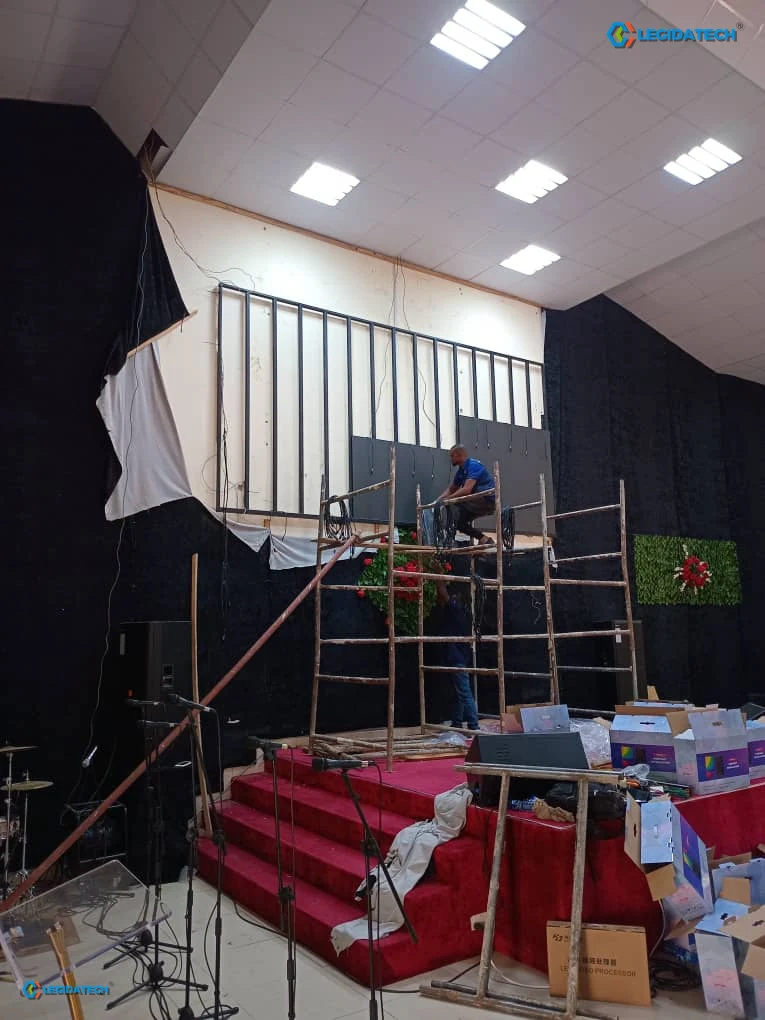
A Lagos install in progress: frame first, cabinets second, modules last.
Pitch, Resolution and the Arithmetic a Committee Can Check
The single most useful thing a church buyer can do is make the supplier show the module grid. Pitches are nominal; cabinets are real. A wall is buildable only when its width and height are whole multiples of the module, and the resolution follows from that grid rather than from dividing the wall by the pitch.
| Wall you have | Modules (320×160 mm) | Resolution at P2.5 | Closest comfortable seat |
|---|---|---|---|
| 2.88 × 1.92 m | 9 × 12 | 1,152 × 768 | 3 m |
| 3.52 × 2.4 m | 11 × 15 | 1,408 × 960 | 3 m |
| 4.8 × 2.4 m | 15 × 15 | 1,920 × 960 | 3 m |
| 6.08 × 2.88 m | 19 × 18 | 2,432 × 1,152 | 4 m |
| 9 × 3.75 m | P3.9 module grid | design-dependent | 5 m |
The viewing rule we use is 1,000 × the pitch for a comfortable seat, so P2.5 is comfortable from about 2.5 m and P3.91 from about 3.9 m. In a hall where the front row is 6 m back and the last row is 22 m back, both pitches work optically — the difference then is not sharpness but price and the camera. If the service is streamed or recorded, specify 3,840 Hz and test it with the church’s own camera before the wall is signed off.
A word on 16:9. Roughly half of our Nigerian church walls are not 16:9. Buildings dictate the band of wall available, and a 4.8 × 2.4 m opening is 2:1, not 16:9. That is not a problem, but the content has to be designed for the wall you own instead of stretching a 16:9 feed across it.
Delivery and Clearing: Lagos, Abuja, Port Harcourt
Almost every church wall we ship to Nigeria moves by sea from Shenzhen to Lagos, then by road. Air freight only makes commercial sense for spares or for one urgent cabinet, and a wall sent by air costs more in freight than the extra it saves in time.
- Survey and drawings. Wall dimensions, the height the platform allows, the position of the steel frame and the module count. This is the step that decides whether the quotation and the delivered area agree.
- Production. Typically two to three weeks for a standard indoor build, longer if the cabinet is custom or the pitch is fine.
- Packing. Export cartons or flight cases, with the module count written on each box and a packing list that matches the invoice line by line.
- Freight to Lagos. Charged by volume, not by weight, so the carton count is the number that moves the freight line.
- Clearing. Your agent works from the commercial invoice, the packing list and the HS code we supply. Duty and VAT are assessed on the CIF value, and the rate depends on the code your agent files under — confirm the current assessment with the agent before you approve the budget, because we quote equipment, not tax.
- Installation. Either your own contractor using our frame drawing and wiring schedule, or a supervised install. About half of our Nigerian projects are installed by the church’s contractor.
Two practical notes from the files. First, the boxes on a Nigerian site are often opened in a hall with no loading bay, so ask for cartons that can be carried by two people rather than one crate that needs a forklift. Second, keep two modules, one power supply and one receiving card on site from day one; the first module failure in a full sanctuary is not the moment to start an import.
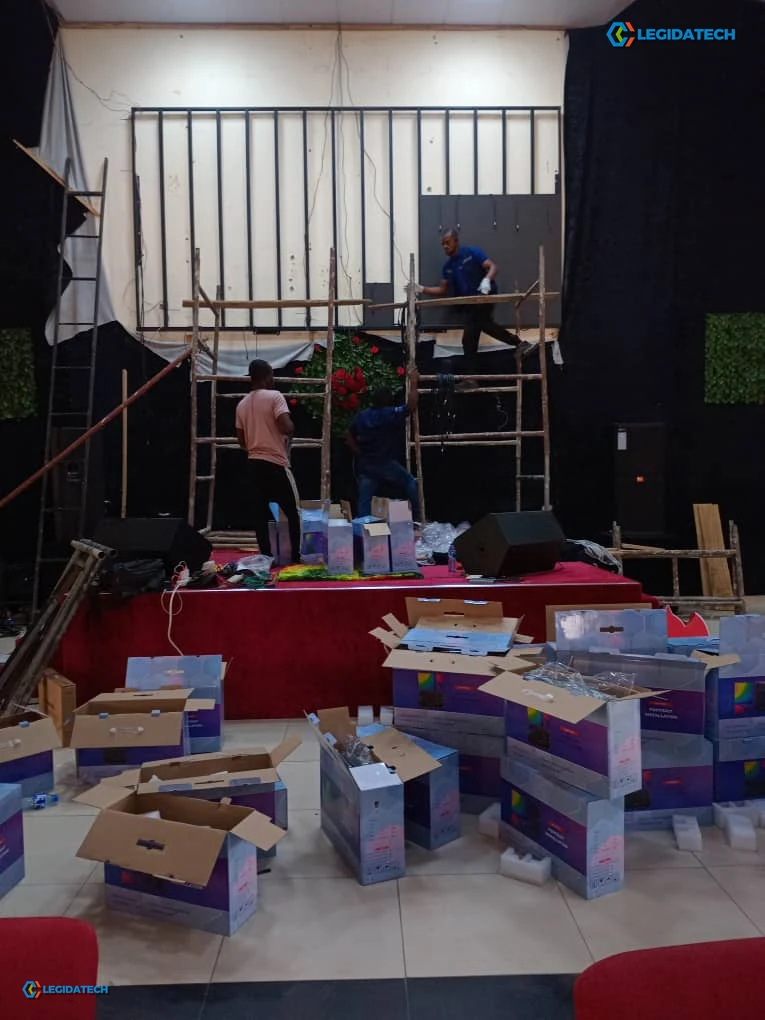
Cabinets unpacked on the floor of a Nigerian church before the frame goes up.
Who Actually Signs the Contract in Nigeria
There are three routes into a Nigerian church screen, and they are not interchangeable. A local AV integrator in Lagos or Abuja sells the screen inside a service contract: site survey, installation, maintenance visits, one number to call. A factory sells equipment with drawings and remote support, and the church arranges installation. A rental company supplies a screen for a crusade or a convention and takes it away afterwards.
Which is right depends on what the church is buying. If the requirement is a fixed wall that will run every Sunday for ten years, the factory route usually wins on price and loses on local response; the integrator route wins on response and carries a margin. Most of our Nigerian work is the factory route with a local contractor on the frame and a maintenance arrangement agreed separately.
The comparison of named suppliers in the market, with what each one is actually good at, is on our Top 10 church LED screen suppliers in Nigeria page. It lists the local integrators, the rental houses and the factory-direct options side by side, including where each one is weak.
What we do not have in Nigeria. We do not keep a warehouse or a service team in Lagos. Every Nigerian project is shipped from Shenzhen against a signed drawing, installed by the church’s contractor or a supervised crew, and supported remotely with spares held on site. A supplier who tells you they have a Lagos warehouse should be able to show you its address and its stock.
Six Questions Nigerian Church Committees Ask
How much does a church LED screen cost in Nigeria?
Indoor P2.5 runs about US$500–800 per m² factory-direct, so a 10–12 m² sanctuary wall is roughly US$6,000–11,000 in equipment. Freight, duty, VAT, the steel frame and installation are additional. Ask every bidder for the same four lines separately, or the quotes will not be comparable.
Can our own contractor install it?
Yes, and about half of our Nigerian projects are installed that way. We supply the frame drawing, the cabinet layout, the wiring schedule and a commissioning checklist, and stay on the phone through the first power-up. The contractor needs to be comfortable with steel fixing and with three-phase power distribution.
What should we budget for duty and clearing?
Duty and VAT are assessed by the Nigeria Customs Service on the CIF value, and the rate depends on the HS code your agent files under, so we do not quote a tax figure. Budget the clearing agent’s fee and the haulage from Lagos separately from the equipment, and ask the agent for the assessment in writing before the container arrives.
Is P2.5 necessary, or is P3.91 enough?
If the closest seat is beyond about 6 m and the room is under 15 m deep, P3.91 usually saves money with no visible difference from the congregation. In a 20 m nave, the back rows notice the softer text on P3.91, and on camera the difference is larger than it looks in the room.
How long from order to a working wall in Lagos?
Two to three weeks of production for a standard indoor cabinet, then sea freight to Lagos and clearing, then installation. The freight and clearing leg is the variable part and depends on the sailing and on how quickly the agent clears; ask for the freight as a number with a date, not as “included”.
What spare parts should we hold on site?
Two or three modules, one power supply and one receiving card, which is roughly three to five per cent of the screen value. On the 480×320 mm cabinet we ship, a module swap is magnetic and front-service, so a technician can change it from the front of the wall without scaffolding.
The Five Things That Let Us Quote in 24 Hours
Four numbers and one photo are enough to produce a real quotation rather than a range: the wall width, the wall height, the distance from the wall to the front row, and the city the screen is going to. A photo of the wall, including the ceiling and the platform, tells us what the drawings cannot.
Send those five things and you get a pitch recommendation with the arithmetic shown, a cabinet layout, an itemised quotation with the freight line separate, and a delivery estimate for your city. If the honest answer is that a smaller screen, a different pitch or a projector would serve the room better, we will say so — several of the projects in our files are smaller than the church first asked for.
LEGIDATECH church LED screens for Nigeria — factory-direct, front service. Part of the church LED screens range; see also Ghana and South Africa for the same treatment in neighbouring markets, and the Nigeria buying guide for the longer version of this decision.