

Case study · Nigeria
P2.5 Church LED Screen in Nigeria: Living Faith Case Study
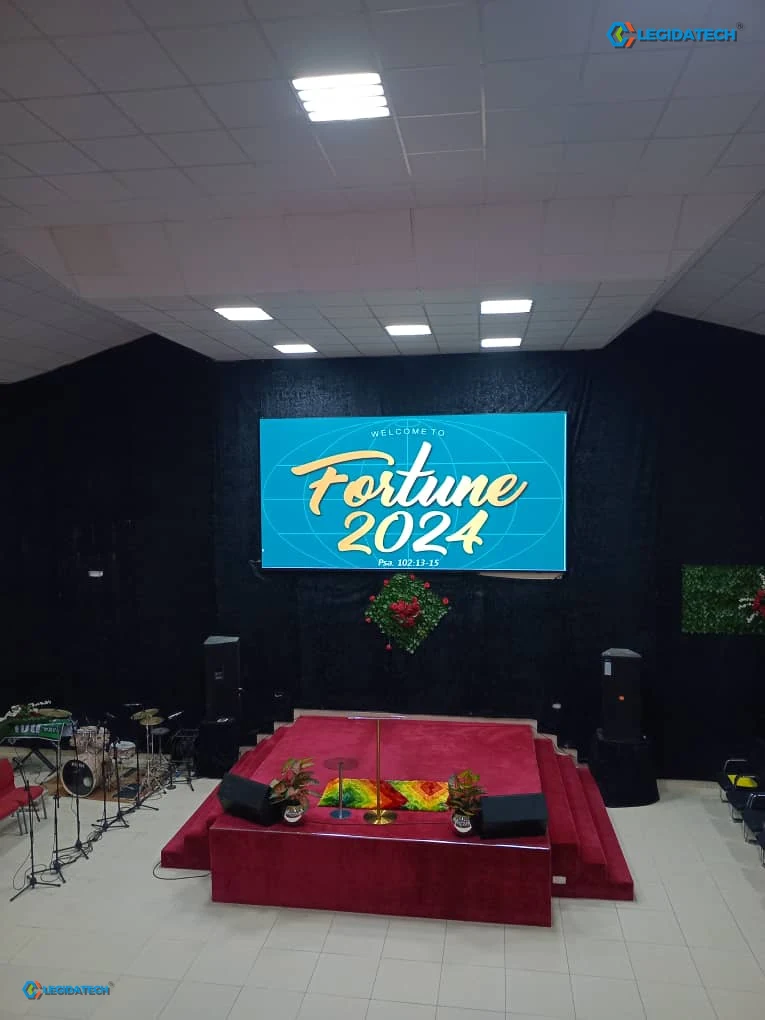
A 4.8 × 2.4 m indoor wall above the altar of a Living Faith Church sanctuary, delivered in December 2024 and photographed during the install and during live services.
- 4.8 × 2.4 m wall · 11.5 m² · 1,920 × 960 px
- P2.5 Ehonor indoor fixed · 225 modules on a 15 × 15 grid · 75 cabinets
- A 2:1 wall, not 16:9 — and why that was the right shape for this room
Quick answer
- How big is the screen?
- 4.8 × 2.4 m, 11.5 m², 1,920 × 960 pixels.
- What pitch and product?
- P2.5 Ehonor series indoor fixed LED display, front service.
- Who supplied it?
- LEGIDATECH, delivered in December 2024.
- Why 2:1 and not 16:9?
- 4.8 m was the usable wall between the speakers; 2.4 m was the sightline limit above the platform.
Project Facts
| Client | Living Faith Church, Nigeria |
|---|---|
| Country | Nigeria |
| Application | Sanctuary wall above the altar, behind the platform |
| Product | Ehonor series indoor fixed LED display |
| Pixel pitch | P2.5 |
| Module / cabinet | 320 × 160 mm module, mounted rotated (160 mm wide × 320 mm high); 480 × 320 × 70 mm cabinet, 3 kg |
| Panel qty | 75 cabinets (15 across × 5 high), mounted portrait |
| Screen size | 4.8 × 2.4 m (11.5 ㎡) |
| Resolution | 1,920 × 960 px |
| Module count | 225 modules (15 across × 15 high) |
| Brightness | 600–800 nits, set for indoor worship |
| Refresh rate | 3,840 Hz |
| Service | Front service, magnetic modules |
| Delivered | December 2024 |
| Supplier | LEGIDATECH |
The Client and the Venue
Living Faith is one of the larger church families in Nigeria, and this sanctuary follows the pattern you see across the country: a wide platform, a deep nave, a dark acoustic wall behind the altar, and a floor that carries sound rather than absorbing it. The room was not built around a screen. The screen had to fit a room that was already doing several jobs at once.
What was already on the wall
The back wall was occupied before the screen arrived. Speakers hung on either side of the centre line, a floral arrangement sat on the backdrop, and the platform itself — carpeted, raised, with a step up from the nave — took the bottom two metres of the wall out of play. Whatever went on that wall had to sit behind the flowers, above head height, and clear of the speakers. No speaker moved for the screen.
That constraint is the reason this wall is 4.8 m wide and 2.4 m high rather than the 16:9 rectangle a specification sheet would suggest. The available band of wall was 4.8 m. The sightline from the platform capped the height at 2.4 m, because anything taller would have been read from the floor of the platform rather than from the congregation.
Why a screen at all
The room seats several hundred people across a nave roughly 20 m deep. At that depth, a projected image is competing with house lighting, and lyrics at the back row are the first thing to go. An emissive wall solves the brightness problem directly: the image is generated at the wall, so it does not depend on how much light falls on a screen surface. That is the whole argument for LED over projection in a room this shape, and it is the argument the church was already making before it asked for a quotation.
The Requirement: Why This Wall Is 2:1, Not 16:9
Most church screen enquiries arrive with “16:9” attached, and most sanctuaries cannot take one. Understanding why is the difference between a wall that fits the room and a wall that fits a catalogue.
The available band decides the width
A 16:9 wall 2.4 m high would be 4.27 m wide. This room had 4.8 m of usable wall between the speakers, so a strict 16:9 build would have left about 0.27 m of unused wall at each end and lost area the church had already paid for in wall space. Building to the full 4.8 m at 2.4 m high gives a 2:1 rectangle, 11.5 ㎡ instead of 10.2 ㎡ — about 12.5% more screen for the same height.
The trade-off is content, not hardware. A 16:9 camera feed on a 2:1 wall either letterboxes with black bars or crops the top and bottom of the frame. The right answer is to design the lyric and slide templates at the wall’s native 1,920 × 960 canvas, which is what the commissioning pack specifies. A wall that is not 16:9 is normal in a sanctuary, and the ones that look wrong on a Sunday are usually the ones where nobody told the media team the canvas size.
The viewing distance decides the pitch
P2.5 puts 2.5 mm between pixel centres. The working rule is that a viewer needs roughly 1,000 × the pitch — 2.5 m here — before individual pixels stop being resolvable. In this room the front row sits about 5–6 m back from the platform, and the rear wall is around 20 m. P2.5 is comfortable at both ends: no pixel structure at the front, and text still legible at the back.
Two neighbouring pitches bracket this decision. P3.076 would have lowered the cost per square metre but resolved only about 1,560 px across 4.8 m, and the same 90 px capital letter would have been visibly softer at 20 m. P1.86 would have added resolution the room cannot use from 6 m back, at a materially higher cost per square metre. P2.5 is the pitch where the room’s depth and the budget meet.
Why the pixel count, not the pitch label, decides legibility
At 1,920 px across 4.8 m, a 90 px capital letter is about 225 mm tall on the wall (90 × 2.5 mm). That is readable from the back row. The same letter in P3.076 would be 277 mm tall but only 1,560 px wide across the wall, so the letter would be built from fewer pixels and the stroke edges would soften at distance. This is the part of a quotation that is hardest to compare and easiest to verify: ask for the pixel count and the letter height, not just the pitch.
The camera decides the refresh rate
The church films its services. A camera pointed at an LED wall imposes a second requirement that has nothing to do with how the wall looks to the eye: refresh rate. At 3,840 Hz the wall does not band when filmed; at 1,920 Hz it usually does, and the artefact appears in the recording rather than in the room. The same refresh rate is why phone footage shot from the congregation does not band. This is why the same physical wall can be specified two ways and why the cheaper board is the wrong buy for a church that streams.
The Configuration Delivered
| Pixel pitch | 2.5 mm, SMD |
|---|---|
| Module grid | 15 × 15 modules (320 × 160 mm each) |
| Resolution | 1,920 × 960 px |
| Brightness | 600–800 nits |
| Refresh rate | 3,840 Hz |
| Viewing angle | 160° horizontal / 160° vertical |
| Colours | 68.7 billion |
| Cabinet | 480 × 320 × 70 mm, CNC aluminium frame with a flame-retardant ABS back cover, 3 kg |
| Protection | IP31 indoor |
| Service | Front service, magnetic modules |
The module grid is worth spelling out because it is the one check any buyer can run on a quotation. 4.8 m ÷ 0.32 m = 15 modules across. 2.4 m ÷ 0.16 m = 15 modules high. 15 × 15 = 225 modules. 225 × 0.0512 ㎡ = 11.52 ㎡, which is the 11.5 ㎡ on the invoice. If a quote’s area does not reconcile with its module count, something is being rounded — and it is usually rounded in the supplier’s favour.
The cabinets go on portrait: 320 mm wide and 480 mm high on the wall. That is why the wall resolves so cleanly. 4.8 m ÷ 0.32 m = 15 cabinets across; 2.4 m ÷ 0.48 m = 5 cabinets high; 15 × 5 = 75 cabinets, and 75 × 3 modules = 225 modules — not one row trimmed at the top edge. Our product data lists the cabinet as 480 × 320 mm because that is its module layout flat; on a church wall it is rotated.
Installation: What the Photos Show
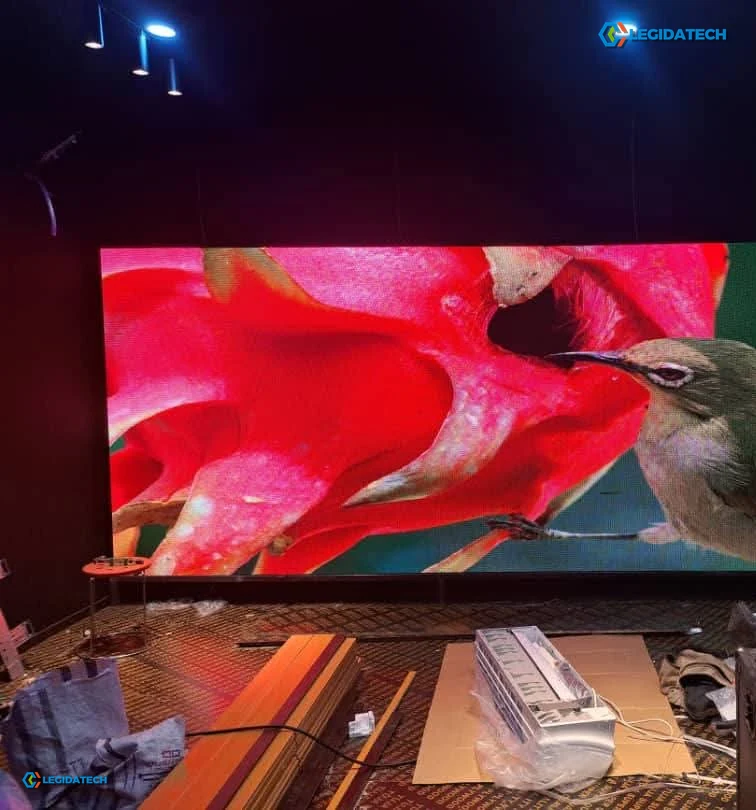
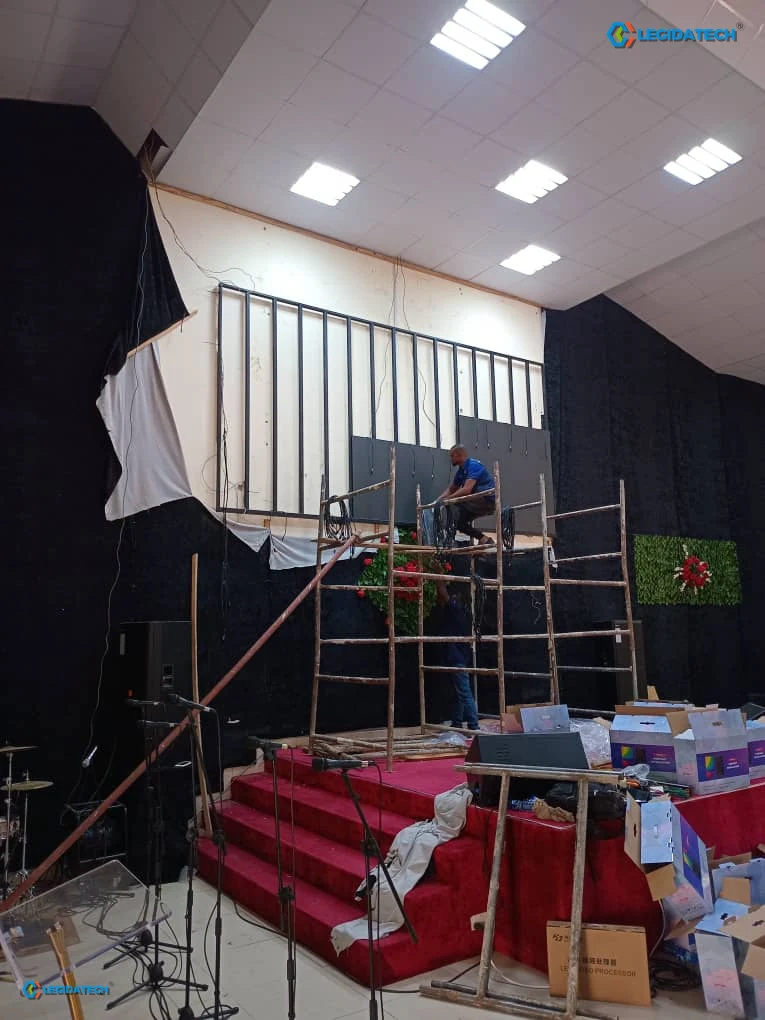
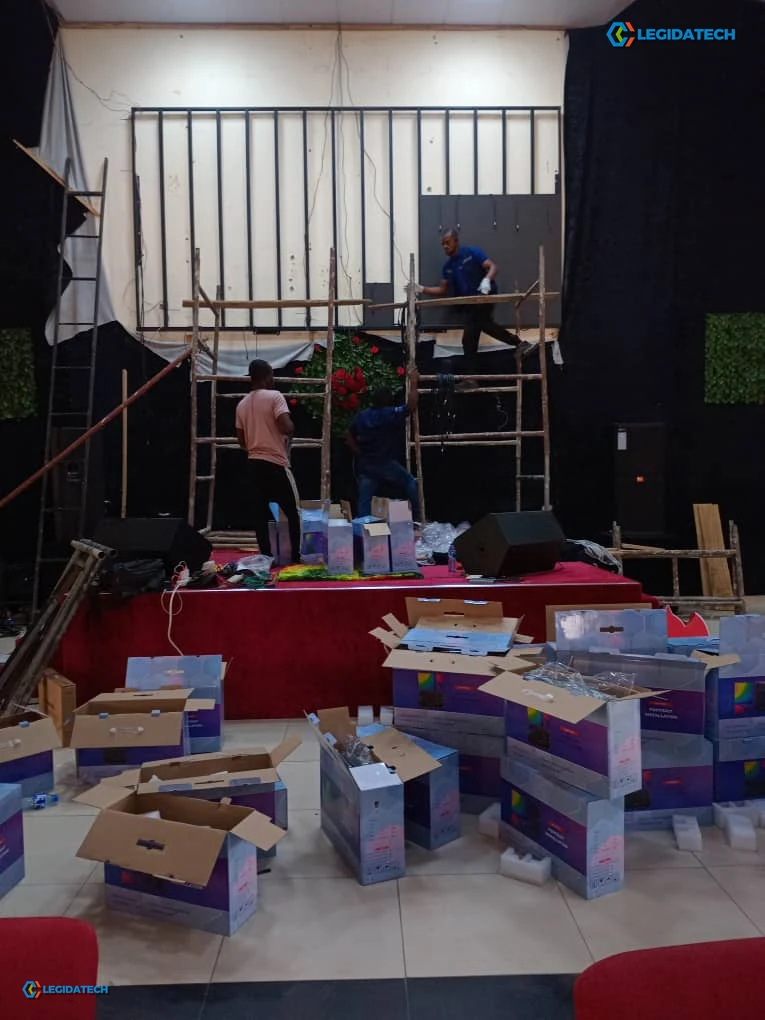
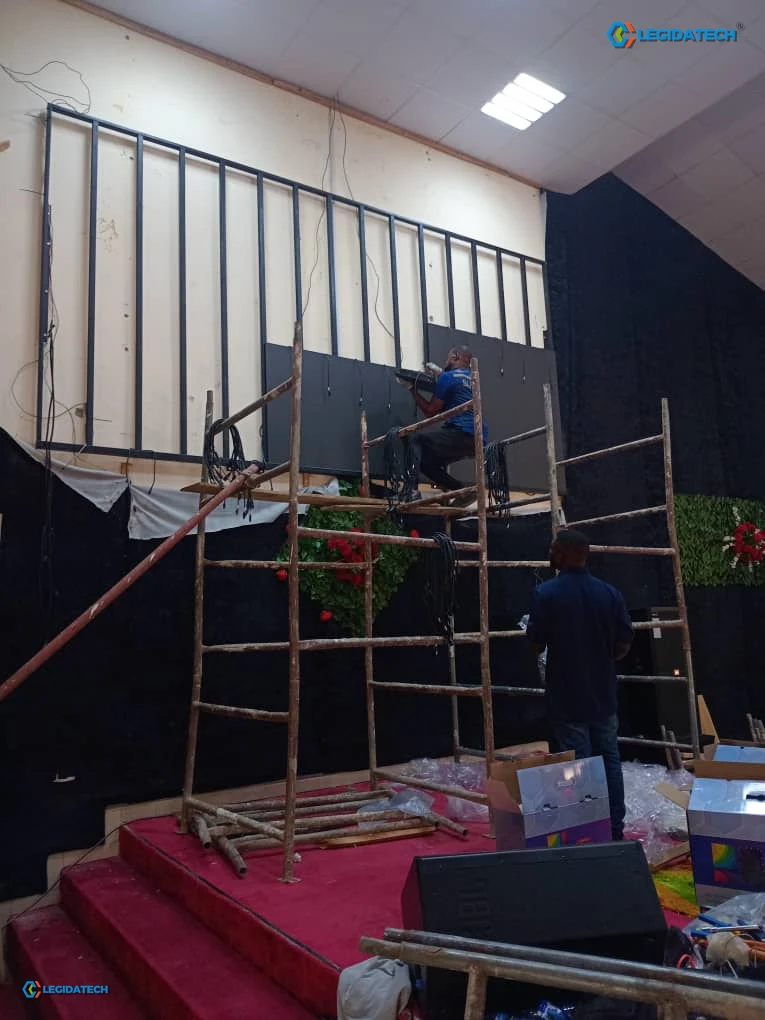
Three of the six photographs are from the install rather than the finished wall, and they are the most useful ones in this set. One shows scaffolding against the dark wall with the screen half mounted and the platform still covered in tools. Another shows the platform floor stacked with cartons and foam while the crew works above.
Working in a building that stays open
That is the honest shape of a church install: the building stays in use while the screen goes up, so the work happens in the gaps between services and the room is never fully cleared. A cabinet weighing 3 kg is what makes that practical. Two people can position a cabinet by hand, the panels hang on a support frame fixed to the wall, and the platform can be cleared and reset between working windows.
Fixing and alignment
The wall hangs on a flat, sound substrate, and the site photographs show the support structure on the wall before the panels go on. The cabinet is a CNC-machined aluminium frame with a flame-retardant ABS back cover: the frame carries the alignment, cabinets locate against each other, and the seam between them is set by the machined edge rather than by shimming every panel. On a fifteen-column wall that matters, because a millimetre of cumulative drift per column shows up as a visible step at the far end.
Commissioning
Commissioning is where a wall is either finished or merely mounted. Three things happen at that stage: the pixel canvas is set to 1,920 × 960 so the media team’s templates match the wall, the brightness and colour temperature are balanced against the house lighting rather than left at factory defaults, and the processor inputs are labelled so the volunteer running the desk on Sunday knows which button is the camera and which is ProPresenter. None of it is hardware, and all of it decides whether the wall looks right.
In Service: Live Feed and Event Graphics
The photographs show two kinds of content on the wall. One is a live camera feed — two presenters, shot from the platform and displayed behind them. The other is event graphics, including the church’s “Fortune 2024” programme artwork.
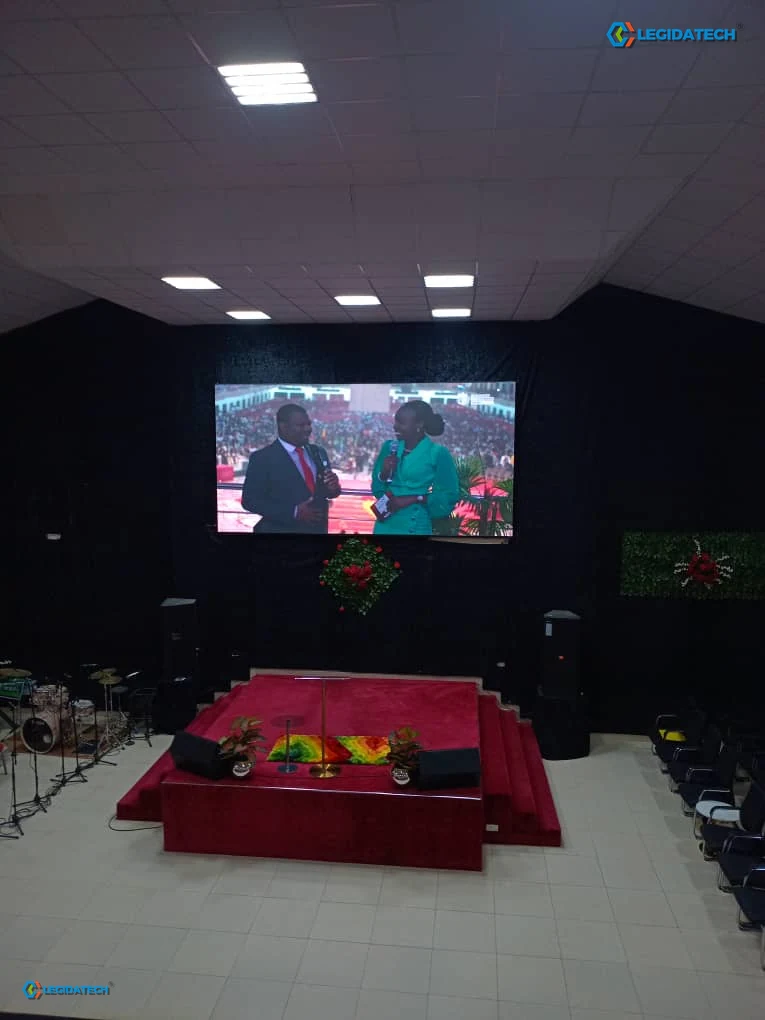
A live feed is the harder test. Camera-to-screen chains add latency and compression, and a wall that looks clean on a static slide can look soft and banded on a moving face. Two things make the difference here. The first is refresh rate, already covered: 3,840 Hz keeps the wall from strobing when a phone films it from the congregation. The second is brightness balance. A wall running at maximum in a room with domestic lighting flattens faces and blows out highlights; the same wall at 600–800 nits, matched to the room, keeps skin tones intact on camera.
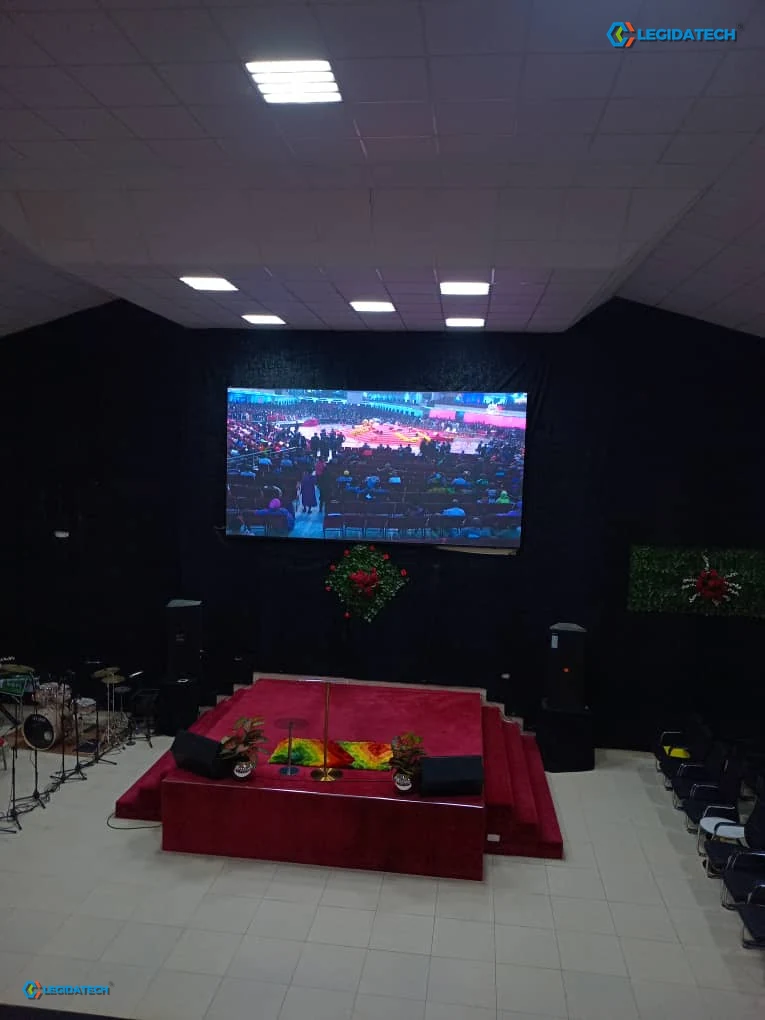
Three properties of this wall do the work, and none of them is about the brand on the cabinet.
Pixel density where it is needed. 1,920 px across 4.8 m means a 90 px letter is 225 mm tall, which is legible at 20 m without making the letters cartoonishly large. A coarser wall forces either bigger letters or a shorter usable text line.
Front service on a wall above an altar. Modules are magnetic and come off from the aisle side. On a wall mounted above a platform, rear service would mean scaffolding every time a module fails, and a failed module would stay failed until the scaffold came back. Front service turns a maintenance event into a ten-minute job between services.
Weight that the building can take. Three kilograms per cabinet, about 19 kg/㎡ for the wall, means the fixing is a wall fix rather than a structural steel project. On a building that was not designed for a screen, that is often the difference between “possible” and “needs an engineer”.
LED Screens in Nigeria: What This Project Sits Inside
This wall is one of a long series of Nigerian church projects, and the pattern repeats across them: a sanctuary that stays in use during the install, a wall shaped by the platform and the speakers rather than by 16:9, and a media team that films the service. The Nigeria church LED screen guide collects the price bands, the delivery routes into Lagos, Abuja and Port Harcourt, and the other projects in the same market.
If the room is smaller or the pitch question is different, two other projects are worth reading side by side with this one: a 46.7 m² stage backdrop in Accra, and a 9.8 m² wall in Kumasi. Same product family, three different rooms, and the pitch decision holds in all three. The most recent two are a 6.1 m² wall at a Church of Pentecost worship centre in Accra and an 8.4 m² RCCG Mount Olives wall in Abuja.
What Drives the Cost of a Similar Wall
Five variables move the number, in roughly this order:
- Area. 11.5 ㎡ is a mid-size sanctuary wall. Every extra 0.5 m of height adds about 2.4 ㎡ of panel and roughly three module rows (0.5 m ÷ 0.16 m = 3.1).
- Pitch. P2.5 is the workhorse for a room this deep. P1.86 or P2 raises cost per square metre sharply; P3.076 lowers it but starts to soften text at 20 m.
- Mounting. A flat, sound wall carries the panels on a simple support frame; an uneven or hollow wall needs a fabricated frame, and that is site work priced separately.
- Control. One processor plus sending and receiving cards for 225 modules; the controller choice is a real line item on a wall this size, and it is the part that decides how many inputs the service has.
- Freight and clearing. Sea freight to Lagos, duty and VAT, and the clearing agent’s charges sit on top of the equipment price and are quoted as their own lines.
Indicative equipment pricing for an indoor P2.5 wall is around US$500–800 per m² (2026 planning figure, equipment only, not a quotation). For 11.5 m² that is roughly US$5,750–9,200 of panel equipment before the support frame, processor, freight, duty and installation. Those figures are indicative; mounting and control vary more than panel price does, which is why we quote per project. The price framework sets out the four cost lines.
Four Checks Any Buyer Can Run on a Quotation
Reconcile the area with the module count. For a 4.8 × 2.4 m P2.5 wall the answer is 225 modules and 11.5 ㎡. If a quote cannot produce that arithmetic, the wall has not been designed.
Ask for the resolution, not the pitch alone. 1,920 × 960 px tells you what the media team can put on the wall. “P2.5” alone does not.
Ask what refresh rate is being supplied. If the church films its services, 3,840 Hz is the working number. If a quote is silent on refresh rate, it is a 1,920 Hz quotation until proven otherwise.
Ask how a module is replaced. Front service from the aisle, or rear service behind the wall. On a sanctuary wall, that answer determines what happens the first time a module fails on a Saturday night.
Frequently Asked Questions
How much does a 4.8 × 2.4 m P2.5 church LED screen cost in Nigeria?
The wall is 11.5 ㎡ of P2.5. The variables that move the total most are whether a support frame has to be fabricated or the wall takes the panels directly, which processor the church chooses, and freight and clearing into Lagos or Port Harcourt. At an indicative equipment band of about US$500–800 per m² (2026 planning figure, equipment only), 11.5 m² comes to roughly US$5,750–9,200 before frame, processor, freight, duty and installation. Those are planning figures, not a quotation.
Can you ship a church LED screen to Nigeria?
Yes. Screens ship to Lagos or Port Harcourt by sea, with air freight when a date is fixed. Nigeria runs on 230 V / 50 Hz, inside the Ehonor power supply range, so the preparation is plug type, earthing and generator stability rather than voltage conversion.
Is 4.8 × 2.4 m big enough for a sanctuary?
For a hall seating a few hundred to about a thousand, yes. The limit is usually the sightline, not the area: if the back row is more than 25 m away, text needs a finer pitch or a taller wall rather than a wider one.
The wall is 2:1, not 16:9. Is that a problem?
It is a content question, not a hardware one. A 16:9 feed will letterbox or crop; the church’s own slides should be designed at the wall’s native 1,920 × 960 ratio. The exact pixel canvas is part of the commissioning pack.
Can the screen be serviced from the front?
Yes. Modules are magnetic and front-service, so a failed module is swapped from the aisle side without removing the cabinet or getting behind the wall — which matters when the wall sits above an altar.
Can we install it ourselves with our own contractor?
Yes, and a number of our church projects are installed that way. We supply the cabinet layout, the fixing detail and the wiring schedule, and we stay reachable through commissioning. The parts that go wrong without support are the pixel canvas and the processor input mapping, not the mounting.
Get a Similar Church LED Screen Quote
Send a photograph of the front wall with the platform and speakers marked, the distance from the back row, and whether the church films its services. If your available band of wall is not 16:9, say so — the layout should be designed to the wall, not to a spec sheet.
Indoor fixed church LED screens | Church LED screens in Nigeria | P2.5 indoor LED screen for churches in Nigeria | Get your church LED screen quote
More church LED screen projects
- A 6.1 m² P2.5 wall at Church of Pentecost Abofu, Accra
- P2.5 church LED screen Kumasi: 9.8 m² Warriors Chapel case
- RCCG Mount Olives Abuja: 8.4 m² P2.5 church LED wall
- A 46.7 m² P2.5 stage wall in Accra, Ghana
- Indoor fixed church LED screens (Ehonor series)
- How much a church LED screen costs: the price framework
- Church LED screens in Nigeria: the 2026 buying guide
Get a quote for a screen like this
Send a photograph of the front wall, the height of the stage opening and the distance to your back row. We will come back with a pitch, a pixel canvas and a price for the room you actually have.
What you get with the quotation: cabinet layout, resolution, processor inputs and an installation sequence your contractor can follow.