


Fine Pitch COB LED Display for Church
P0.62–P0.9375 · 4K in a 3.6m Wall · 600 nit at P0.62 · 1/48–1/60 Scan · Front Service
A fine pitch COB LED display is the screen you specify when the closest person in the room is inside two metres and the camera is closer still. On this page we work in the sub-millimetre band — P0.62, P0.78 and P0.9375 — in the same 600×337.5mm cabinet, where a true 4K picture needs only a 2.4m to 3.6m wide wall instead of a nine-metre one.
- Native 4K (3840×2160) in a wall as small as 2.4 × 1.35m at P0.62, or 3.6 × 2.03m at P0.9375
- 600 nit white balance at P0.62, 1/48 to 1/60 scan, ≥3840Hz refresh — no scan bars on broadcast or mirrorless cameras
- Sealed flip-chip COB surface at 4H hardness — no exposed lamp for a camera cage or a chair to shear off
- Dual signal and power backup on the P0.9375 model — specified when one failed card would blank the whole screen
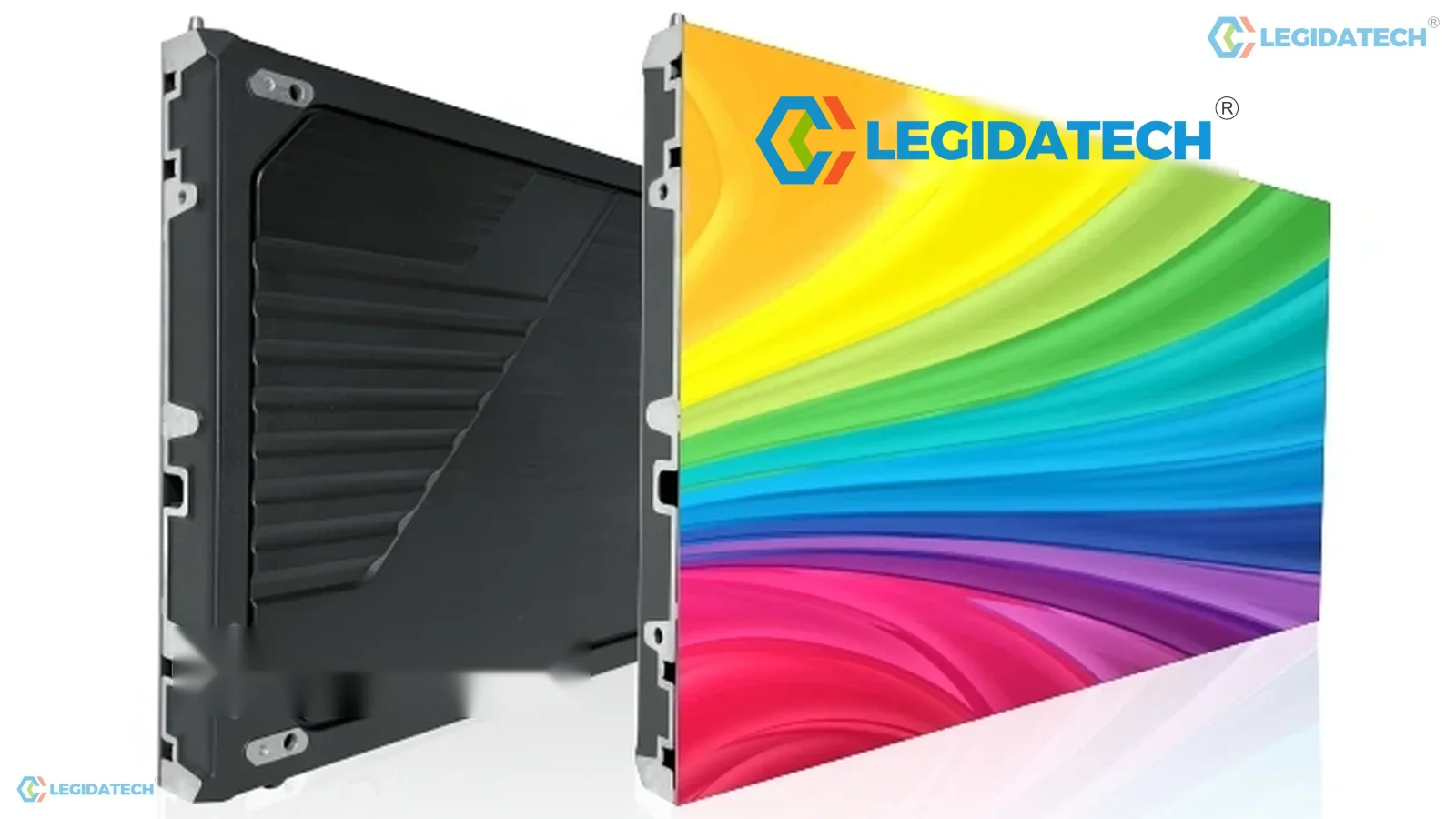
Fine pitch COB — sealed module face, front service, 39.75mm cabinet
Quick Answers Before You Scroll
How small is “fine pitch”? The term is used loosely in the trade. On this page it means sub-1.5mm and specifically the sub-millimetre band: P0.62, P0.78 and P0.9375. Panels from P1.25 upward are documented on the main COB church page, because they solve a different problem — front-row viewing at 2–3m rather than close-range detail work.
How big a wall do we need for 4K? It depends only on pitch. P0.62 reaches 3840×2160 in a 2400×1350mm wall, P0.78 in 3000×1687.5mm, and P0.9375 in 3600×2025mm. All three are whole-cabinet sizes with no partial panels, which is why the numbers are exact rather than approximate.
Is P0.62 overkill for a church? Usually yes, unless the screen is a platform confidence monitor, a studio backdrop, or a wall in a small chapel where the front row is under 1.5m away. For a 300-seat sanctuary with a front row at 2.5m, P1.25 — at a fraction of the cost per square metre — is the honest recommendation.
Does fine pitch stop camera moiré? It reduces the pattern rather than eliminating it. Moiré is a relationship between pitch, camera distance and sensor sampling. Going finer moves the problem out of the visible range at a given camera distance; the remaining control is camera position and a shutter that matches the 3840Hz refresh.
Can we service an ultra-fine panel without removing the wall? Yes. Modules are released from the front. The tighter tolerance at P0.62 makes the swap slower than at P1.25 — the modules align to a finer seam — so we ship a spare module allowance and a written swap procedure with the screen.
What Makes an Ultra-Fine Pitch Wall Different to Build
A display does not simply become “finer” when the pitch shrinks. Three things get harder, and they are where the cost of a P0.62 wall actually goes.
1. More pixels per cabinet means more driver channels. The 600×337.5mm cabinet holds 960×540 pixels at P0.62 and 640×360 at P0.9375. Same cabinet, 2.25 times the pixel count. Every one of those pixels needs a driver channel and a calibration entry, so the driver IC and the scan design change with the pitch — note that this family runs 1/60 scan at P0.62 and 1/54 at P0.9375.
2. The tolerance band closes. At P1.875 a 0.3mm seam is invisible. At P0.62 the same seam is half a pixel and reads as a line. Cabinet machining, module alignment and the wall substrate all have to hold tighter, and a wall that is not flat will show.
3. Calibration becomes the product. A 4K wall has 8.3 million pixels and each needs a known brightness and colour point. Factory calibration per batch is what makes an ultra-fine wall look uniform across a scene rather than like a grid of slightly different modules.
What does not change: the cabinet is still 600×337.5×39.75mm at about 4kg, the surface is still sealed flip-chip COB at 4H, and service is still from the front. Fine pitch is a denser version of the same platform, not a different product family.
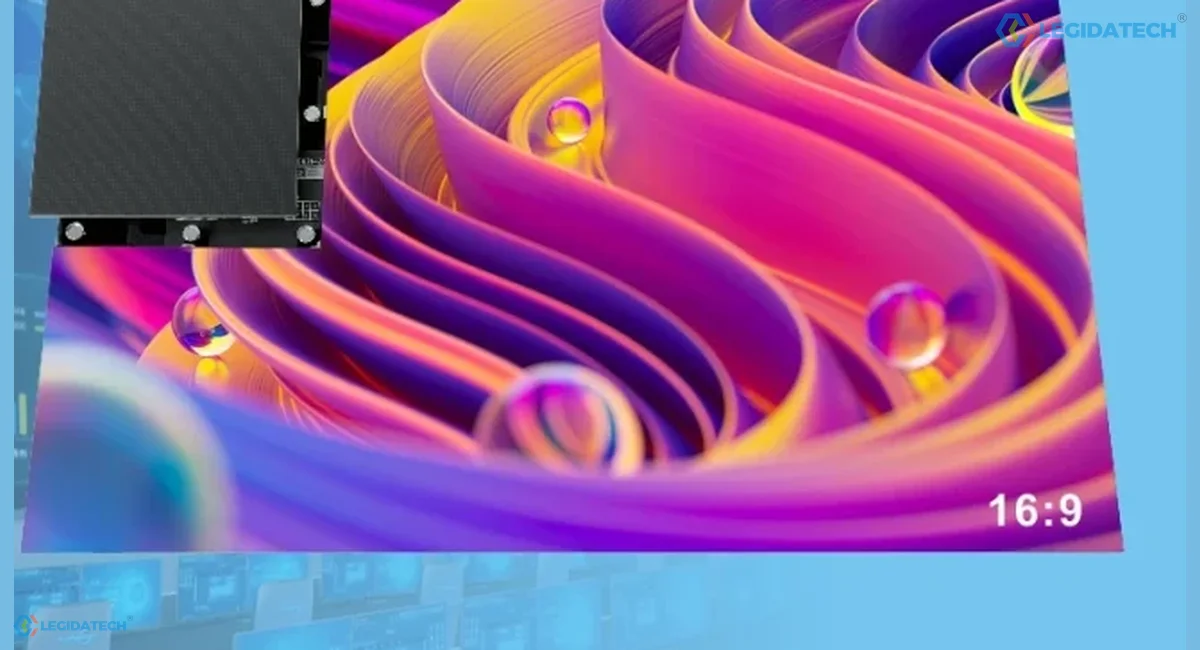
16:9 walls close on whole cabinets at every pitch — at P0.9375 a 6×6 cabinet wall is exactly 3840×2160
The Two Problems Only Sub-Millimetre Pitch Solves
Most churches never need this band. The ones that do are almost always trying to solve one of these two problems, and they have usually already tried something else.
The camera is closer than the audience
A live-stream camera at the platform edge or a handheld operator in the aisle sees the screen at 3–5m through a long lens — an effective viewing distance no seat in the room has. A P1.875 wall that looks clean to the congregation can still show structure on the stream. Sub-millimetre pitch fixes it at the camera rather than at the seating.
The screen is a confidence monitor at 1m
A platform monitor is seen by the worship team from about a metre, all service, at an angle, with stage lights behind it. At P2.5 that is a visible grid of lamps to the people who have to read it. This is the one case where P0.62 is genuinely the right answer rather than an expensive one.
4K Resolution Planning: The Wall Size Each Pitch Forces
This is the single most useful calculation when specifying a fine pitch wall, and it removes most of the guesswork. A 4K signal is 3840 pixels wide. Multiply by your pitch in metres and you get the exact wall width that shows it pixel-for-pixel.
| Pitch | Wall for 3840×2160 (4K) | Wall for 1920×1080 (HD) | Area at 4K | Typical use |
|---|---|---|---|---|
| P0.62 | 2400 × 1350mm (4 × 4 cabinets) | 1200 × 675mm | 3.24 m² | Platform confidence monitor, studio backdrop, chapel |
| P0.78 | 3000 × 1687.5mm (5 × 5 cabinets) | 1500 × 843.75mm | 5.06 m² | Small sanctuary close front row, production desk |
| P0.9375 | 3600 × 2025mm (6 × 6 cabinets) | 1800 × 1012.5mm | 7.29 m² | Main wall in a mid-size room, close camera positions |
Why this changes the purchase decision
A church that wants a 4K picture on a 6m wide wall has three routes. It can buy P0.9375 and accept a 3.6m wall inside a larger recess, it can buy P1.25 and accept 4K-equivalent resolution at 4.8m, or it can buy the pitch that matches its wall and let the processor scale. Each is defensible; what is not defensible is buying P0.62 for a 6m wall and paying for 23 million pixels that the source will never fill.
Quick check. Divide your planned wall width in millimetres by the pitch in millimetres. If the result is well under 1920, the wall is bigger than HD needs — you are paying for density nobody sees. If it is over 3840, the wall is being fed less than it can display.
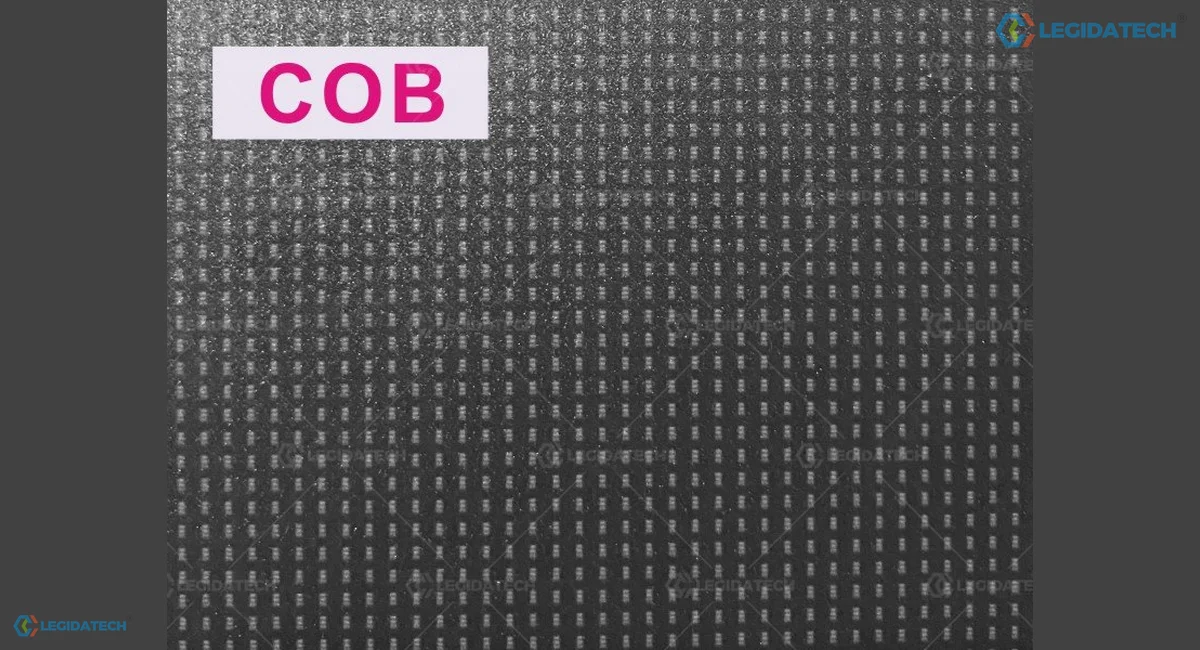
The COB face at close range — one sealed surface over the chip grid, which is the difference that shows up on camera
Scan Design, Driver IC and the Reason Fine Pitch Walls Flicker
Scan mode is how many rows of pixels are lit at once. A 1/60 scan panel drives sixty rows per refresh cycle and spends less time on each row than a 1/8 scan panel, which is why a badly designed fine pitch wall can flicker on camera even when the refresh number looks high.
What this family runs
P0.62 uses 1/60 scan, P0.78 uses 1/48 and P0.9375 uses 1/54, all at ≥3840Hz refresh, driven over the NovaStar-based control platform our indoor range is built on. The scan ratio and the refresh rate together are what keep a 4K wall stable under a camera rather than showing a rolling band on the recording that nobody can see in the room.
The test that matters more than the spec sheet
Point a camera at the wall and record. Then record at a second shutter speed, and a third. If the wall is clean at 1/50, 1/60 and 1/100, the scan and refresh design are sound for your workflow. This takes ten minutes at commissioning and it is the only test that reflects how the service will actually look to the online congregation.
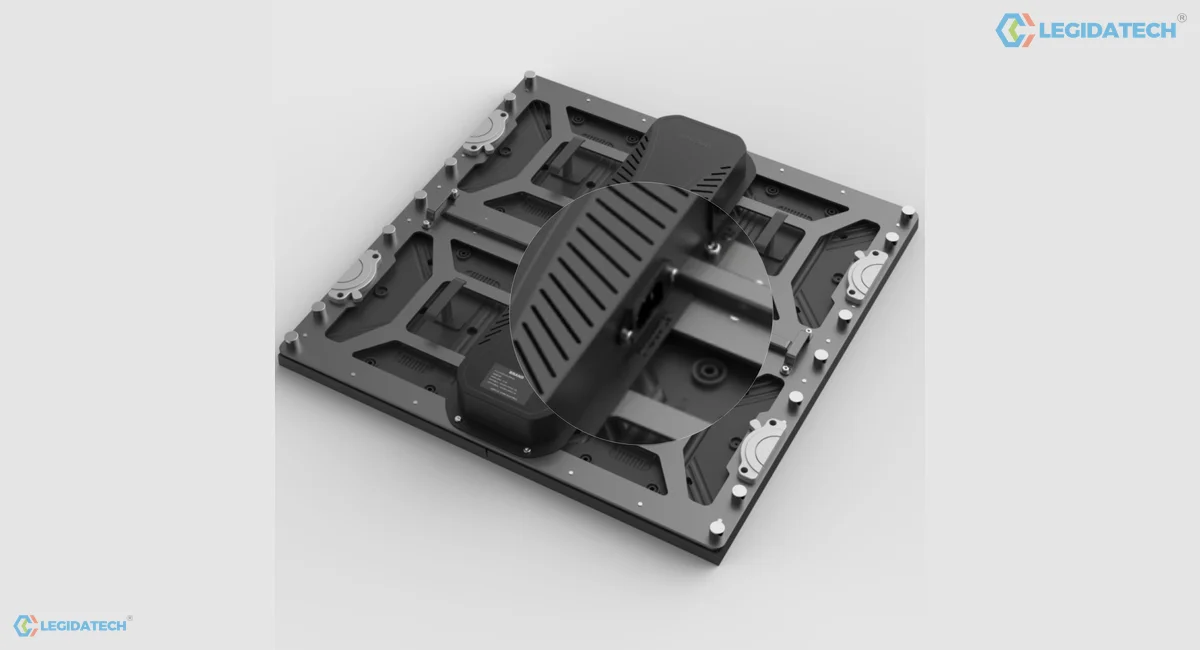
Rear of a fine pitch cabinet — the die-cast chassis carries the heat, and more pixels on the same panel means the power design gets more attention, not less
Common Cathode Power, Panel Heat and a Wall That Runs Cool
At P0.62 the cabinet carries 2.25 times the pixels of the P0.9375 version, and pixel count — not area — is what drives switching loss. This family answers that with power design rather than more cooling: all three pitches in this series run common cathode drive, at 1/60 scan for P0.62, 1/48 for P0.78 and 1/54 for P0.9375, so the loss is handled at the driver instead of by adding airflow.
Why the cabinet depth stays at 39.75mm
Reducing driver loss is what allows a dense panel to stay in a 39.75mm cabinet without forced air. For a church that means no fan noise behind the platform during quiet moments, and no extra 100mm of standoff eating into the room. It also means the wall still hangs at about 20kg per square metre — the same figure as the coarser pitches, because the cabinet is the same.
Where the heat goes at commissioning
Run the wall for a full service length — 90 minutes at your normal brightness — and check the back of the cabinets with an infrared thermometer. If a panel is materially hotter than its neighbours, that is a power supply or a connection worth investigating before the wall is closed in behind a fascia.
Calibration and Redundancy: What You Are Really Buying at This Pitch
Two things separate a good ultra-fine wall from a wall of the same parts: how uniformly it is calibrated, and what happens when one component fails.
Uniformity is a commissioning task, not a factory sticker
Ask for the calibration report with the screen and ask for a re-calibration during commissioning, after the wall has run hot for a day. LED brightness drifts in the first hundred hours; a wall calibrated in the factory and never re-checked will show it as a faint patch over a large flat background — exactly the shot a worship set uses most.
Dual backup is worth it on the P0.9375 model, and only there
Dual signal and dual power backup is available on P0.9375, and is not offered on P0.62 or P0.78 on this platform. It costs more, it adds commissioning work, and on a large redundant wall it is often unnecessary. On a 3.24m² platform monitor that the worship leader reads from, a single failed receiving card blanks the entire screen with no partial workaround — and this is where the redundancy pays for itself the first time it is needed.
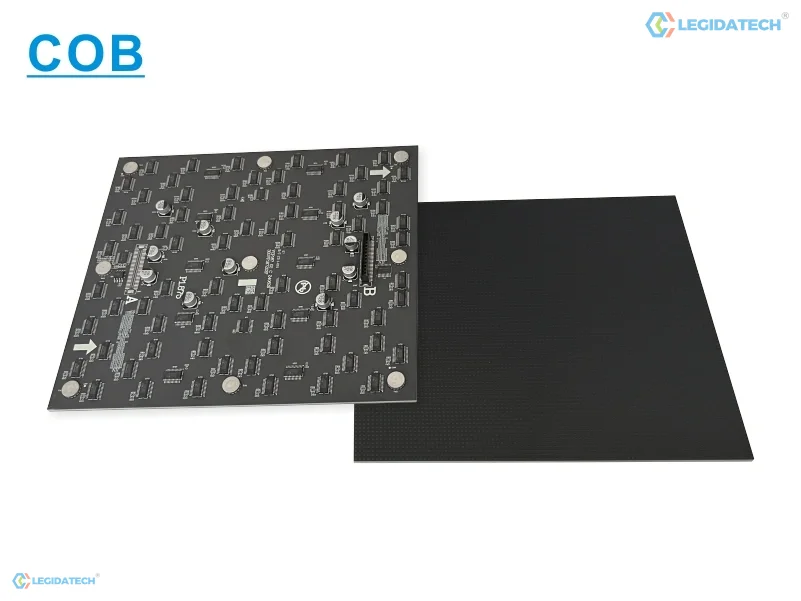
The same module from both sides — the sealed COB face and the driver side that faces into the cabinet
Where Sub-Millimetre Pitch Is the Right Answer
Three rooms justify this band. If your room is not one of them, the main COB church page will cost less for a better result.
A large sanctuary with a camera at the platform edge
The screen has to satisfy two audiences at once: the front row at 2.5m and a long lens at an effective 3–4m. P0.9375 at 3.6m wide gives a native 4K surface that stays clean through glass, and the sealed COB face keeps stage wash out of the recording.
A broadcast or streaming room
If your service is produced rather than just streamed, the wall is a set element. That means close camera positions, controlled lighting and a screen that appears at a range of focal lengths. This is the case for P0.78 or finer, and for treating the calibration report as a deliverable.
A small chapel or a platform confidence monitor
Where the front row is genuinely inside 1.5m, P0.62 stops being an indulgence. A 2.4 × 1.35m wall at native 4K, hung flat, with the first row at 1.2m — that is the configuration the pitch exists for.
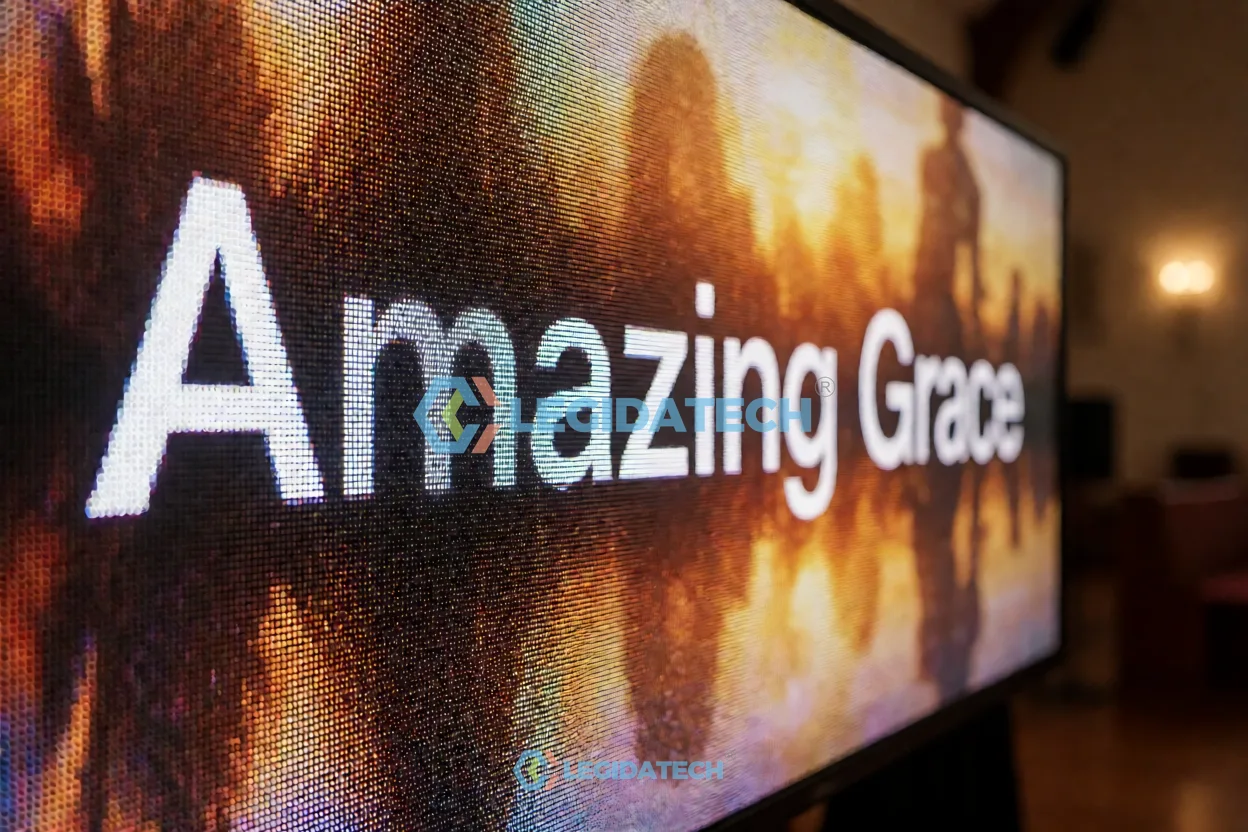
Lyrics at close range — at this distance the pixel grid is still visible on the letter edges, and the pitch is what decides how far back that stops
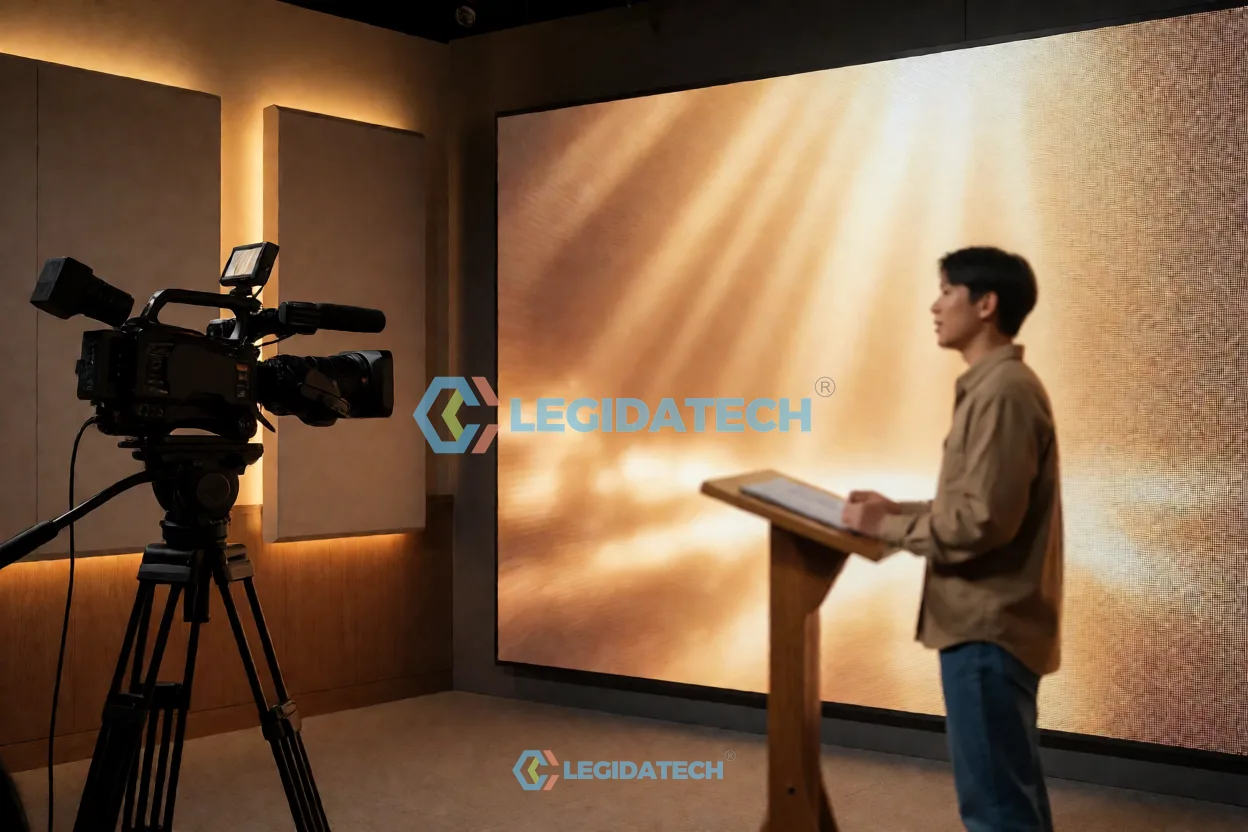
Streaming studio set — where the camera, not the seating, sets the pitch
Fine Pitch COB Specifications, 600×337.5mm Cabinet
Same cabinet, three ultra-fine pitches. Values are the platform figures for these models. Where a figure is still being finalised on the factory datasheet we say so instead of filling the cell — a number that is quietly wrong is worse than a gap.
| Parameter | P0.62 | P0.78 | P0.9375 |
|---|---|---|---|
| Nominal pitch (mm) | 0.625 | 0.78125 | 0.9375 |
| Common name | P0.6 | P0.78 | P0.9 |
| Cabinet size (mm) | 600 × 337.5 × 39.75 (die-cast aluminium) | ||
| Cabinet weight | ≈ 4 kg per panel | ||
| Cabinet resolution | 960 × 540 | 768 × 432 | 640 × 360 |
| Resolution per m² | 2,560,000 | 1,638,400 | 1,137,777 |
| Module size (mm) | 150 × 168.75 | To be confirmed | 150 × 168.75 |
| White balance brightness | 600 nit | To be confirmed | To be confirmed |
| Refresh rate | ≥ 3840 Hz | ||
| Scan mode | 1/60 | 1/48 | 1/54 |
| Power circuit | Common cathode | Common cathode | Common cathode |
| Max power per panel | To be confirmed | 85 W | 75 W |
| Driver IC / receiving card | Specified per pitch and fixed on the datasheet issued with your quotation — not interchangeable between pitches | ||
| Dual signal / power backup | Not supported | Not supported | Supported |
| Module surface | Flip-chip COB, 4H hardness, IP54 module face, washable | ||
| Viewing angle (H/V) | 160° / 160° (typical) | ||
| Input voltage | AC 100–240 V | ||
| Maintenance | Front service — module, receiving card and power supply | ||
| Control system | NovaStar-based platform; processor and receiving cards confirmed on the datasheet for your configuration | ||
How to read these numbers. Three cells are deliberately not filled: the P0.78 module size, and the P0.62 panel power and brightness, which are being finalised on the datasheet for that model. The driver IC and receiving card are specified per pitch rather than quoted as one number for the range. The datasheet issued with your quotation is the authoritative document. If you are comparing quotations, check the cabinet resolution column first — a supplier quoting a different cabinet resolution for the same pitch is quoting a different panel module.
Picking Between P0.62, P0.78 and P0.9375
Three questions answer it: how close is the nearest eye, how close is the nearest camera, and how much wall can the room take. If all three point at the same row, the decision is made.
| Your situation | Pitch | Wall at 4K | Why |
|---|---|---|---|
| Front row under 1.5m, or a platform confidence monitor | P0.62 | 2.4 × 1.35 m | Pixels stop resolving at conversational distance; the smallest 4K wall possible in this family |
| Camera at the platform edge, wall 3–5m wide | P0.78 | 3.0 × 1.69 m | The compromise where the room wants a mid-size wall and the stream needs a clean surface |
| Main wall 3.6m or wider with a close camera position | P0.9375 | 3.6 × 2.03 m | Native 4K on a wall the room can actually accept, with dual backup available |
| Front row 2.5m+, camera far back or none | P1.25 or P1.5625 | — | You do not need this page — the standard COB church wall costs less per m² for the same visible result |
Why Fine Pitch Costs What It Costs
Below about P1.5 the price curve steepens for a structural reason: pixel count per square metre grows as the inverse square of the pitch. Going from P1.25 to P0.62 doubles the linear density, so the same area carries roughly four times the pixels, four times the driver channels and four times the calibration work.
What that means for a budget conversation. A 3.24m² P0.62 wall is not four times the cost of a 3.24m² P1.25 wall — the cabinet, structure and control are shared — but the panel price per square metre is in a different bracket. When a board asks why the confidence monitor costs what it does, the answer is pixel count, driver channels and calibration, not margin.
Where the money is wasted. Buying sub-millimetre pitch for a wall nobody views inside 3m. The two numbers to take into the meeting are the closest seat distance and the closest camera distance. If both are over 3m, the case for P0.62 has not been made.
When Fine Pitch Is Over-Specified
Your front row is 3m back and there is no camera. P1.25 delivers the same visible result on a bigger wall for less money. Sub-millimetre pitch is not a quality upgrade — it is a distance upgrade, and if nobody is that close, there is nothing to upgrade.
Your source is a 1080p switcher. A 4K wall fed 1080p is being scaled up by the processor; the extra density buys a smoother upscale, not more detail. If 4K is not in the signal chain, price the wall against HD sizing before committing to P0.62.
The wall will be behind glass or in a bright room. 600 nit is a controlled-lighting figure. Fine pitch panels are not the place to solve a daylight problem — a brighter build at a coarser pitch is the correct answer, and we will say so.
Nobody can re-calibrate it. An ultra-fine wall needs a calibration check at commissioning and a plan for later. If your team has no access to the calibration software and no supplier support path, the wall will drift toward visible non-uniformity over years, and the pitch advantage erodes with it.
It has to move. This is a fixed-install cabinet. For a travelling ministry or a multi-site rotation, a rental cabinet with quick locks and flight cases is the right product regardless of pitch.
Fine Pitch COB Against the Rest of the Range
The choice is rarely “fine pitch or nothing” — it is between this band and two or three alternatives built on the same platform.
| Option | Pitch band | Fits | Trade-off |
|---|---|---|---|
| Fine pitch COB (this page) | P0.62–P0.9375 | Close camera, platform monitor, small chapel | Highest cost per m²; needs calibration discipline |
| COB church wall | P1.25–P1.875 | Sanctuary wall with the front row at 2–6m | Structure visible below about 1.5m viewing distance |
| CPS 640×480mm | P1.25–P3.07 | Bright rooms and larger walls, GOB option | Larger cabinet; coarse for close camera work |
| All-in-One 108″ | P0.78–P1.87 | Rooms with no structure budget at all | Capped at 162″; not a custom-size wall |
Two of these often both fit. Send us the seating plan and the camera positions and we will price both against the same room, with the pitch that each one would actually be built at.
The coarser pitches of the same cabinet are on the COB series page, P1.25 to P1.875 COB LED screen for church, and the whole indoor range is on indoor church LED screens.
What We Can Show You Before You Commit to Sub-Millimetre Pitch
Fine pitch is the part of the range where a case photo carries the least weight and a test sample carries the most, so it is worth being precise about which evidence exists and which does not.
| Installation | Country | Built with |
|---|---|---|
| Ehonor series church screen | Peru | P2.5, 5.12 × 2.88m |
| H3 stage screen | Nigeria | P3.9, 13 sqm |
| House of Miracle Ministry | Accra, Ghana | P2.5 indoor fixed |
| Magic series church wall | Nigeria | P3.91, 6 × 2m |
| Church LED wall | United Kingdom | P2.5 indoor |
Each project above links to the case page on this site. Dimensions and pitch are as published there.
What this table does not show. None of the walls above is a sub-millimetre COB build, and none of the named church case pages on this site documents one either — they are P2.5, P3.91 and H3 series walls. For P0.62 to P0.9375 the evidence before an order is different in kind instead: a sample module at your pitch, a calibration report from a production run of that pitch, and a live test at the factory or over a video call. We would rather give you those than point at a P2.5 installation and call it a fine pitch reference.
Documentation issued with the quotation
- Shop drawing with the cabinet layout, mounting points and power and signal routing for your wall dimensions, approved by you before production starts.
- Datasheet for the exact pitch in your order, with every cell on this page that reads To be confirmed filled in.
- Certificate copy for your destination — CE, RoHS and FCC as applicable, with UL on specific configurations.
- Spare parts list, module-swap procedure and the packing list.
- Warranty terms in writing, and the payment structure on the proforma invoice.
Lead Time, Spares and Warranty on a Fine Pitch COB Wall
Lead time. 15–25 working days after the deposit and the approved shop drawing, plus freight. Fine pitch batches include a calibration run, so the schedule assumes the drawing is approved before production starts.
What ships with the screen. Panels, receiving cards on the NovaStar-based platform, power supplies, cabling, a spare module allowance, a calibration report, and the processor you specified. On P0.62 we also ship a written module-swap procedure, because the seam tolerance makes the procedure matter.
Warranty. Two years on modules, receiving cards and power supplies as standard, with extension available on the order. A fine pitch order ships with a spare module allowance, because a dead pixel that cannot be swapped locally means a wall out of service for an international freight cycle. Dead pixels, driver IC failure and power supply failure are the three modes the warranty is written around.
Certification. CE, RoHS and FCC documentation is available for the models we ship, with UL on specific configurations. The certificate set for your destination is confirmed in the quotation rather than assumed at the specification stage.
Before you order. Ask for a sample module at your pitch and a calibration report from a production run of that pitch before you commit. We do not ask a church to approve P0.62 from a photograph, and a fine pitch order that starts with a sample usually ends in a short conversation about viewing distance rather than a replacement batch.
Payment terms. Deposit and balance structure is set out in the proforma invoice; T/T is the normal route and L/C is available on larger orders.
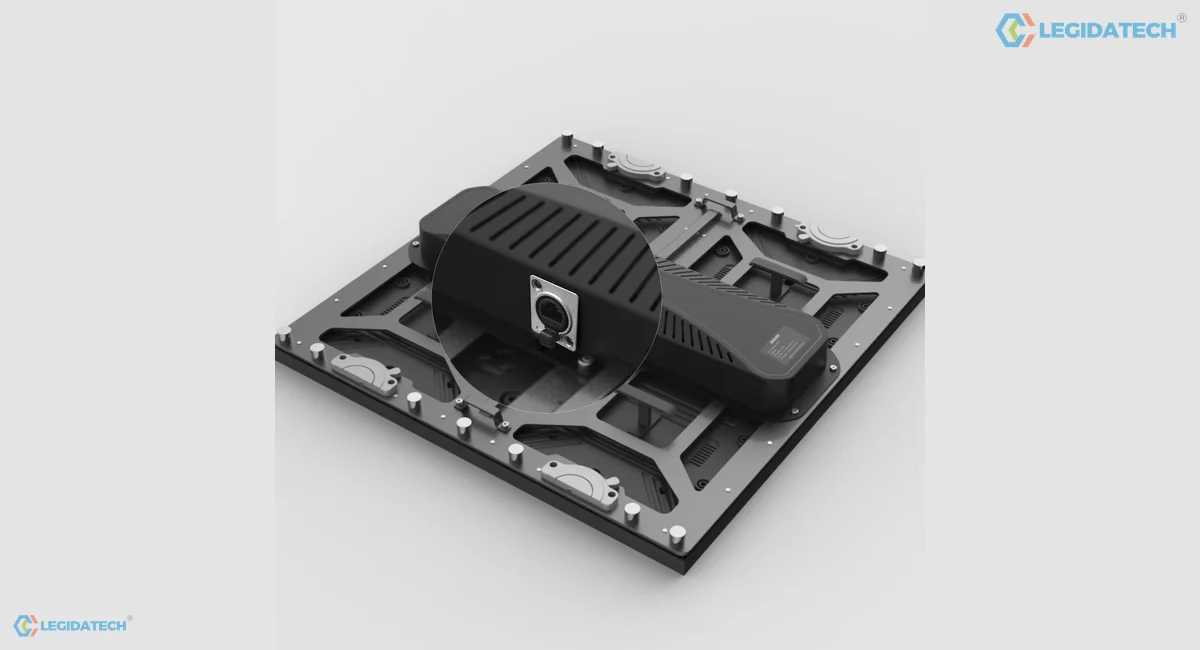
Rear of the cabinet — the die-cast bracket and the signal connector that seats into the cabinet
Fine Pitch COB Installation: What Changes Below P1.0
Below P1.0 the cabinet is not the difficult part; the seams are. Two panels that are one tenth of a millimetre out of line read as a visible line across the picture, because at this pitch the eye is already resolving individual pixels nearby. This clip shows a LEGIDATECH fine pitch COB installation.
One thing to be clear about: the system in the video is CPS Pro Max, which is a different series to the 600 × 337.5mm cabinet on this page. The point of the clip is the handling and seam discipline, not the model.
Fine pitch COB installation. Cabinet size differs by series; the seam discipline does not.
Fine Pitch Questions From Church AV Teams
Q1What makes a fine pitch COB LED display different from a normal COB wall?
The pitch band, and what that forces in the design. This page covers P0.62, P0.78 and P0.9375 in the same 600 x 337.5mm cabinet as the standard COB wall, but with more pixels per panel, a different scan design, tighter seam tolerance and calibration work as a deliverable rather than a footnote.
Q2How big a wall do we need for true 4K?
Multiply 3840 by the pitch in metres. At P0.9375 that is a 3600 x 2025mm wall (six by six cabinets), at P0.78 it is 3000 x 1687.5mm, and at P0.62 it is 2400 x 1350mm. All three close on whole cabinets with no partial panels.
Q3Is P0.62 realistic for a church, or is it for broadcast studios?
It is realistic in two church cases: a platform confidence monitor read from about a metre, and a small chapel where the front row is inside 1.5m. For a 300-seat sanctuary with the front row at 2.5m, P1.25 or P1.5625 is the honest recommendation and costs far less per square metre.
Q4Will a fine pitch wall show seams between cabinets?
Only if the wall and the cabinets are wrong. At P0.9375 a 0.3mm seam is a third of a pixel and effectively invisible; at P0.62 the same seam is half a pixel and can read as a line. That is why cabinet machining tolerance and a flat wall substrate matter more at this pitch, and why we ask for the wall survey before signing off the drawing.
Q5What refresh and scan do we need to avoid scan bars on video?
This family runs 3840Hz or higher with 1/60 scan at P0.62, 1/48 at P0.78 and 1/54 at P0.9375. The practical test is to record the wall at the shutter speeds your cameras actually use, at commissioning, and check the footage rather than the datasheet.
Q6Does a finer pitch remove camera moire?
It moves the pattern out of the visible range at a given camera distance rather than eliminating it. Moire depends on pitch, camera distance and sensor sampling. Going finer, plus matching shutter to refresh and avoiding extreme angles, is what produces a clean recording.
Q7Can we upgrade a P0.9375 wall to P0.62 later?
The cabinet is identical, so the frame, power and signal infrastructure carry over. What changes is the panel set, the receiving card configuration and the calibration. If an upgrade is plausible, say so at order stage so the power and control capacity are planned for it rather than discovered later.
Q8How do we keep the wall calibrated after installation?
Ask for the calibration report with the screen, re-calibrate during commissioning after a day of running hot, and schedule a check when you change major batches of modules. We supply the report and walk your technician through the process; the software is part of the control platform you receive.
Q9Is dual backup necessary on a fine pitch wall?
On the P0.9375 model it is worth the cost where one failed card would blank a platform monitor entirely. P0.62 and P0.78 do not offer it on this platform, so if redundancy is a hard requirement, that decides the pitch for you. On a large main wall with partial redundancy of other kinds, it is often unnecessary. We quote it as an option and tell you which side of the line your configuration falls on.
Q10What is the minimum order and lead time?
A single wall is a normal order; the only constraint is that the screen is a whole number of 600 x 337.5mm panels. Production is 15 to 25 working days after the deposit and the approved shop drawing, including the calibration run, plus freight.
Q11Which processor do we need for a 4K fine pitch wall?
One that handles 4K in and 4K out at the pixel count of your wall, with enough input capacity for your sources. A wall running ProPresenter, a confidence monitor feed and a live-stream output usually needs a dedicated processor rather than a small scaler. The processor is quoted as a line item so you can see what it costs.
Q12What warranty and certificates come with it?
Two years on modules, receiving cards and power supplies as standard, with extension available on the order. CE, RoHS and FCC documentation is available, with UL on specific configurations, confirmed in the quotation for your destination.
Written by the LEGIDATECH church display team from church installations in Africa, Europe and Latin America. Values on this page are the platform figures for the 600 x 337.5mm fine pitch COB cabinet; cells marked to be confirmed are finalised on the datasheet issued with your quotation.