


How Much Does a 20ft LED Screen Cost for a Church?What a 20 × 10 ft wall actually builds to, what it shows from the back row, and the three configurations priced at this size
Price a 20ft Wall for Your Room
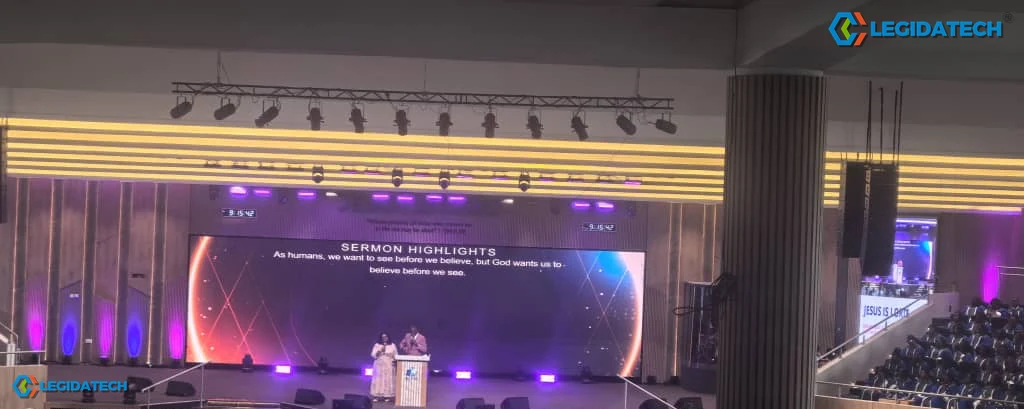
A wide sanctuary wall mid-service. A 20 ft screen is the size most 300–500 seat rooms settle on.
The Short Answer
A 20 × 10 ft church LED screen is 18.6 m² (6.10 × 3.05 m) — about 200 sq ft. At indoor P2.5 that is US$9,300–14,900 of equipment, factory-direct, or US$46–74 per square foot. At P3.9 fixed it is US$7,400–11,200; at COB P1.5 it is US$14,900–22,300. If you want a true 16:9 wall 20 ft wide, it is 20 × 11.25 ft — 20.9 m², or about US$10,500–16,800 at P2.5. Freight, duty, steel and installation sit outside these figures, and typically add a third to two thirds of the equipment price again before the screen is working. All bands are indicative planning figures, not a quotation.
Two things surprise buyers at this size. The first is that “20 foot” is a label, not a dimension: the wall snaps to whole modules, so it typically builds at 6.08 × 3.04 m — 18.5 m² rather than 18.6. The second is that at 18–19 m² the screen is no longer the dominant cost: structure, freight volume and the control system start to carry real weight, and those are quoted separately.
What a 20 × 10 ft Wall Actually Is
Twenty feet is 6.10 m and ten feet is 3.05 m, so the nominal outline is 18.6 m² at a 2:1 aspect ratio. Two consequences follow, and both matter more than the label.
| 20 × 10 ft (2:1) | 20 × 11.25 ft (16:9) | |
|---|---|---|
| Outline | 6.10 × 3.05 m | 6.10 × 3.43 m |
| Area | 18.6 m² | 20.9 m² |
| Builds to, on 320 × 160 mm modules | 6.08 × 3.04 m — 18.5 m² | 6.08 × 3.36 m — 20.4 m² |
| Pixels at P2.5 | 2,432 × 1,216 | 2,432 × 1,344 |
| Native content | 2:1 — lyrics, lower thirds, wide graphics; 16:9 video pillarboxed (bars left and right) | 16:9 — camera, video and slides fill the frame |
| What it costs you | The cheaper wall, the wrong frame for streamed video | About 12% more area for a native fit |
The 2:1 shape is not a defect — a wide letterbox is excellent for lyrics, scripture references and lower-third graphics, and it uses a shallow platform wall well. It is the wrong shape only if the wall is primarily a video and IMAG surface, because 16:9 content then sits inside black bars and you have paid for area you cannot use. Decide this before the steel is drawn: the two shapes need different frames.
At P2.5, the 2:1 wall gives you 2,432 × 1,216 pixels. That is wider than full HD: to fill the width, a 1080p feed has to be scaled up by about a quarter, and that crops roughly 11% of the picture height — about 5.5% at the top and 5.5% at the bottom. Fit the height instead and the wall leaves bars at the left and right. One size down, a 16 × 9 ft wall (nominal 4.88 × 2.74 m, 13.4 m²) lands at US$6,700–10,700 at the same pitch — useful if your room is 150–300 seats rather than 300–500. If a native 1080p mapping matters more than area, the wall that gives it at P2.5 is 4.8 × 2.72 m — 1,920 × 1,088 pixels, 15.7 × 8.9 ft, about 13.1 m².
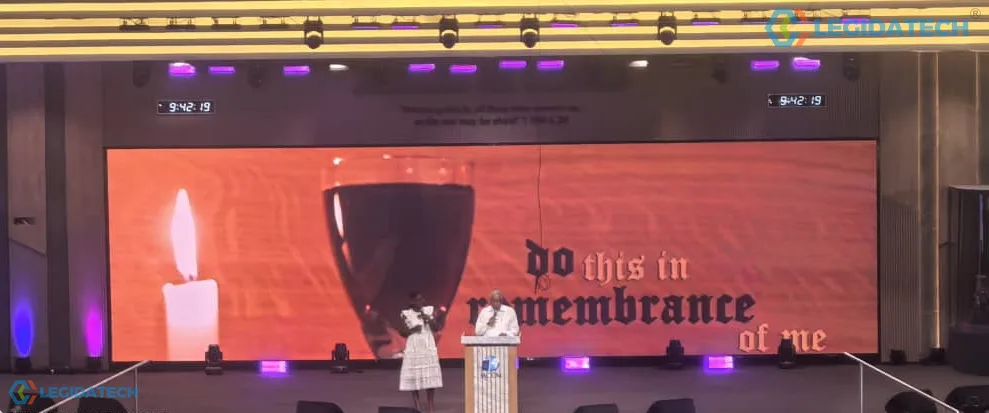
What a wall this size is bought for: lyrics and scripture readable from the back row, with IMAG when the camera is on.
The Three Ways to Buy 20 Feet
The same physical wall, three products. The band is per square metre, so the total is area × band; the trade-off is the same one that appears at every size, only the numbers are bigger.
| Essential — P3.9 fixed | Standard — P2.5 | Pro — COB P1.5 | |
|---|---|---|---|
| Band (US$ / m²) | 400–600 | 500–800 | 800–1,200 |
| Equipment for 18.6 m² | 7,400–11,200 | 9,300–14,900 | 14,900–22,300 |
| Per square foot (US$ / ft²) | 37–56 | 46–74 | 74–111 |
| Closest comfortable seat | 4.5–6 m | 3–4.5 m | 1.5–2.5 m |
| Camera verdict | Fine from the back of the room on a long lens | Good for IMAG at 8–15 m | Clean at the platform edge, no lamp grid |
| Right when | The room is deep, the camera is far, the budget is fixed | The default for a 300–500 seat sanctuary | The livestream is the product and the camera is close |
| Wrong when | The front row is inside 4 m or the camera cuts close | Cameras are inside 3 m all service | You are buying resolution the back rows cannot see |
At 18–19 m² the pitch decision is worth more money than at small sizes, so it is worth getting right. The test is not taste: measure the distance from the wall to the front row, and from the wall to the camera. If the camera is closer than the front row — common when the operator shoots from the platform side — the camera sets the pitch, not the seating.
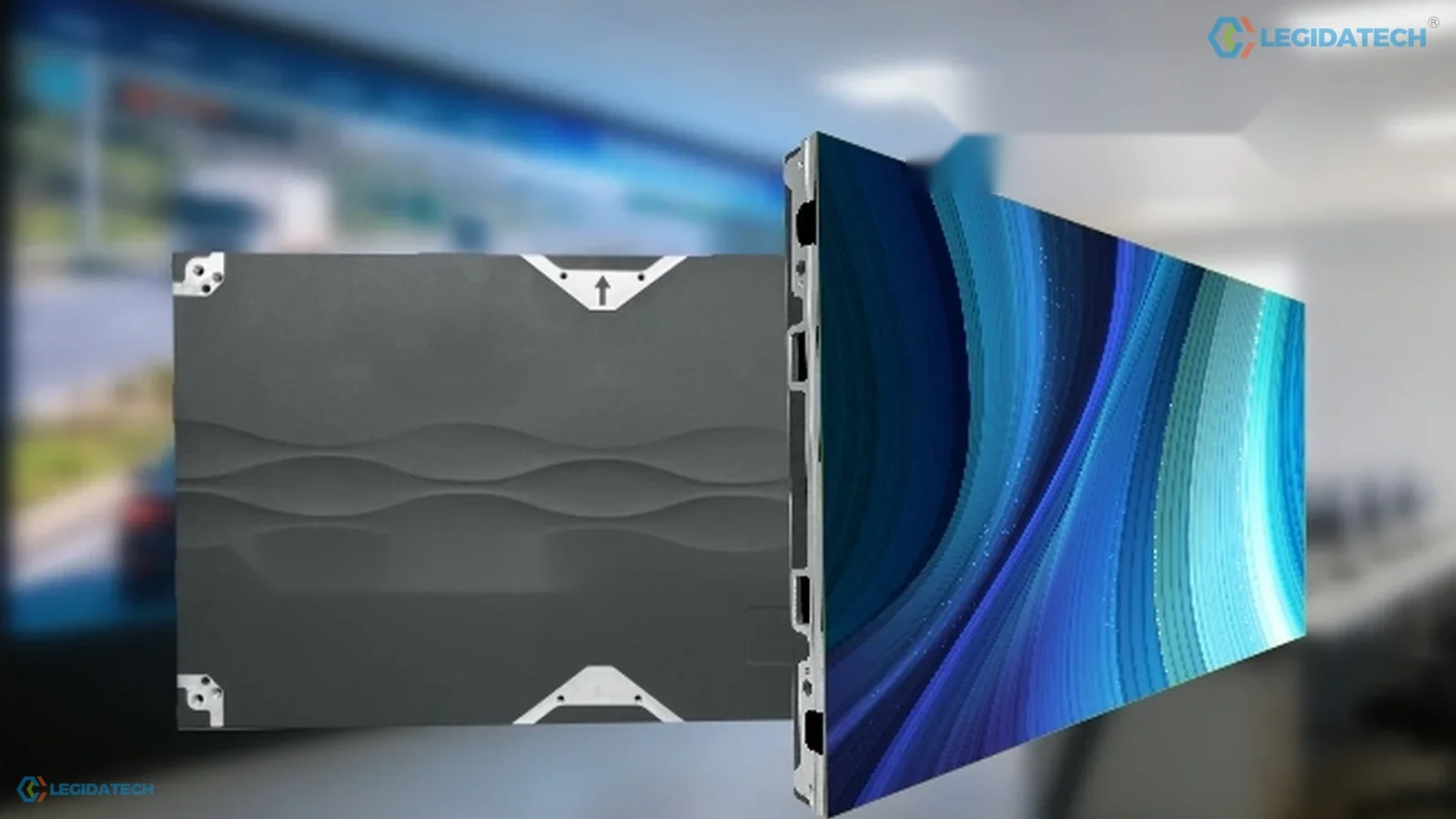
The Pro option at this size: sealed COB panels, front service, pitched for tight camera framing.
What a 20ft Screen Serves, and Where It Stops Working
The honest sizing rule for a church wall is not seat count but the furthest seat’s distance and angle. A common planning rule is that the back row should sit no further than six times the screen height for text to remain comfortably readable.
| If your back row is | A 3.05 m high wall works | What usually limits it |
|---|---|---|
| Up to 18 m | Yes — comfortable, text legible | Nothing; this is the design case |
| 18–24 m | Yes, with large type and high-contrast layouts | Content design, not the screen |
| 24–30 m | Marginal for body text, fine for IMAG | Side screens or a taller wall become cheaper than more pitch |
| Over 30 m, or a balcony at a shallow angle | No — add side screens or go taller | Geometry: the angle, not the resolution |
This is why a 20 ft wall is the natural size for 300–500 seats in a room up to about 25 m deep, and why the same wall in a 900-seat room with a balcony is usually paired with two side screens rather than replaced by a bigger front wall. Side screens are cheaper than area, and they fix the seats the main wall cannot serve.
Two real reference points from our archive bracket this. The Warriors Chapel wall in Kumasi is 5.12 × 1.92 m — 9.8 m² — and serves a mid-sized sanctuary; the Accra wall is 12.16 × 3.84 m — 46.7 m² — for a room several times larger. A 20 ft wall sits between them, closer to the Warriors Chapel end in cost than the Accra end in area.
What Changes the Price at This Size
Four cost lines behave differently at 18–19 m² than they do on a 10 m² wall. Budget for all four before you compare panel prices.
| Line | What it is at 20 ft | Rough scale |
|---|---|---|
| Steel or truss | A 6 m span needs a frame, not a bracket; wall type decides whether it is bolted or hung | Local fabricator quote, typically 10–20% of equipment |
| Freight volume | The wall ships as packed cabinets; you pay for cubic metres, not kilograms | Charged on volume, port to port plus inland |
| Processing capacity | 2,432 × 1,216 is roughly 3 million pixels — check the processor’s rated capacity, not just its port count | One processor tier up from a 13 m² build |
| Service plan | Larger walls need a spare kit sized to more modules, and a plan for reaching the top row | Spare kit 3–5% of equipment |
The processor line is the one that catches churches out. A control system chosen for a small wall can run out of pixel capacity at 18 m² and P2.5, and the replacement costs more than the difference between pitches. Ask for the pixel count and the processor’s rated capacity in the same sentence.
The five-year arithmetic on spares, wear parts and servicing at this size is worked through in our church LED screen maintenance cost guide; the full pitch-by-pitch price bands are on the church LED screen price guide.
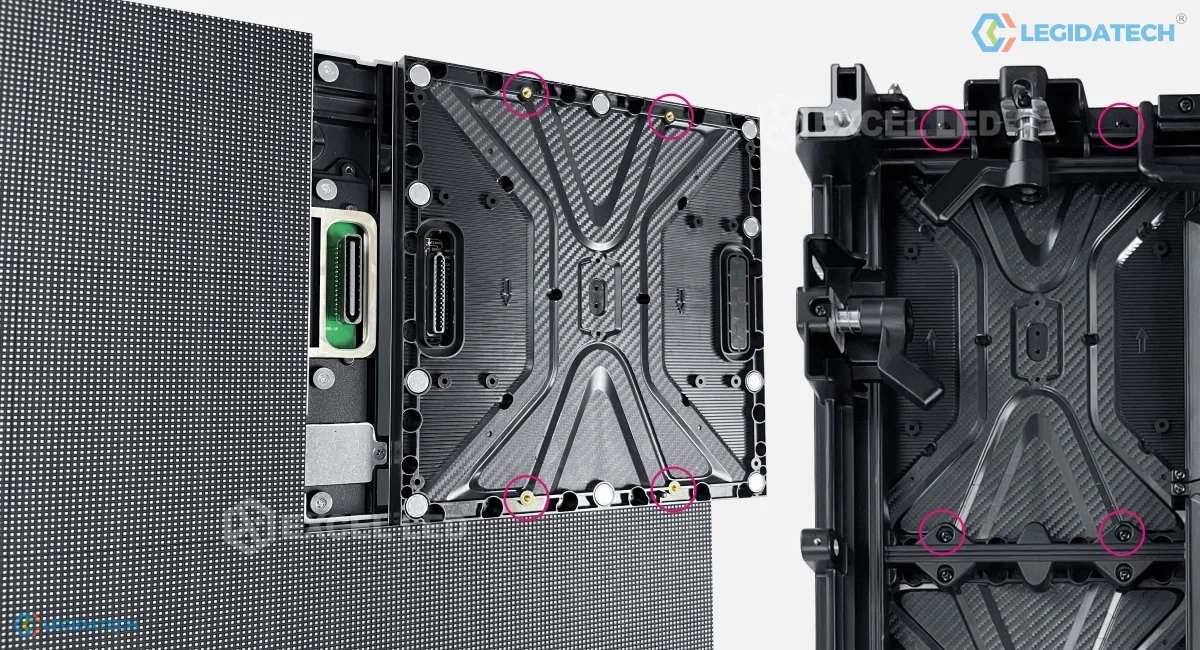
Module retention and cabinet design decide how a wall this size is serviced — and what a module swap costs in labour.
Three Ways to Spend the Same Budget
At a fixed budget of roughly US$10,000–11,000 for equipment, there are three defensible buys. Which is right depends on the room and the camera, not on the spec sheet.
| Buy | What you get | Best for |
|---|---|---|
| Bigger and coarser | 20 × 10 ft at P3.9, US$7,400–11,200 | Deep rooms, distant camera, area beats resolution |
| The default | 20 × 10 ft at P2.5, US$9,300–14,900 | 300–500 seats, IMAG at 8–15 m, streamed in 1080p |
| Smaller and finer | 13 × 9 ft at COB P1.5, around US$8,700–13,000 | A room where the camera is close and the seating is tight |
The third option is the one buyers rarely consider and often should: a smaller, finer wall inside the same money, when the room cannot use 20 ft anyway. It resolves better on camera and costs less to service, because there are fewer modules to fail. The mistake in the other direction — a 20 ft P3.9 wall filmed from two metres at the platform edge — is the one that gets a screen replaced inside two years.
The same numbers, applied to real markets: Church LED screens in Nigeria · Church LED screens in Ghana · Church LED screens in South Africa. For supplier-by-supplier comparisons, see the Top 10 church LED screen suppliers in Nigeria and the Top 10 church LED screen suppliers in Ghana.
Frequently Asked Questions
At 20 × 10 ft (18.6 m²) the equipment is US$9,300–14,900 at indoor P2.5, US$7,400–11,200 at P3.9 fixed, and US$14,900–22,300 at COB P1.5. These are factory-direct indicative bands; freight, duty, steel and installation are additional.
Usually yes. A 3.05 m high wall stays comfortable for text to about 18 m of back-row distance, and longer if the content is designed for it. Above roughly 24 m, or with a balcony at a shallow angle, side screens are usually a better spend than a taller front wall.
20 × 10 is 2:1 and suits lyrics, scripture and wide graphics; 16:9 needs 20 × 11.25 ft (20.9 m², about 12% more area) so that camera and video fill the frame. If the wall is mainly a video surface, buy 16:9; if it is mainly a lyrics surface, 2:1 uses a shallow platform wall better.
Built on 320 × 160 mm modules it comes out at 6.08 × 3.04 m, which is 2,432 × 1,216 pixels — wider than full HD, so a 1080p feed is scaled up by about a quarter to fill the width, with the top and bottom of the frame cropped. A 16:9 version of the same width gives 2,432 × 1,344.
The wall is built from whole modules, so the drawing snaps to the module grid: 6.08 × 3.04 m instead of the nominal 6.10 × 3.05. The difference is under 1% in area, and it is shown on the shop drawing along with the resolution rather than left to be discovered on site.
Typically 10–20% of the equipment price, quoted by a local fabricator rather than by the screen supplier. A wall bolted flat to a solid masonry wall is at the low end; a 6 m span that must be hung, braced or made removable is at the high end.
Only if it is bought as a rental product with flight cases and quick-lock cabinets — a fixed wall is not designed to be struck and re-hung. Churches that do both usually buy a fixed wall plus a smaller portable screen rather than making one wall do both jobs.
3–5% of the equipment price, ordered with the screen: spare modules from the same batch, receiving cards, power supplies, ribbon and network cables and fans. At 18–19 m² the wall holds several hundred modules, so the kit is sized to that count rather than to the area alone.
Where to go next
All pitch bands and the whole-screen budget table: church LED screen price. Five-year running costs on the same basis: LED screen maintenance cost. Sealed-face panels and when they are worth it: COB church LED screens. Delivered projects by size and country: church LED screens.
Indicative planning bands, last reviewed November 2026. Not a formal quotation. Freight, duty, structure, installation and warranty terms are confirmed in the project quotation.