


What Does a Church LED Screen Cost to Maintain Over Five Years?The parts that actually fail, what each line of a maintenance budget costs at real church sizes, and how to tell a cheap screen from a cheap five years
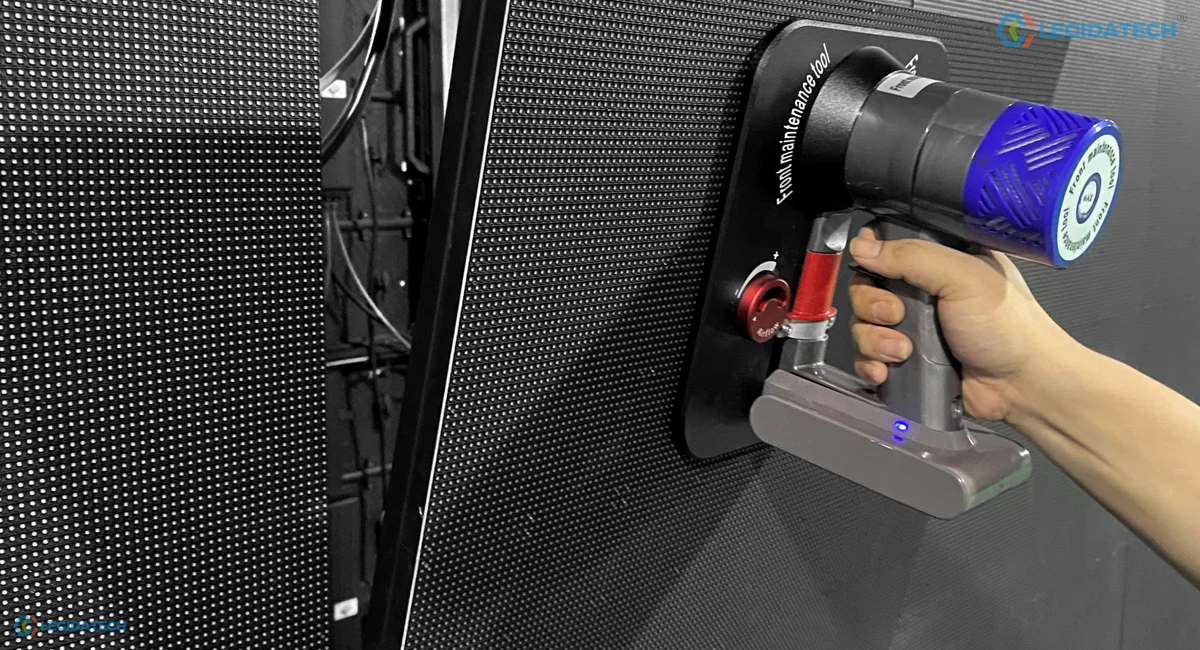
A church LED screen module coming out from the front of a live wall — the single design decision that decides most of your maintenance bill.
The Short Answer
Budget 1.5–3% of the equipment price per year for parts and labour once the warranty ends, and hold a 3–5% spare parts kit from day one. On a 11.5 m² indoor P2.5 church wall costing US$5,750–9,200, everything spent on maintenance across five years — spares, cleaning, replacement parts, one emergency air shipment — lands at roughly US$700–2,500, or 12–27% of the screen price. Electricity is a separate line, and across five years it usually lands within the same order of magnitude as the maintenance budget. All figures below are indicative planning bands, not a quotation.
Most building committees ask this question as if there were one number. There is not. LED screen maintenance cost is decided by the parts you hold, the way the wall is built, and the distance to the nearest spare — which is also why LED wall repair cost for a church varies so much between two buildings that look identical. A church LED screen is a passive object with a handful of consumable parts inside it, and the maintenance bill is decided by three things: what pitch you bought, whether the modules come out from the front, and how far the nearest spare part sits from your building. Two churches can own the same screen for five years and spend four times different amounts on it.
What LED Screen Maintenance Cost Actually Covers
Five separate things get called “maintenance”. Lumping them together is why quotes for the same screen look so different, so it is worth separating them before any number is discussed.
| Line | What it pays for | How it is usually charged | Status of the figure |
|---|---|---|---|
| Consumables and spares | Extra modules, power supplies, receiving cards, ribbon and network cables, held at your site or your installer’s | One-off, 3–5% of the equipment price, ordered with the screen | Our own practice; standard on our church projects |
| Routine servicing | Dust removal, connector check, screw torque, brightness and colour check, cabinet fan and filter cleaning | Per visit or under an annual contract | Local labour rate, varies by city |
| Wear replacement | Modules with dead pixels, power supplies that drop out, fans at end of life | Parts at contract price plus labour | Planning band, 1.5–3% of equipment price per year after warranty |
| Corrective repair | Lightning and surge damage, water ingress, a cabinet knocked by scaffolding or a camera crane | Parts, labour and shipment | Event-driven, not budgetable as a yearly figure |
| Control and content | Processor settings, mapping backup, sender card firmware, the laptop or media player feeding the wall | Usually bundled with servicing | Varies with the control system chosen |
Two of these five lines are predictable and two are not. The useful thing a buyer can do is make the predictable lines small and make the unpredictable ones rare — which is a purchase decision, not a maintenance decision. A wall whose modules come out from the front, whose power supplies are duplicated, and whose spare kit was ordered with the screen converts most “corrective repair” events into a twenty-minute job by a volunteer.
Where the Calls Really Come From
The failure profile of an LED wall is narrow. Our own experience and the published fault lists of independent service companies in West Africa and South Asia converge on the same short list: the power supply, the receiving card, the module itself, and the connectors between them. The display technology rarely fails; the electronics around it does.
| What fails | What the church sees | Usual cause | What it takes to fix |
|---|---|---|---|
| Power supply | One cabinet or one row stays dark, or the wall restarts repeatedly | Surge, generator changeover, heat, dust blocking the fan path | Swap the unit, 20–30 minutes with a spare on site |
| Receiving card | A block of cabinets shows garbage, or one cabinet is missing from the picture | Surge down the signal cable, damp, firmware corruption | Swap the card and re-address it, under an hour |
| Module / LED lamp | Single dead pixels, a darker patch, one module out | Heat, over-current, a batch of lamps at end of life | Module swap, 15–30 minutes when front service |
| Connectors and ribbon cables | Flicker, an intermittent cabinet, a colour shift on one panel | Humidity, dust, vibration, oxidation | Clean and reseat, or replace the cable |
| Cooling fan and filter | Brightness drops after an hour, or the cabinet runs hot | Dust-clogged filter, fan bearing wear | Clean or swap the fan, under an hour |
| Configuration loss | The wall boots but the picture is split or scrambled | Power cut during a write, processor replaced without a backup | Restore the mapping file, minutes if a backup exists |
Two consequences follow. First, the parts that fail are cheap relative to the wall — the expensive part of a repair is almost never the component, it is the shipment and the trip. Second, almost every item on that list is a twenty-minute job for someone who has the part. Which means the real maintenance cost question is not “how reliable is the screen” but “how far is the nearest power supply”.
A Five-Year Budget You Can Check Line by Line
The table below is built on an 11.5 m² indoor P2.5 wall — the same area as the Living Faith Church wall we installed in Nigeria, at 4.8 × 2.4 m. Equipment is priced at US$500–800 per m², the indicative band for indoor P2.5. Every line is arithmetic you can redo with your own quote.
| Line | Basis | 11.5 m² P2.5 wall, 5 years (US$) |
|---|---|---|
| Equipment price | 11.5 m² × US$500–800 / m² | 5,750 – 9,200 |
| Spare parts kit, ordered with the screen | 3–5% of equipment | 173 – 460 |
| Freight or courier on parts during warranty | One or two events assumed | 0 – 200 |
| Cleaning and inspection, twice a year, years 2–5 | Labour only, local rate | 120 – 400 |
| Post-warranty parts and labour, years 3–5 | 1.5–3% of equipment per year × 3 | 259 – 828 |
| One emergency air shipment of a part | Only if no local stock | 150 – 600 |
| Total maintenance, 5 years | — | 702 – 2,488 |
| As a share of the screen price | — | 12 – 27% |
Read the top line and the bottom line together. On a screen of this size, five years of maintenance is a smaller number than most committees expect — but the range is wide, and the difference between the low and high end is almost entirely logistics, not parts. The church that holds a 3% spare kit and a local installer spends near US$700. The church that air-freights one power supply twice because nobody thought to order spares spends near the top of the range on shipping alone.
Why the percentages are the honest unit. Absolute dollars for a spare module, a receiving card or a power supply change with pitch, cabinet size, batch and freight. Expressing the budget as a percentage of what you paid keeps the plan valid when any of those move, and it is the only basis on which two quotes for different screens can be compared. The percentages here are planning bands from our own church projects, deliberately rounded, and they are confirmed against your actual quotation before you sign.
Want this sized to your own wall? Send the wall dimensions and the pitch you are considering, and we will come back with the spare-kit list, the part counts and a five-year budget in your currency.
Year by Year: What Changes
| Period | What you are paying for | What to do in this period |
|---|---|---|
| Year 1 | Almost nothing. Manufacturing defects surface in the first weeks and are warranty events, not maintenance. | Log the mapping file and the processor configuration, and put the spare kit on a shelf in the building rather than in a store room at the installer’s office. |
| Years 2–3 | Cleaning, connector checks, the first power supplies, occasional modules. Still mostly warranty on the parts we supply. | Two service visits a year. Photograph the wall from the same spot each time — colour drift shows in a photo comparison before anyone notices it in the room. |
| Years 4–5 | Modules and power supplies at wear rates. This is the band the 1.5–3% per year is sized for. | Decide whether to refresh a section rather than a whole wall. Cabinets and structure do not age at the same rate as modules. |
| After year 5 | A judgement call: keep replacing parts, or replace the wall. Brightness and colour shift, not failure, usually sets the date. | Compare the cost of a module refresh against a new wall at current prices. On an old wall this is often closer than expected, because pitch per dollar has moved. |
The shape of that curve matters more than any single number. A church that budgets nothing in years 1–3 and then meets one large repair bill in year 4 has not been unlucky; it has simply deferred the predictable part of the curve into one month. Setting aside the 1.5–3% each year from year two is the least expensive way to own the screen.
Maintenance Cost Is Not the Electricity Bill
Buyers routinely fold electricity into “running cost” and then compare it to a projector. It is worth separating, because on a church wall the five-year power bill usually lands in the same order of magnitude as the five-year maintenance budget — and unlike maintenance, it is fully controllable from the control desk.
The arithmetic is simple enough to do before you buy. An indoor church wall draws roughly 200 W per m² at working brightness, averaged over content. Multiply by the area, by the hours the wall is actually on, and by your local tariff.
| Input | 11.5 m² P2.5 wall | How to change it |
|---|---|---|
| Average draw | 2.3 kW (11.5 × 200 W) | Scales linearly with area; drops with a lower brightness setting |
| Hours per week | 7.5 h (three services × 2.5 h) | Count rehearsal and event time, not just Sunday |
| Annual energy | about 900 kWh | 2.3 kW × 7.5 h × 52 weeks |
| Cost at US$0.15 / kWh | about US$135 per year | Use your own tariff; this is the only country-specific input |
| Cost at US$0.25 / kWh | about US$224 per year | Generator running costs are higher than grid tariffs in most of West Africa |
Two things follow that are worth knowing before a committee meeting. Running the wall at 60–70% brightness in a room that is lit for people, not for cameras, cuts the energy line visibly and also extends power supply life — heat is the main killer of the electrolytic capacitors inside a PSU, and every 10 °C matters to their service life. And standby draw is real: a processor and a wall left powered overnight in a building that is empty six days a week is the most common way a church wastes more electricity than it spends on maintenance.
Spare Parts: The 3–5% Rule and the 30–46 Day Gap
If you take one operational decision away from this page, take this one: order the spare kit with the screen. Not later, not when something fails — with the screen, on the same purchase order, in the same shipment.
The reason is not the price of the part. It is the calendar. Sea freight from China to Tema runs 30–46 days, door to door 40–55 days with clearance; Lagos direct sailings are around 27 days when the schedule holds. A single failed power supply ordered after the event therefore means a dark cabinet for one to two months in a church that has no local stock — and a dark cabinet is exactly the thing that makes a building committee conclude the screen was a mistake.
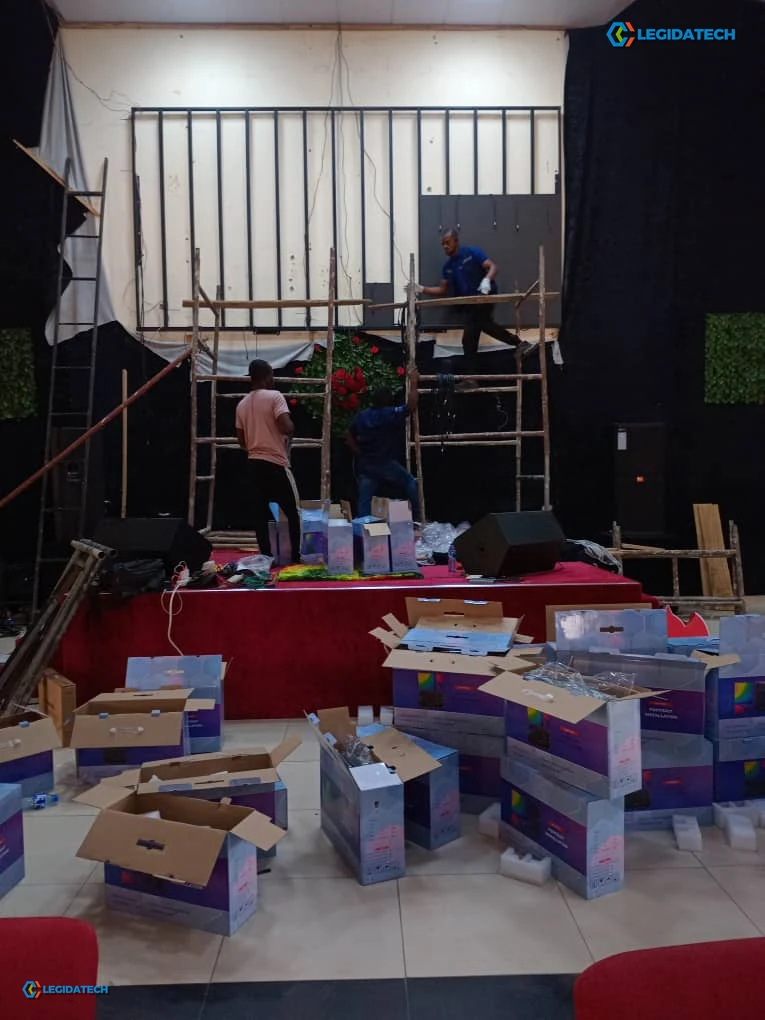
Cabinets unpacked on site in Nigeria. The foam and cartons matter more than they look: spares that travel with the original shipment arrive intact and in the same batch.
A practical kit for a fixed indoor church wall, expressed against the equipment price rather than in units:
| Item | Why this item | Quantity guide (planning) |
|---|---|---|
| Spare modules | Matches the colour batch of the installed wall; a module from a different batch shows as a patch even when it works | 1 per 100 modules installed, minimum 2 |
| Spare receiving cards | The most common electronic failure after the PSU, and a swap nobody needs to be trained for | 1 per 20–30 cabinets, minimum 2 |
| Spare power supplies | One per cabinet row is what keeps a Sunday on air | 1 per 10–15 cabinets, minimum 2 |
| Ribbon and network cables | Cheap, and a surprising share of intermittent faults | 2 of each length used |
| Spare fans | The part nobody orders and everybody needs in year four | 1 per 4–6 fans |
| Mapping and configuration backup | Restores a scrambled wall in minutes after a power event | On file, dated, in two places |
To size the quantities, it helps to know how many parts are actually in the wall. On 320 × 160 mm modules, an 11.5 m² wall holds about 225 modules and a 25 m² wall about 488. The power supply count is not arithmetic — it depends on the cabinet design — so ask for it in the cabinet specification, because that is the number the spare kit should be sized against rather than the area.
Cheap to Buy, Expensive to Own
Four design decisions move the five-year number more than any maintenance contract does. They are all visible on a specification sheet before you buy, and none of them shows up in the headline price per square metre.
| Decision | What it costs at purchase | What it saves over five years |
|---|---|---|
| Front service versus rear service | Small or nil at this pitch | Every module swap becomes a job from the aisle instead of a job behind the wall. On a wall bolted to a back wall with no service corridor, rear service means dismantling cabinets — a two-person afternoon instead of a twenty-minute task. |
| Dual power supplies and dual signal | A modest increase in cabinet cost | A single PSU failure no longer darkens a cabinet: the wall keeps working while you schedule the swap. This is the difference between a fault and an outage. |
| Standard control system | No difference, if specified up front | Receiving cards and processors that any local AV technician recognises and stocks. A proprietary control line turns a consumable card into a shipment from one factory. |
| Batch consistency and documented module spec | No difference, if ordered together | Spares that match the wall in colour and brightness. Churches that buy a second section two years later are the ones who discover this. |
The COB church LED screens we build take two of those four by default: the face is sealed, so cleaning is a wipe rather than a lamp-by-lamp job, and modules come out from the front. Whether that is worth the difference for your room is a different question from this page — but it is the same calculation, because a sealed face changes the cleaning line and the dead-pixel rate together.
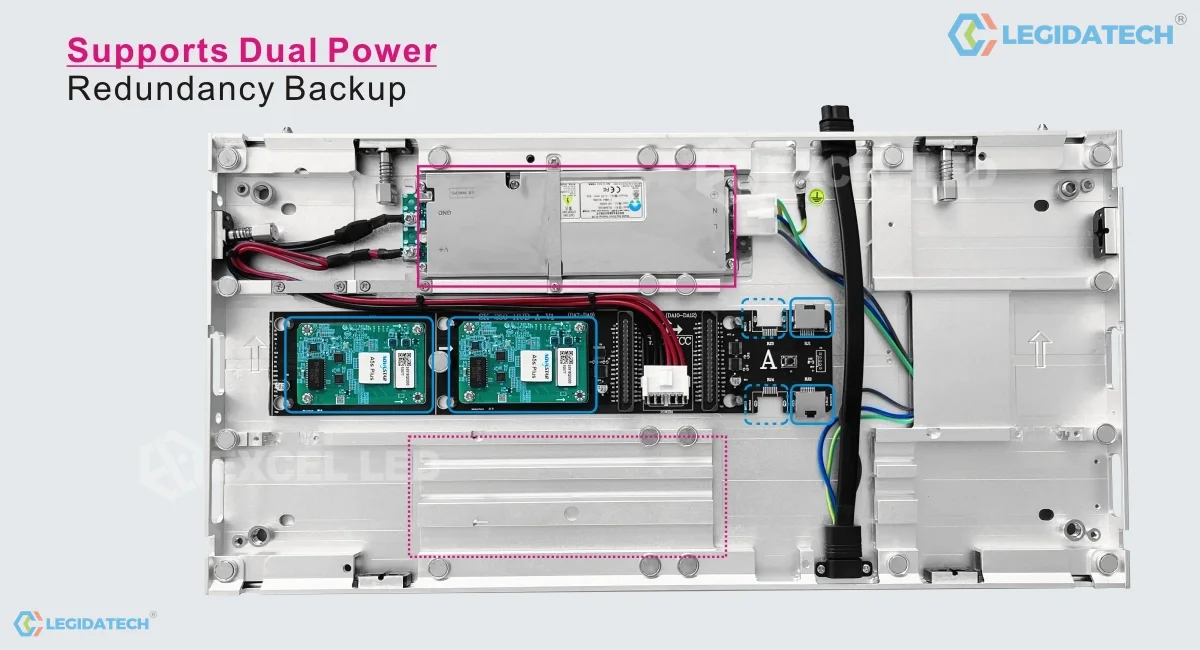
Two supplies and two receiving cards in one cabinet. Redundancy is a maintenance-cost decision disguised as a specification.
The inside of the cabinet is where this argument is settled. A supply and a receiving card that a technician can reach, identify and swap without removing the cabinet is worth more across five years than a slightly better pixel pitch. In the photo above, the second supply is not a spare sitting on a shelf — it is wired and live, which is why the cabinet survives a single failure.
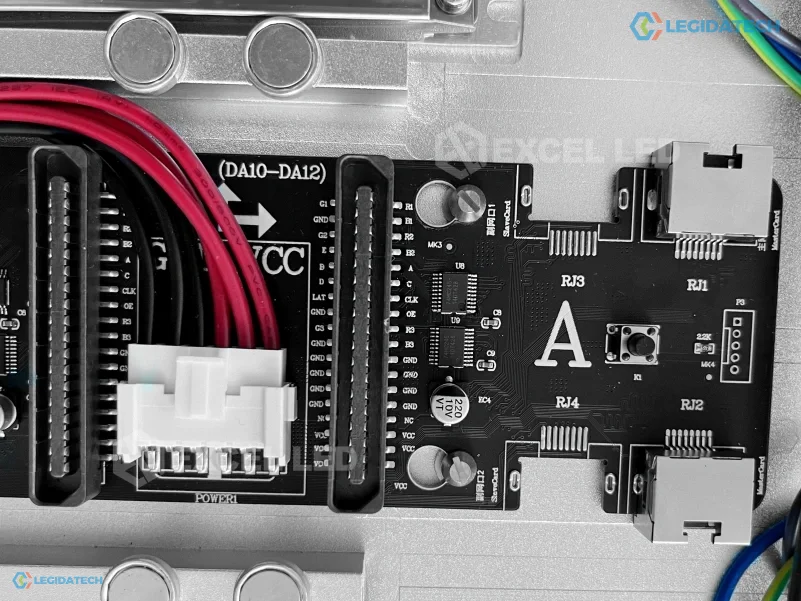
Wiring layout inside an indoor church cabinet: supply, receiving card, and the signal path a volunteer will be asked to check first.
Worked Example: A Wall Now in Year Five
One of the walls in our project archive is a 9 × 3.75 m P3.9 screen — 33.8 m² — installed in a Nigerian church. When we photographed it in December 2024 it was already three years old, which puts it in year five this year. Nothing about it is theoretical, and the pattern it shows is the one the tables above predict.
At 33.8 m² the wall is large enough that logistics, not part prices, dominate its cost of ownership. The failure history of a wall that age in that climate is dominated by power: grid collapse, generator changeover and lightning arrive at the power supply first. The screen itself — modules, cabinets, structure — is the part that lasts. That is why the West African maintenance question is really a power-protection question: a surge protection device at the distribution board, a second at the cabinet, correct earthing, and an AVR or UPS in front of the wall do more for the five-year bill than any service contract, and they cost a fraction of one screen-wide repair.
The same archive holds the complementary case: a client in Abuja who came back to us to add 17 cabinets to an existing wall and re-hang it. That is the other half of the maintenance story — walls get extended, and a wall built on a documented, still-available cabinet is extendable in a way a discontinued one is not. If your church expects to grow the screen in three years, ask at purchase which cabinet will still be in production.
For a larger reference point, the 46.7 m² P2.5 wall we installed in Accra is roughly four times the 11.5 m² example above. Its maintenance budget scales with the same percentages, but its service structure does not: at that size a church should be training one volunteer to swap modules and one technician to hold the spare kit, because the round trip for a service visit becomes the dominant cost.
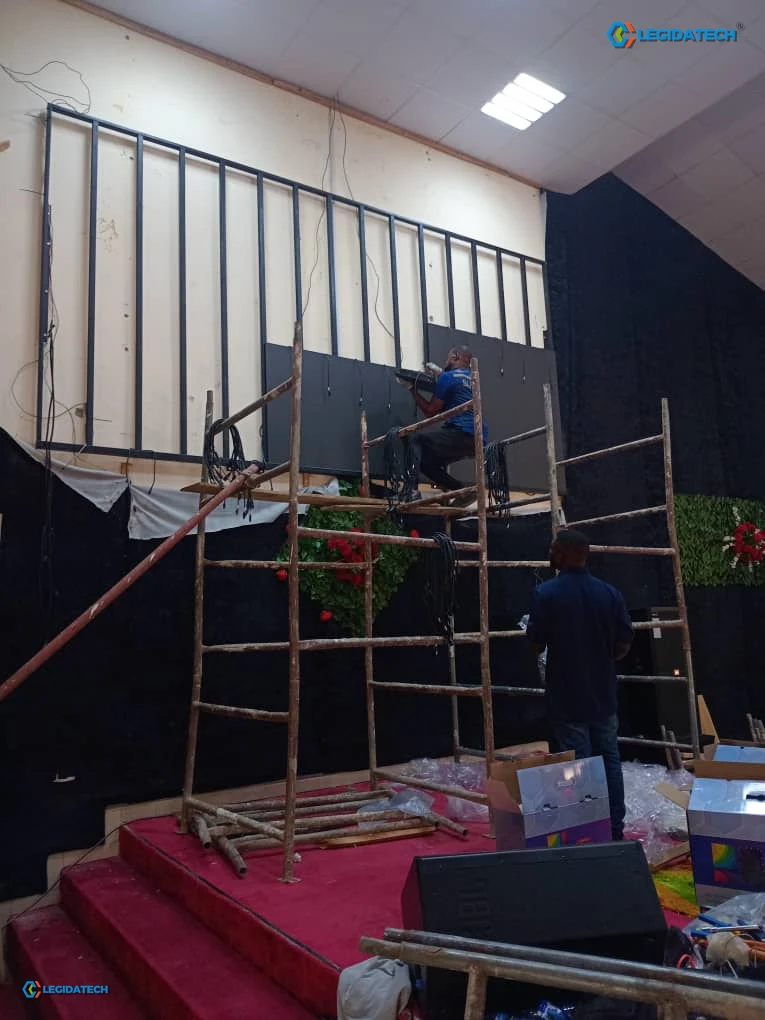
Access decides cost. A wall that can be reached from the floor is serviced in minutes; the same wall behind fixed seating is a scaffolding job.
Three Budget Tiers
If a committee needs one defensible number to put in a five-year plan, these are the bands to argue about. Parts are expressed as a percentage of the equipment price; servicing labour is local and should be added from a local quote.
| Church size | Typical wall | Annual parts budget, years 3–5 | What else to fund |
|---|---|---|---|
| Church plant, rented hall | 6–12 m² P2.5, portable or single wall | US$45–290 per year | One service visit a year; a spare module and PSU on the shelf; a case for transport if the wall travels |
| Single-site sanctuary | 12–25 m² P2.5 fixed | US$90–600 per year | Two service visits a year; the full 3–5% spare kit; a documented mapping backup |
| Multi-site or megachurch | 25–60 m² P2.5, or several walls | US$190–1,440 per year | A named technician per campus, a shared spare pool, and one contract covering all sites so response time is contractual rather than hopeful |
The ranges are computed as 1.5–3% of the equipment price at the indicative P2.5 band of US$500–800 per m². Where a church sits inside a band is decided by climate and logistics, not by the screen: a building in a lightning belt with a two-day spare-parts distance belongs at the top of its band even if the wall is small.
How to Check a Supplier’s Maintenance Claim
Every supplier will tell you the screen needs almost no maintenance. That claim is roughly true and entirely unfalsifiable as stated, so replace it with questions that have answers you can verify.
- Ask what is in the warranty and what is not. Cabinets, modules, power supplies, receiving cards and labour are frequently on different terms. Warranty periods and coverage are confirmed in your project quotation, not in a brochure.
- Ask where the nearest spare part is. Not “do you support us” — where. A city, a warehouse, or a six-week sea freight answer are three different ownership experiences.
- Ask for the module batch and the cabinet model in writing. If the model is discontinued, the five-year cost of an extension goes up sharply.
- Ask what a module swap involves. Front or rear, how many people, what tool. If the answer is vague, that is the answer.
- Ask for the mapping file and login at handover. No backup, no recovery time — a scrambled wall then becomes a service call for something a volunteer could fix in ten minutes.
- Ask what the service partner in your country actually stocks. A contract that promises 48-hour response through a channel that has no parts is a promise about travel, not about repair.
None of these questions is about price. They are about the cost of the years after the invoice, which is what this page is about. The church LED screen price guide covers the purchase side of the same decision; this page covers what comes after it.
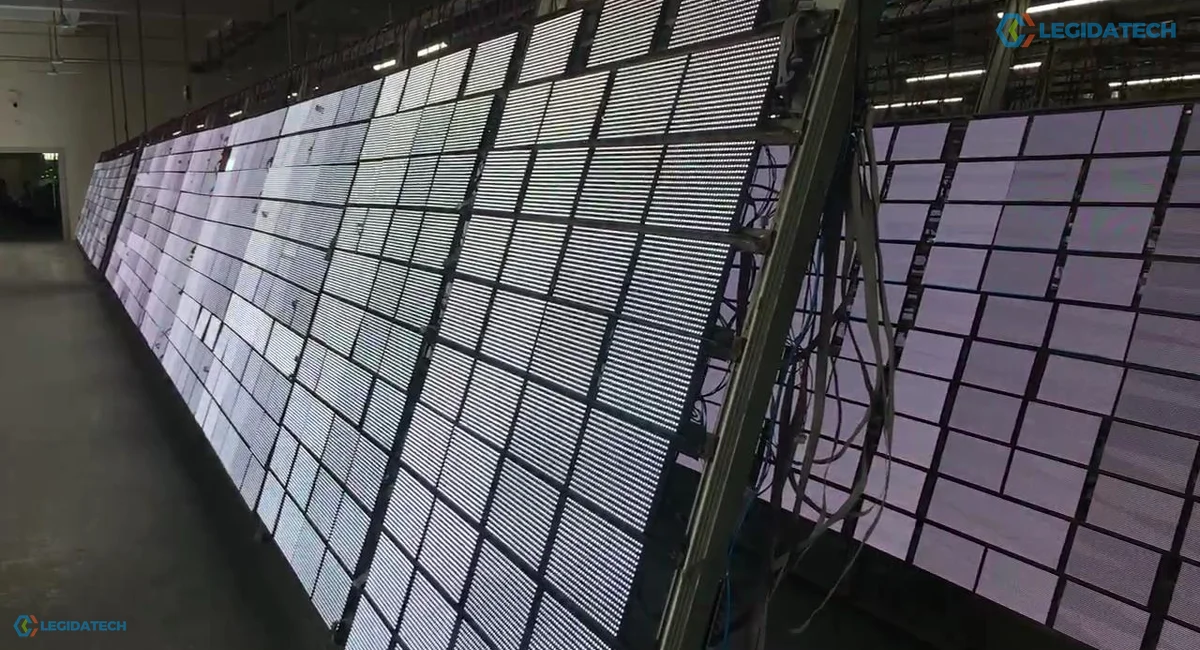
Panels on the ageing rack before dispatch. This is where a dead pixel rate is either caught or shipped.
Frequently Asked Questions
Budget 1.5–3% of the equipment price per year once the warranty ends, plus local labour for one or two service visits. On a 12 m² indoor P2.5 wall that is roughly US$90–290 a year in parts, with servicing charged at your local rate. Before the warranty ends the figure is close to zero, which is why the five-year total is lower than most committees expect.
On an 11.5 m² P2.5 wall priced at US$5,750–9,200, five years of maintenance — spare kit, cleaning, post-warranty parts and one emergency shipment — lands at roughly US$700–2,500, or 12–27% of the screen price. The low end assumes a spare kit ordered with the screen and a local installer; the high end assumes parts flown in after each failure.
Manufacturing defects are. Wear, surge damage, water ingress, physical impact and labour are frequently excluded or time-limited, and the parts inside a cabinet are often on different terms from the cabinet itself. Ask for the warranty scope in writing, split by cabinets, modules, power supplies, receiving cards and labour, before comparing quotes.
Twice a year in a normally ventilated building, and quarterly where there is construction dust, cooking, or open windows onto a road. Cleaning is dust removal from the cabinet fans and filters, a check of connectors and screws, and a wipe of the face — on a sealed COB face that is a cloth, on an SMD face it is a careful cloth and never a solvent.
Spare modules from the same batch, receiving cards, power supplies, ribbon and network cables, spare fans, and a dated copy of the mapping and configuration files. Size the kit at 3–5% of the equipment price when you order the screen, and base the quantities on the module and power supply count in the wall rather than on its area alone.
It depends on what the alternative is. Service contracts are normally priced per visit or per square metre of wall rather than from a published rate card, so the number has to come from a local quote — ours included. A contract is worth paying for when it buys response time, stocked parts in your country, and a named technician — not when it buys an annual invoice and a phone number. For a single small wall with a spare kit on site, a pay-per-visit arrangement is often cheaper. For multi-site churches, a contract with a written response time is usually the lower-risk option.
Long enough that modules are rarely the reason a wall is replaced. Individual dead pixels accumulate slowly and are usually a cosmetic decision rather than a functional one until a noticeable share of a cabinet is affected. Power supplies, fans and connectors reach end of life earlier, which is why the maintenance budget is weighted towards electronics rather than towards the display surface.
Cleaning, filter and fan checks, and a module swap on a front-service wall are all realistic volunteer tasks with a short briefing and the right suction tool. Anything involving a power supply, a receiving card or the processor configuration should be a trained technician, and any work inside a cabinet should start with the circuit isolated.
About 200 W per m² averaged over content at working brightness, so an 11.5 m² wall draws roughly 2.3 kW while it is on. At three services of 2.5 hours a week that is about 900 kWh a year — around US$135 at US$0.15 per kWh, or US$224 at US$0.25. Running at 60–70% brightness in a normally lit room reduces both the bill and the heat load on the power supplies.
Maintenance is the recurring, predictable spend: cleaning, inspection, and the wear parts you expect to replace. Repair is event-driven: lightning, water, impact, a failed batch. A maintenance budget should cover the first and hold a contingency for the second — typically the spare kit plus one emergency shipment is enough to make a repair an inconvenience rather than an outage.
The same numbers, applied to real markets: Church LED screens in Nigeria · Church LED screens in Ghana · Church LED screens in South Africa. For supplier-by-supplier comparisons, see the Top 10 church LED screen suppliers in Nigeria and the Top 10 church LED screen suppliers in Ghana.
Related reading
Purchase side of the same decision: the church LED screen price guide by pitch.
Sealed-face options and what they change about cleaning and dead pixels: COB church LED screens. Two real walls quoted in full: the 46.7 m² Accra P2.5 project and the 11.5 m² Living Faith wall in Nigeria. Wider context on sizing and pitch: the church LED screens hub.
How these numbers were built
Three inputs, stated plainly so you can challenge them. The equipment bands are indicative price bands for indoor P2.5, not our quotation. The 3–5% spare kit and the 1.5–3% annual wear band come from how we specify spares on our own church projects and from the fault profile that public service-company fault lists and our own church projects agree on. The transit times are the published sea-freight ranges for those lanes, and the failure profile comes from public fault lists published by independent LED service companies, checked against the projects in our own archive. Everything is arithmetic on top of those three inputs, which is why the tables show the basis column rather than a single final figure — change the input and you get your own number.
Indicative planning figures, last reviewed November 2026. Not a formal quotation. Warranty terms, spare part pricing and freight are confirmed in the project quotation.