


Choosing a church LED screen is not a shopping decision, it is a stewardship decision: the wall you approve this year will still be on your platform in 2035. In our church projects across 12 countries — 44 installations in the LEGIDATECH project records as of 2026 — the same four questions decide whether a church ends up delighted or disappointed: how big, what pitch, what cost, and who to buy from. This guide answers all four with the numbers we actually install, the sizing rules our engineers apply, and the supplier checks that separate a factory from a reseller. If you are preparing a proposal for your board, read it in order; if you already have quotes in hand, jump to the vetting section.
What Is a Church LED Screen and Where Do Churches Use It?
Quick Answer: A church LED screen is a modular, self-emissive video wall assembled from cabinets and replaceable LED modules; our case database tags 44 church installations across 12 countries, with a median area of 9.8 m².
Unlike a projection system, an LED wall produces light at every pixel instead of reflecting a projector beam off a fabric surface. That single physical difference explains nearly every practical benefit churches care about: readable lyrics under full stage wash, no lamp hours to track, true black backgrounds for worship content, and a fixed geometry that never needs re-focusing before a Sunday service.
The screen is also not one piece of equipment. It is assembled from three nested levels — LED module, LED cabinet, and the assembled wall — which is why churches can fit a screen to an irregular platform wall or a split-level stage without paying for a custom-moulded panel. Module-level construction also means a damaged corner from a ladder during stage setup is a one-module service job, not a rebuild.
Three levels of construction: module, cabinet, wall
Churches typically install these screens in four roles, and the role determines the specification far more than the brand does:
- Main stage screen behind the platform, showing lyrics, scripture, sermon slides and video.
- Side or IMAG screens at left and right, showing the live camera feed and close-ups for larger rooms.
- Lobby and foyer displays for announcements, giving and service times, usually viewed from 2-4 m.
- Outdoor signage at the street entrance, which uses sealed, high-brightness cabinets instead of indoor ones.
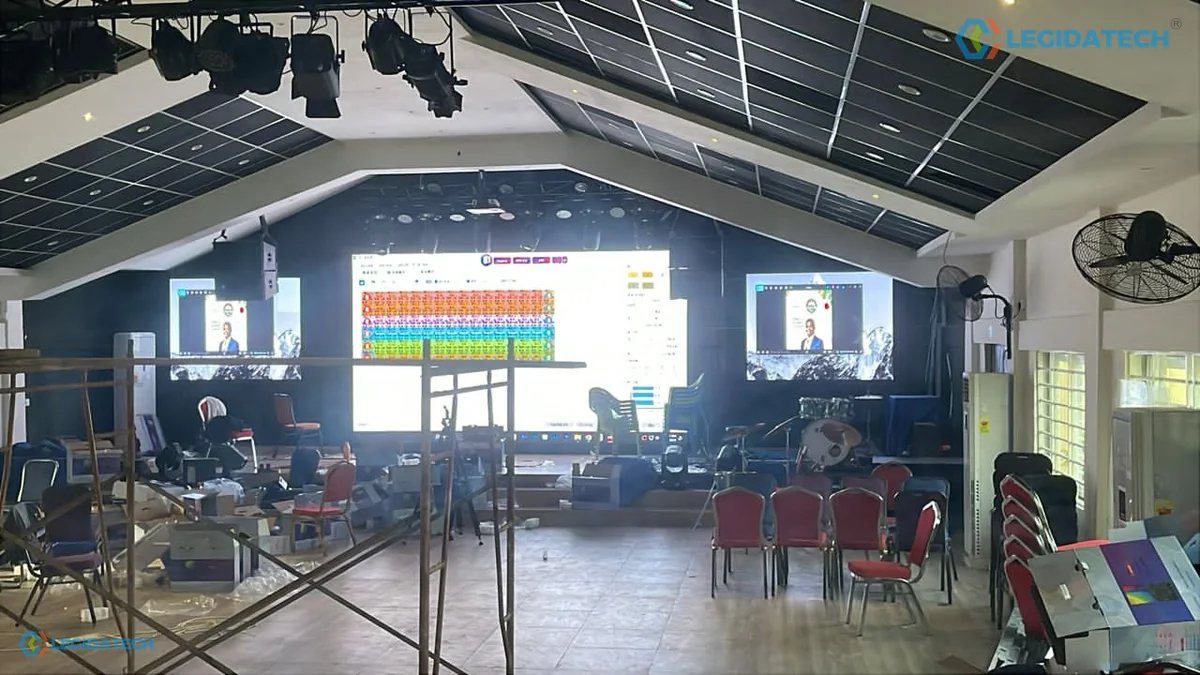
Church LED Screen vs Projector: Which Belongs in Your Sanctuary?
Quick Answer: A church LED screen wins whenever the room has stage lighting or daylight; a projector can still suit a dark, small room where a projector plus screen still costs a fraction of an LED wall.
The honest comparison is not “which is better” but “which failure mode can your church live with”. LED walls fail on price per square metre at fine pitches, and they need a load-bearing wall or truss rather than a pull-down screen. Projectors fail on ambient light: every lumen competes with stage wash and window light, so lyrics wash out exactly when the room is full of people.
| Factor | LED screen | Projector |
|---|---|---|
| Light source | Self-emissive per pixel | Lamp or laser reflected off a surface |
| Performance in lit sanctuaries | Holds contrast and colour under stage lighting | Washes out; needs controlled lighting |
| Consumables | No lamps; modules and power supplies replaced as needed | Lamp or laser module replacement on an hour count |
| Black level | True black when pixels are off | Grey, limited by ambient light on the surface |
| Alignment | Fixed; no focus or keystone drift | Needs periodic focus and geometry correction |
| Installation weight | Requires a load-bearing wall or truss | Ceiling mount and screen surface |
| Where it fails | Cost per m² at very fine pitch | Ambient light, lamp hours, image washout |
In our own project records the pattern is consistent: churches that livestream or run contemporary worship with full stage lighting almost always move to LED, while chapels with controlled lighting and a 120-200 seat room often stay with projection and spend the difference on audio. If your sanctuary has windows, LED is usually the cheaper long-run answer once you count lamp replacement and the dimming compromises you make on Sunday mornings.
How Do You Size a Church LED Screen for Your Seating Capacity?
Quick Answer: Size follows the furthest viewer, not the stage; our tagged church projects run from 1.8 m² to 33.8 m² with a median of 9.8 m².
The most common sizing mistake we see is a church ordering a screen sized to the platform opening rather than to the room. A wall that looks generous in a 3D render can be illegible from the back row of a balcony, and a wall that is slightly smaller but correctly pitched will read better from every seat.
Three inputs decide the size: the distance from the screen to the furthest seat, the number of seats, and the content you intend to show (lyrics read at a glance, IMAG needs more resolution than slides). Use the table below as a planning starting point, then confirm with the distance maths in the next section.
| Seating capacity | Typical screen area | Typical dimensions (16:9) | Typical pitch | What it is usually used for |
|---|---|---|---|---|
| Under 150 | 2-6 m² | 2.88 x 1.62 m | P2.5-P3.0 | Lyrics and slides; main screen only |
| 150-250 | 6-10 m² | 3.84 x 2.16 m | P2.5-P3.9 | Lyrics plus occasional video; often one main screen |
| 250-400 | 10-13 m² | 4.48 x 2.52 m | P2.5 | Main screen, sometimes with two side screens |
| 400-700 | 13-20 m² | 5.76 x 3.24 m | P2.5 | Main screen plus two side screens |
| 700-1,200 | 20-35 m² | 7.68 x 4.32 m | P2.5-P3.9 | Stage backdrop plus IMAG, multi-camera production |
| Over 1,200 | 30 m² and up | 8.64 x 4.86 m | P2.5-P4 | Backdrop, IMAG and overflow rooms |
Two of our larger church projects show how far this scales: a 33.2 m² P2.5 wall in Tema, Ghana at 8.64 x 3.84 m, and a 33.8 m² P3.9 wall at 9 x 3.75 m in Nigeria. Our largest documented church wall is bigger still: 46.7 m² at 12.16 x 3.84 m in Accra, Ghana, delivered in December 2025. At the other end, our smallest recorded church screens are around 1.8-2.8 m², usually a single side screen or a chapel wall.
The full chart — with resolution per band and a reference project in each band — is in the companion guide on what size LED screen a church needs by seating capacity.
Which Pixel Pitch Works From the Back Pew?
Quick Answer: Minimum comfortable viewing distance is about 1,000 times the pitch value, and optimal distance is about 3,000 times; a P2.5 wall is comfortable from roughly 2.5 m to 7.5 m.
Pixel pitch is the centre-to-centre distance between neighbouring pixels, written as P plus the value in millimetres. It is the single largest price driver in a church quotation, because halving the pitch quadruples the number of LED beads for the same wall area. It is also the specification most often mis-sold to churches: too fine wastes budget, too coarse is visible from the second row.
The industry planning rules most installers apply come from LED display engineering practice, and they are simple to check against your room:
- Minimum viewing distance is about 1,000 times the pixel pitch.
- Optimal viewing distance is about 3,000 times the pixel pitch.
- Maximum useful distance is about 30 times the screen height, after which the wall stops filling the viewer’s field of view.
| Pixel pitch | Minimum distance | Optimal distance | Where it fits in a church |
|---|---|---|---|
| P1.86-P2.0 | ~1.9-2.0 m | ~5.6-6.0 m | Small chapels, lobby screens, close IMAG |
| P2.5 | ~2.5 m | ~7.5 m | Most sanctuaries; the dominant choice in our records |
| P3.0-P3.9 | ~3.0-3.9 m | ~9-11.7 m | Larger halls and balconies, budget-sensitive rooms |
| P4-P6.67 | ~4-6.7 m | ~12-20 m | Very large auditoriums, overflow rooms, outdoor |
Our church data supports the general rule: of the project records that note a pitch, P2.5 accounts for 23 of 25 — churches overwhelmingly land on P2.5 because it reads cleanly from both the front row and the back wall of a typical sanctuary. Where a church has a balcony or a long room, the pitch is often raised one step to P3.0-P3.9 to control budget without losing legibility at the furthest seat.
Pitch also sets the resolution you get for a given wall size, and the arithmetic is short: resolution equals screen dimension divided by pitch. A 5 m wide wall at P2.5 gives 2,000 pixels across. If your content plan includes IMAG or detailed slides, check that number before you approve the size, because resolution and viewing distance must both work at once. More depth on the trade-off is in our guide to pixel pitch in LED displays.
What Does a Church LED Screen Cost in 2026?
Quick Answer: Indoor church walls typically fall between USD 400 and 900 per m² depending on pitch, plus 15-25 percent for structure, control and installation.
Cost questions are where most church buyers get burned, not because suppliers lie but because quotes are rarely comparable. One quote includes the control system, the next does not; one includes a steel frame, the next assumes your contractor builds it. The ranges below are indicative market ranges in USD per square metre for the LED cabinet and modules, before structure, freight, duties and installation.
| Type and pitch | Indicative range (USD/m²) | Typical church use |
|---|---|---|
| Indoor P1.53 | 800-1,200 | Fine-pitch chapels, lobbies, close-viewing screens |
| Indoor P1.86 | 600-900 | Small sanctuaries with very close front rows |
| Indoor P2.97 | 400-600 | Large halls, balconies, budget-sensitive rooms |
| Outdoor P3.91 | 500-800 | Street signage and entrance walls |
| Outdoor P5.95 | 350-500 | Notice boards read from the car park |
| Outdoor P10 | 200-350 | Road-side signage at long viewing distance |
| Rental P3.91 (panels) | 600-1,000 | Touring, crusades, temporary event walls |
What sits outside the per-square-metre price
These ranges come from our 2026 quotation book, not from list prices. P2.5, the pitch most churches choose, has no line of its own in that book: it sits between the P1.86 and P2.97 rows, so expect roughly 500-800 USD/m² for it.
Four cost items sit outside that per-square-metre number and are the usual source of a surprise 30 percent: the steel structure or truss that carries the wall, the control system and cabling, freight and import duties, and installation labour with commissioning. A practical budget split for a fixed indoor church installation is roughly 70 percent screen, 15 percent structure, and 15 percent control plus installation, though the ratio shifts with room height and access.
Two rules keep this step honest. First, always ask for a quote broken down by cabinet, control, structure, freight and installation, so you can compare like for like. Second, ask what is excluded — duties, crane hire, electrical work and commissioning are the four most commonly excluded items. Our church LED wall price quick guide explains how each line item moves the total, and our engineering team will review a competing quote line by line if you send it over.
SMD vs GOB vs COB: Which Panel Technology Fits Church Use?
Quick Answer: SMD suits fixed indoor sanctuary walls on budget, GOB adds impact protection for busy stages, and COB delivers the smoothest close-view image with the highest moisture resistance.
Underneath the pitch decision sits a packaging decision that most church buyers never get asked about, yet it decides how the wall behaves on a busy platform. All three technologies can deliver the same pixel pitch, so the choice is about protection, contrast and viewing comfort rather than resolution.
| Technology | Surface and protection | Contrast | Typical church fit |
|---|---|---|---|
| SMD (surface-mount device) | Individual LED beads on the module surface; standard protection | Good; depends on mask design | Fixed indoor sanctuary walls where budget matters and the screen is above reach |
| GOB (glue on board) | Epoxy layer over the beads; resists knocks, moisture and dust | High; deep black background | Stage backdrops close to performers, multi-use halls, humid climates |
| COB (chip on board) | Beads sealed in a flat surface; no exposed lamp | Very high; minimal seam visibility | Fine-pitch close viewing, lobbies, camera-facing IMAG where moire matters |
For most churches the decision reduces to two questions. Is anything likely to hit the screen — mic stands, props, a drum riser being wheeled in? If yes, GOB earns its premium within the first year. Is the closest viewer within about 2.5 m, or will the wall be on camera at a shallow angle? If yes, COB is the smoother answer. If neither applies and the wall sits safely above the platform, SMD at P2.5 remains the value choice and covers the majority of fixed church installations we deliver.
What Specs Keep Volunteers in Control of a Church LED Wall?
Quick Answer: A church wall should accept a standard HDMI or SDI feed from the existing presentation computer and reach full brightness within one button press; 3840 Hz refresh keeps it clean on camera.
Five control requirements that matter
This is the section most vendor guides skip, and it is the one that decides whether your media team enjoys Sundays. A church screen is operated by volunteers on rotation, often with less than an hour of handover, so the control path must be boring: the same laptop, the same output, the same scene buttons every week.
- Input compatibility. The wall should take a direct feed from the presentation computer (ProPresenter, EasyWorship, or a media server) over HDMI or SDI without a proprietary adapter.
- Refresh rate for cameras. If the service is filmed or livestreamed, specify a high-refresh configuration — 3,840 Hz is the common target — or the camera will capture scan lines across the lyrics.
- Scene recall. Preset scenes (lyrics, sermon, video, blackout) let a volunteer switch content with one button instead of re-patching a processor.
- Service access. Decide front or rear service before fabrication; a wall mounted 20 cm from a wall with no rear access is a maintenance trap.
- Spare modules on site. Keeping two or three modules in the building turns a dead-pixel call into a 20-minute fix.
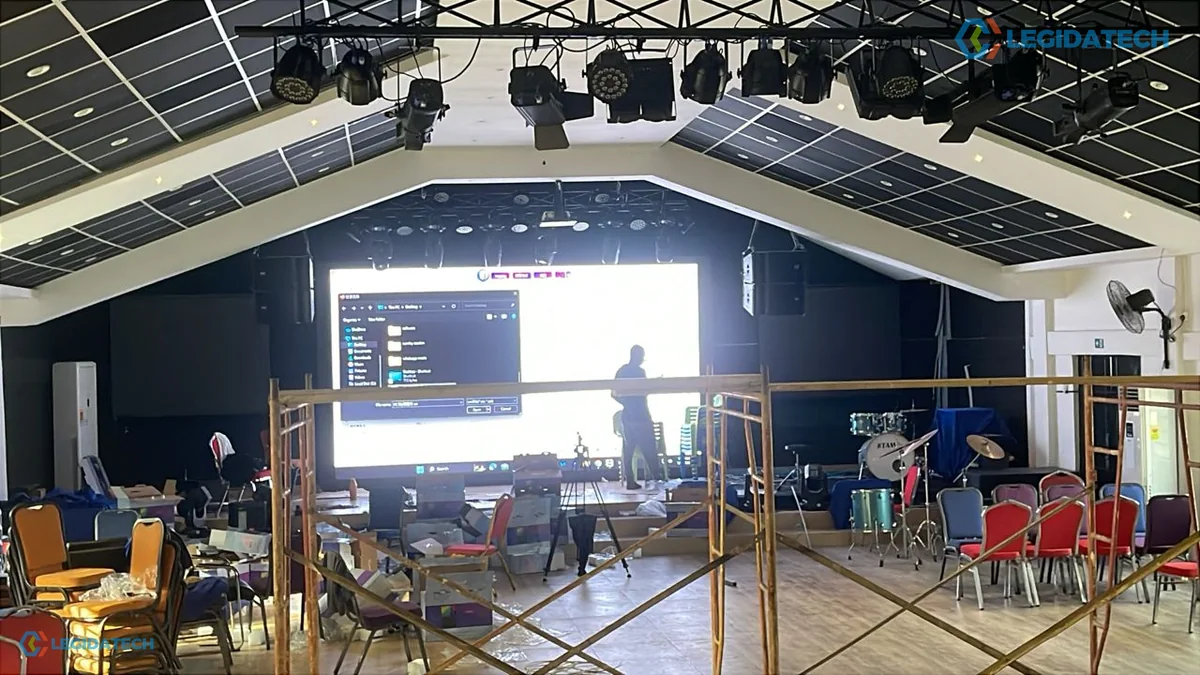
Our fixed-installation church series is specified around exactly this workflow, and the Ehonor series for church fixed installation page lists the cabinet options and service access for each size.
Where Do Church LED Screens Actually Fail?
Quick Answer: Power supplies and module damage account for most church wall failures, and both are inexpensive to prevent with branded power units and a small spare-parts kit.
After-sales records across LED brands point to the same two failure families. Switching power supplies inside the cabinets are the first component to age; undersized or unbranded units fail earlier, often mid-service, and take a whole cabinet block dark. The second family is physical damage to modules — a ladder, a prop, a cleaning cloth pressed too hard.
Neither failure is expensive when prepared for. Standard cabinet power supplies accept 100-240 V AC at 50/60 Hz with rated output commonly between 150 W and 400 W; asking for the brand and rating in writing is the lowest-cost insurance in the whole project. A spares kit of three to five percent of the screen area in modules, one or two power supplies and a spare receiving card covers the realistic failure set for the first three years.
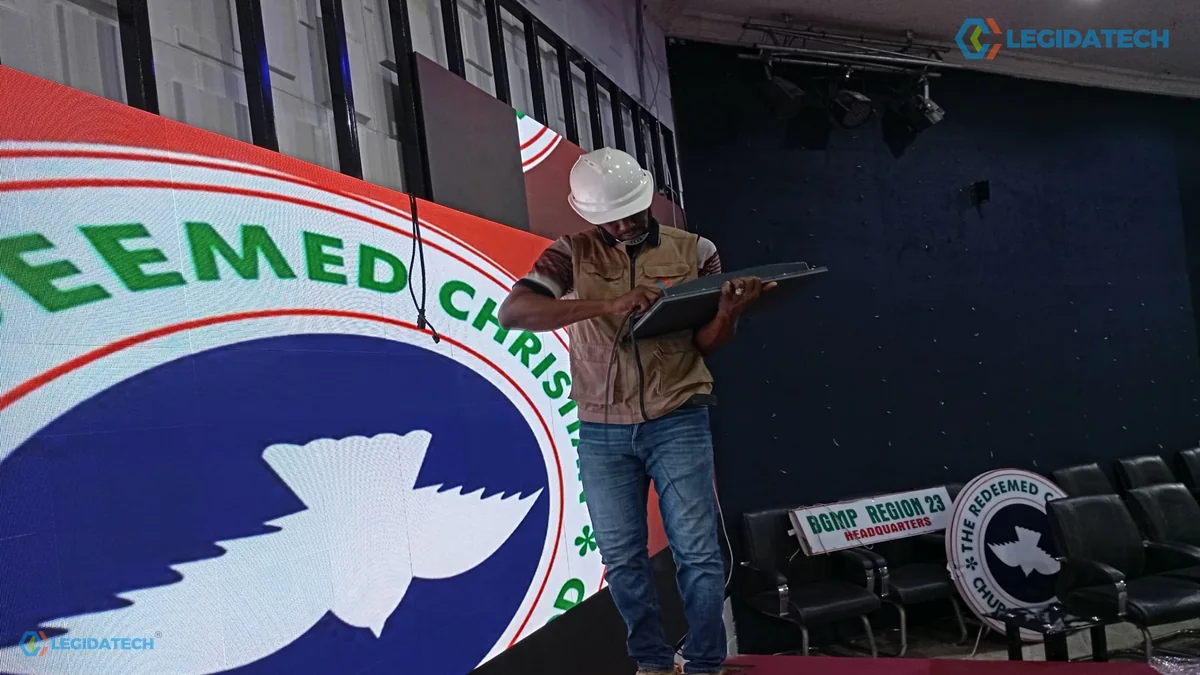
LED beads themselves are rated for roughly 80,000 to 100,000 hours of operation, which is decades of Sunday services at typical usage. The components around them are what you will replace, so the warranty conversation should be about response time and spare availability rather than the headline number of years.
How Do You Vet a Church LED Screen Supplier?
Quick Answer: Verify factory status, church case evidence, component brands, warranty terms in writing, and spare-part lead time; a supplier who cannot produce all five is a reseller.
Six documents to keep in your project file
Buying a church screen from a trading company is not automatically wrong, but it changes who owns the risk. Six checks separate a manufacturer from a middleman, and each one produces a document you can keep in the file for your board:
- Factory proof. Ask for a short video walkthrough of the production floor and a business licence matching the company name on the quote.
- Church-specific evidence. Ask how many church projects they have delivered, in which countries, with photos per project. Vague answers here usually mean none.
- Component disclosure. Request the LED bead brand, driver IC grade, power supply brand and receiving card model in writing on the quotation.
- Warranty terms. Ask what is covered, what voids it, whether advance replacement is included, and who pays freight on a claim.
- Spare-part lead time. A two-week module delivery is acceptable; a two-month one means the screen stays dark through a season.
- Certification documents. CE and RoHS declarations, plus UL-certified configurations where North American projects require them, should be produced on request rather than promised.
Our own terms, for comparison: church screens carry a two-year warranty covering dead pixels, driver IC failure and power supply failure, with advance replacement on module and power-supply claims and freight responsibility written into the quotation. Spare modules and power supplies are quoted with the screen so the church holds them before the first service. Every cabinet runs a 72-hour aging test plus brightness-uniformity and per-point checks before packing, and test records are available on request.
When we quote a church project, the proposal includes the component list, the cabinet and module layout, the structure assumptions and the warranty terms, because those are the four items churches compare badly when left to a bare price. You can see how our own projects were delivered on the LEGIDATECH about page and in the church project video library.
Real Church LED Screen Projects Across 12 Countries
Quick Answer: Our 44 church installations are concentrated in Nigeria (17), Ghana (8) and the UK (7), with a further nine countries including the USA, Ireland and Kenya.
Case evidence is the part of a proposal that most persuades a board, so it should be specific: country, size, pitch and the constraint that shaped the design. The table below summarises our church project records by country.
| Country | Church projects | Note from the records |
|---|---|---|
| Nigeria | 17 | Largest cluster; includes a 33.8 m² P3.9 wall at 9 x 3.75 m |
| Ghana | 8 | Includes a 33.2 m² P2.5 wall at 8.64 x 3.84 m in Tema |
| United Kingdom | 7 | Includes a 24.6 m² ultra-wide wall at 10.24 x 2.4 m |
| United States | 4 | Screens from 8 m² to 18.4 m² |
| Uganda, Ireland, Kenya, Tanzania, Chile, Mexico, Philippines, Zimbabwe | 1 each | From 11.1 m² to 24 m²; several in humid or high-dust climates |
The pattern worth noting is that church screens cluster in the 8-13 m² band regardless of country, because a 300-500 seat sanctuary has broadly similar geometry whether it is in Lagos, Accra or London. Where projects break the pattern, the reason is almost always a balcony, a multi-camera IMAG setup, or a room that doubles as a community hall.
This table counts the 44 projects our database tags as church installations. A few additional church projects are documented individually rather than in that tag set — the 46.7 m² Accra wall above, a 27.6 m² P2.5 wall in Cameroon and a 27.6 m² P2.5 wall in Brazil — which is why you may see slightly different totals elsewhere on this site.
One recent Ghana project is documented in detail: an installation for a church in Accra, with the site conditions and final configuration written up on the Ghana church case page. If your country is Nigeria, the dedicated Nigeria church LED screen guide covers local pricing, port clearance and delivery times in more depth than this global guide can.
How Do Delivery, Installation and Power Work?
Quick Answer: A fixed church wall typically ships in 15-25 days, installs in 2-4 days on site, and needs a 100-240 V supply and a load-bearing wall or truss.
Churches often imagine installation as the hard part, but the schedule risk sits earlier: structure decisions and electrical readiness. The wall itself arrives as pre-assembled cabinets with modules, receiving cards and power supplies already fitted, so on-site work is alignment, wiring and commissioning rather than assembly from parts.
- Site preparation. Confirm the wall or truss can carry the load, and decide the mounting offset; front-service walls can sit close to the wall, rear-service walls need 60-80 cm of access.
- Power. Cabinet power supplies run on 100-240 V AC at 50/60 Hz; the electrical plan needs dedicated circuits and a safe isolation point, not an extension lead from the sound desk.
- Signal runs. A standard network cable run reaches about 100 m; beyond that the installer moves to fibre, where single-mode links reach far further. This matters in long halls where the control position is at the back.
- Commissioning. Brightness, colour uniformity and scene presets are set on site, and volunteers are trained on the scene buttons before handover.
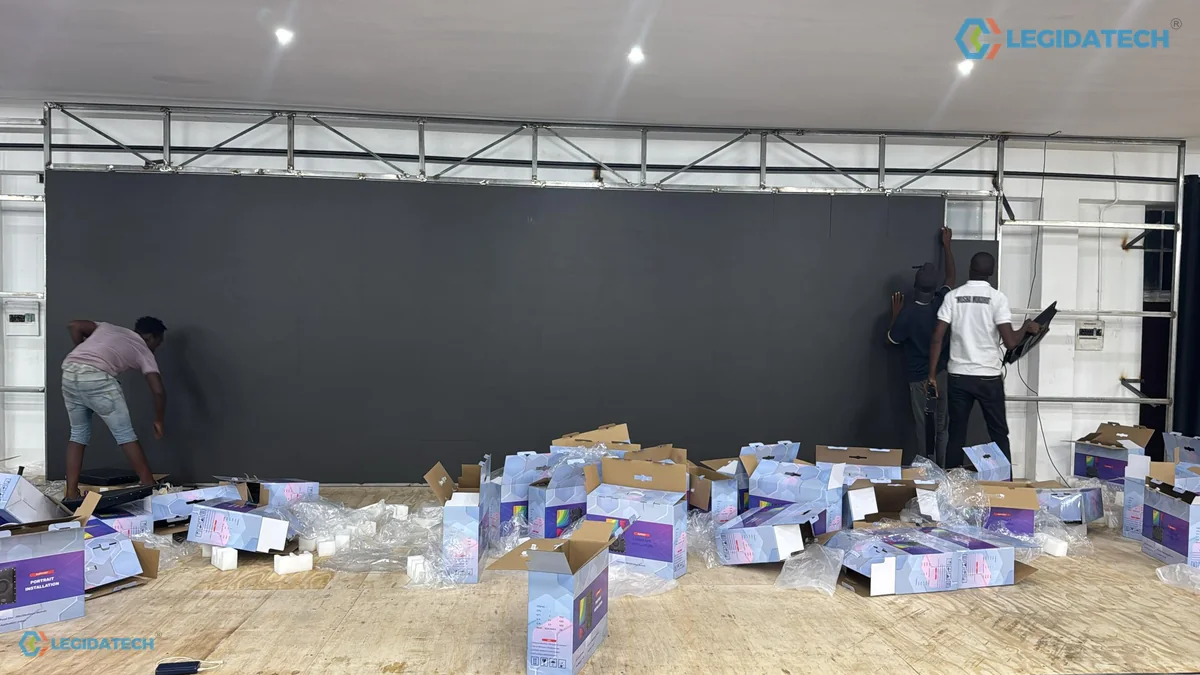
Shipping cost and import duty vary enough by country that they deserve their own line in the budget rather than a percentage guess. If you are in West Africa, our team can quote freight and clearance alongside the screen; for other regions, ask for the freight term you want (FOB or CIF) so the landed cost is comparable.
Seven Sanctuary Screen Buying Mistakes
These are the mistakes we see most often when a church asks us to review quotes from another supplier, and each one has a cheap fix at the specification stage.
- Sizing from the platform instead of the room. Measure to the furthest seat first, then choose the wall size that reads there.
- Buying a finer pitch than the room needs. P1.8 in a room whose front row is 6 m away buys resolution nobody can see.
- Comparing total prices instead of line items. A lower total that excludes structure, control or installation is not lower.
- Ignoring the camera. A wall that looks perfect in person can strobe on a livestream if the refresh rate is too low.
- No spare modules. A dark square during a service is entirely avoidable for the cost of a few modules.
- Unbranded power supplies. The lowest-cost component in the quote is the one most likely to take the wall down.
- Warranty by headline, not by terms. Five years of return-to-factory shipping can serve a church worse than two years of advance replacement.
If you have a quote in hand, the fastest way to test it is to ask for the same six disclosures listed in the supplier section above. A supplier who answers in writing is a supplier worth continuing with. If you would rather have ours, send your sanctuary dimensions and seating layout and our engineering team will return a sizing and cost estimate with the assumptions stated.
Frequently Asked Questions About Church LED Walls
How much does a church LED screen cost?
Indoor church walls typically run from about USD 400 to 900 per square metre depending on pixel pitch, and structure, control and installation add roughly 15-25 percent on top. A 10 m² P2.5 sanctuary screen therefore usually lands in a range rather than at a single price. Send your dimensions and room height and we will return an indicative figure with the assumptions written out.
What size LED screen does a church need?
Size follows the furthest viewer and the seat count. The church projects tagged in our records range from 1.8 m² to 33.8 m² with a median of 9.8 m², which matches a 300-500 seat sanctuary. Rooms under 150 seats usually need 2-6 m², while rooms over 700 seats typically start at 20 m².
Which pixel pitch suits a church sanctuary?
P2.5 fits most sanctuaries because it stays clean from about 2.5 m and reads well at 7.5 m. Of the church projects in our records that note a pitch, P2.5 accounts for 23 of 25. Balconies or very long rooms often move to P3.0-P3.9 to control cost without losing legibility at the back row.
Is an LED wall better than a projector for church?
For rooms with stage lighting, windows or livestream cameras, yes: an LED wall holds contrast and never needs a lamp. For a small chapel with controlled lighting and a tight budget, a projector can still be the sensible choice, and the money saved is often better spent on audio, seating or children’s ministry space.
Can volunteers operate a church LED screen?
Yes, when the wall accepts the existing presentation computer’s output directly and scene presets are configured. Volunteers keep using the software they already know, and content changes happen in the presentation app rather than in the screen’s control software. We train the media team on the scene buttons during commissioning and leave a one-page operating sheet with the church.
Will a church LED screen flicker on camera?
Only if the refresh rate is too low for the camera shutter. High-refresh configurations at 3,840 Hz and above are the standard answer for filmed and livestreamed services, and the difference is invisible to the congregation but obvious on the stream. If you already livestream, tell the supplier before the quote is built, not after.
How long does a church LED screen last?
LED beads are rated for roughly 80,000 to 100,000 hours. In practice the wall stays in service well beyond ten years, with power supplies and occasional modules replaced along the way. That is why a small spare-parts kit matters more than the headline lifespan figure: a module on site turns a dark square into a twenty-minute fix.
How much power does a church LED screen need?
Cabinet power supplies typically run 100-240 V AC at 50/60 Hz with rated output between 150 W and 400 W each, so a mid-size sanctuary wall usually needs dedicated circuits rather than a building upgrade. Actual consumption depends on pitch, brightness setting and content mix; we provide a per-cabinet load schedule with every quotation.
What are the big screens in churches called?
They are usually called LED walls or LED video walls, and churches also refer to them as IMAG screens when they carry the live camera feed. The technology differs from an LCD video wall: an LED wall is built from modular cabinets with self-emissive pixels rather than LCD panels, which is why it stays bright in a lit sanctuary.
What is the difference between an LED wall and a video wall?
An LED video wall is made of LED cabinets with self-emissive pixels, while the phrase “video wall” is also used for LCD panels tiled together in a grid. LCD walls show visible seams, are limited in size by their bezels and lose contrast under stage lighting. LED walls have no bezels, scale to any size and are the usual choice for sanctuaries.
How long does delivery and installation take?
Production typically runs 15-25 working days depending on size and configuration, then sea freight adds several weeks depending on destination. On-site installation for a fixed wall is usually 2-4 days including alignment, wiring, commissioning and volunteer training. If you have a fixed date such as an Easter or Christmas service, tell us early because freight is the variable we cannot compress.
Why are LED video walls so expensive?
Because price scales with pixel density: a given area at P1.86 needs roughly twice the LED beads and driver channels of the same area at P2.5, and structure, control and installation add another 15-25 percent. Most of the cost questions we receive are really pitch questions in disguise: right-size the pitch and the budget usually works.
Next Step: Turn This Buying Guide Into a Specification
A sanctuary LED wall is a long-term piece of infrastructure, and the churches that get it right are the ones that arrive at the quotation with numbers instead of adjectives: room dimensions, furthest seat distance, seat count, content plan and a camera decision. With those five inputs, the size, pitch and budget questions in this guide collapse into a single configuration, and comparing suppliers becomes a matter of documents rather than impressions.
If you would like that configuration built for your building, send us your sanctuary dimensions, seating layout and service style, and our engineering team will return a size, pitch and indicative budget with the reasoning attached — or request a phone call and we will walk through your room together. You can also browse the church LED screen range and the stage backdrop size options to see how the sizes map to real installations.


