


Church LED Screens in the UKPrice bands in dollars, six delivered walls in Derby, Swindon, London, Manchester and Luton, and what a UK electrician will ask for before the screen is signed off
What a UK Church Wall Costs, in One Paragraph
An indoor P2.5 church wall in the UK runs about US$500–800 per m² factory-direct, outdoor P4 about US$450–700 and outdoor P10 about US$200–320. A 15 m² sanctuary wall therefore sits in a US$7,500–12,000 equipment band, before freight, import VAT and duty, the steel frame, the electrician and installation. We quote in dollars because that is what the factory and the forwarder invoice in; the budget the church approves is in pounds, and the exchange rate is the one thing on this page nobody can fix in advance.
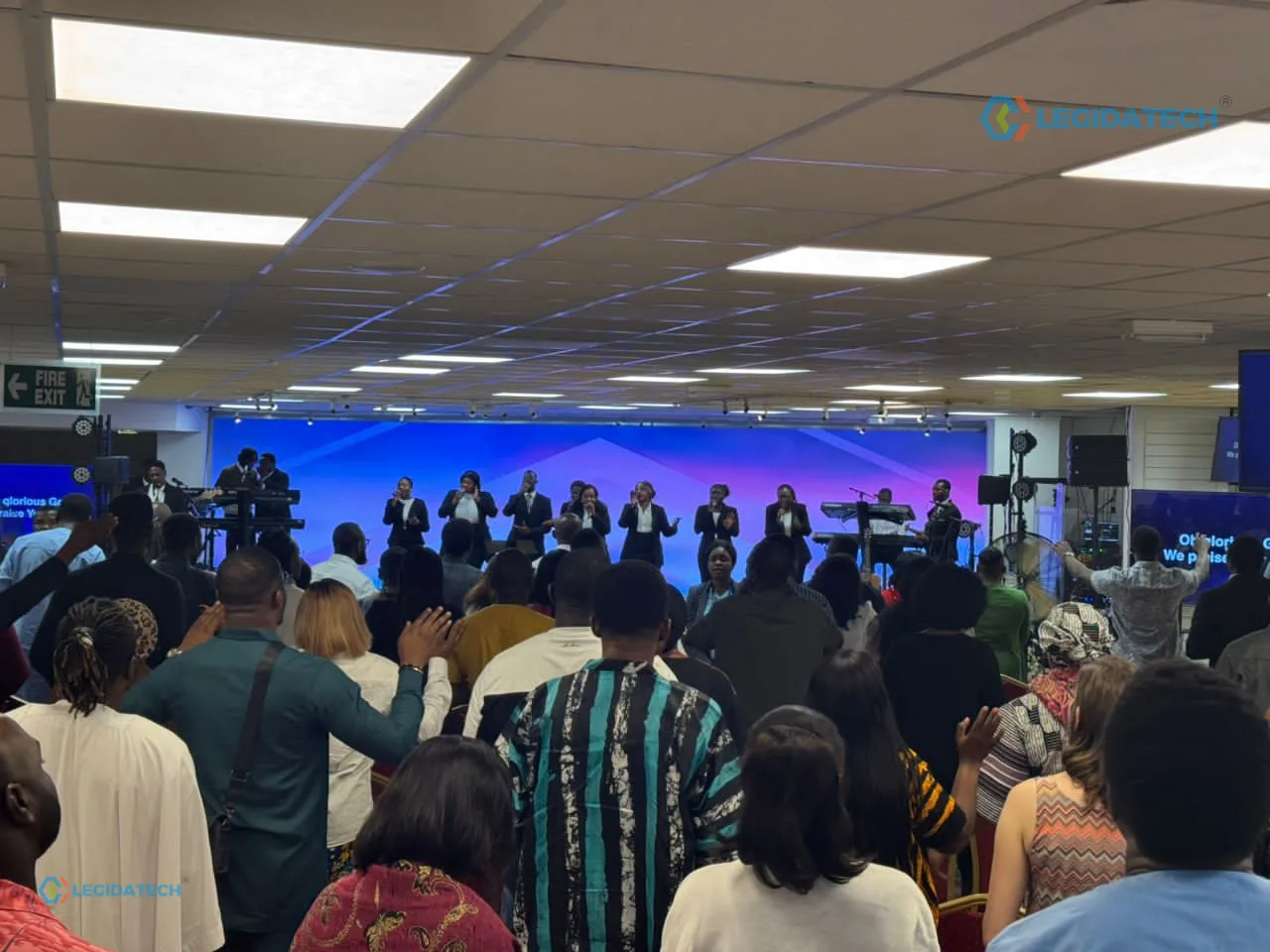
Six sites across England appear in our project files: RCCG Derby, RCCG Swindon, Dunamis London, Dunamis Manchester, RCCG in the UK and New Testament Assembly in Luton. All six are P2.5 indoor walls between 7.4 m² and 24.6 m². That is a narrow enough range to be honest about: the UK work we hold is sanctuary front walls and wide stage bands, not outdoor signage, and everything below reflects that.
Price Bands, and the Three Lines That Are Not the Screen
A UK committee usually sees a single “supply and install” figure and has no way to see what is inside it. These are the bands we work with, and the three lines that sit outside them.
| Pixel pitch | Where it is used in a UK church | Indicative band (US$/m²) | Typical cabinet |
|---|---|---|---|
| Indoor P2.5 | Sanctuary front wall, 15–25 m viewing depth | 500 – 800 | 320×160 mm module, front service |
| Indoor P3.91 | Stage backdrop, mixed seating, tighter budgets | 450 – 700 | 500×500 or 500×1000 mm |
| Outdoor P4 | Street-facing notice board or entrance sign | 450 – 700 | 960×960 mm, IP65 |
| Outdoor P10 | Roadside sign read from 30 m and beyond | 200 – 320 | 960×960 mm, IP65 |
Indicative factory-direct ranges for standard configurations, reviewed November 2026, excluding freight, import VAT and duty, steel structure, control system and installation. These are our own bands for standard builds, not a competitor price list, and not a quotation.
The three lines that surprise UK buyers are the frame, the electrician and the access equipment. A steel frame fabricated in the UK is priced by a local fabricator and is not part of any screen quotation we issue; the electrical work has to satisfy the wiring regulations and ends with a certificate the church keeps; and a wall that needs a scissor lift inside a sanctuary needs the lift in the budget from the start.
The pitch bands themselves, with whole-screen budgets for four room sizes, are on our church LED screen price guide, and what a wall costs to run after year one is on the maintenance cost page.
What We Have Delivered in the UK
Six sites, seven records in our files — the London project appears twice because our files hold two entries for the same layout: two 2.88 × 2.88 m panels plus a 6.08 × 2.88 m band. Resolutions are calculated on a 320×160 mm module at P2.5.
| Church | City | Wall size | Resolution | Year |
|---|---|---|---|---|
| RCCG Derby | Derby | 10.24 × 2.4 m (24.6 m²) | 4,096 × 960 | 2025 |
| RCCG Swindon | Swindon | 8 × 1.92 m (15.4 m²) | 3,200 × 768 | 2025 |
| Dunamis International Gospel Centre | London | 2 × 2.88 × 2.88 m plus a 6.08 × 2.88 m band | 2,432 × 1,152 on the wide band | 2025 |
| Dunamis International Gospel Centre | Manchester | 3.2 × 2.4 m (7.7 m²) | 1,280 × 960 | 2025 |
| RCCG (UK) | — | 2.88 × 2.88 m (8.3 m²) | 1,152 × 1,152 | 2025 |
| New Testament Assembly | Luton | 3.84 × 1.92 m (7.4 m²) | 1,536 × 768 | 2026 |
Areas are the wall area of the main screen. The London project is recorded twice for the same layout — two square panels plus one wide band — not two separate installations.
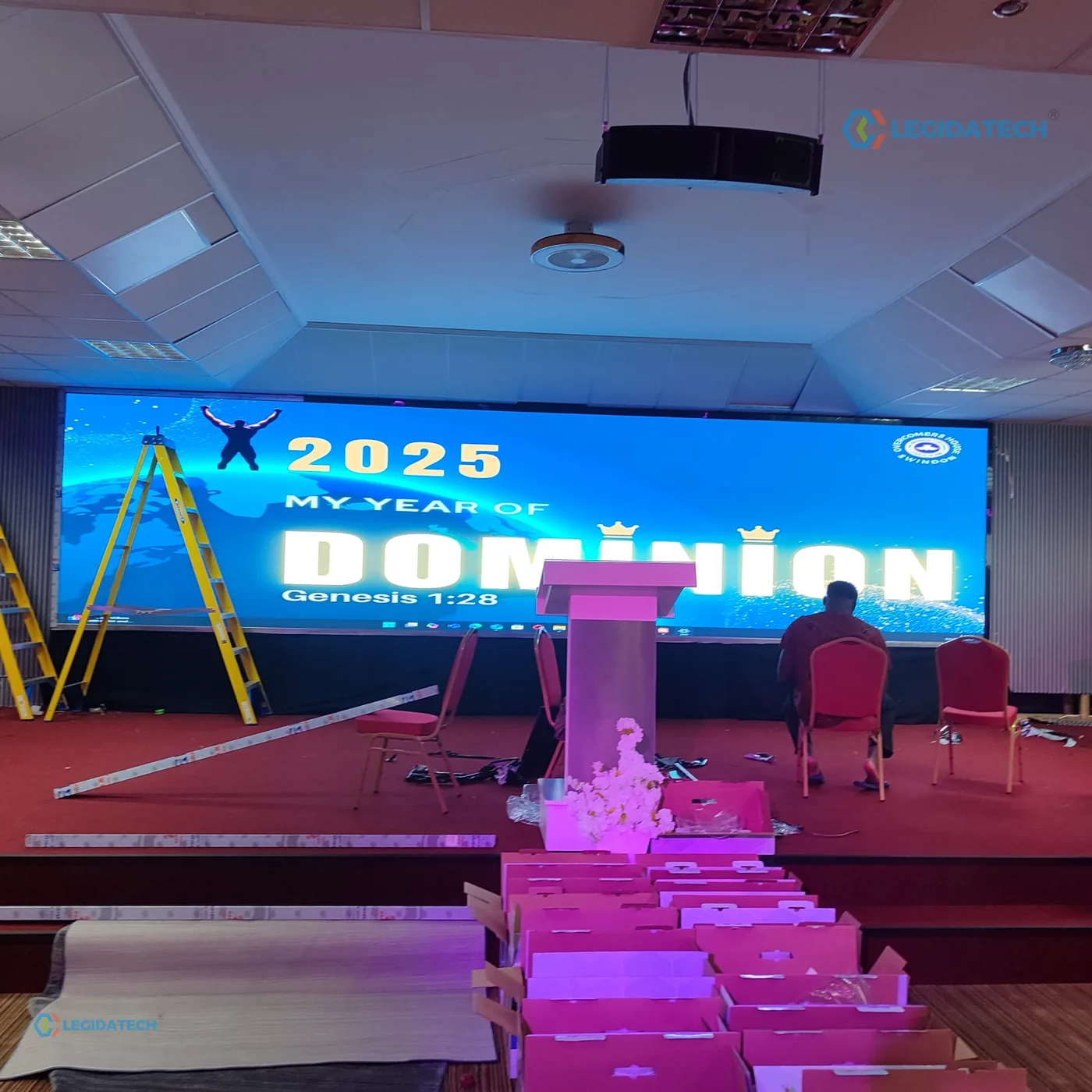
RCCG Swindon — 8 × 1.92 m at P2.5 across the front of the hall.
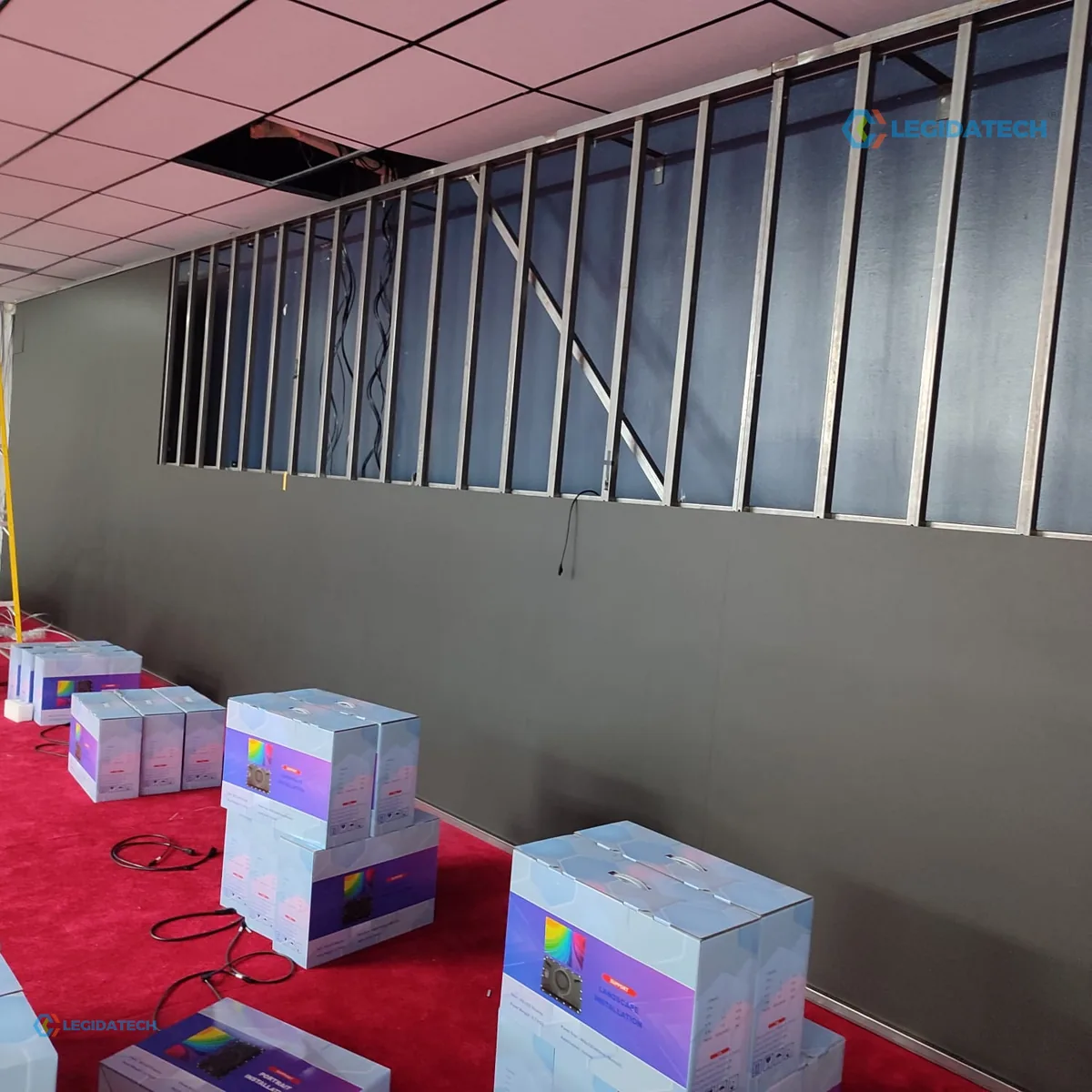
London, the morning the cabinets arrived: boxes under the wall, ladder in the aisle.
Compliance: What a UK Electrician Will Ask For
The screen is one part of an electrical installation, and the installation is what has to be signed off. Four things come up before every UK handover, and none of them are things a supplier can wave away with a datasheet.
- A certificate at the end. The electrical work in the building — the dedicated circuit, the isolator, the earthing — is certified by the electrician who did it. Ask for that certificate, not a screen specification, because it is what the building’s insurer and the church’s trustees will look at.
- Product marking and test evidence. The cabinets and power supplies should arrive with CE documentation, and for the Great Britain market a UKCA declaration where the supplier claims it. Ask for the actual document, not a logo on a brochure page.
- Where the isolator goes. A service engineer has to be able to kill the wall without walking on the platform mid-service. Decide the isolator position with the electrician before the frame is fixed, because afterwards it is a wall-crawling job.
- Fire strategy in the room. A large screen above a stage changes what a fire officer can see and where heat goes. If the church is a listed or older building, the frame fixing into historic fabric needs a method statement, and that is a document the church produces, not the screen supplier.
The one line worth adding to a UK tender. “The supplier shall provide the electrical load schedule, the isolator position drawing and the cabinet earthing arrangement for the installing electrician.” A supplier who has commissioned a UK wall can produce all three in a day; one who has only shipped containers cannot.
Delivery and Clearing into the UK
Container freight from Shenzhen to a UK port, then either a return load to the church or a pallet delivery. The sequence we run is the same everywhere, with the UK lines changed:
- Survey and drawings. Wall width, height, the band available above the platform and the module count, so the quotation and the delivered area agree.
- Production. Two to three weeks for a standard indoor cabinet.
- Packing. Export cartons with the module count marked on each box and a packing list that matches the invoice line by line.
- Freight. Charged by volume; the carton count moves this line, not the weight.
- Customs and VAT. A UK customs entry needs a GB EORI number and a commodity code; import VAT is charged at the standard rate on the value of the goods plus freight and duty. Confirm the code and the rate with your broker before the container sails — a screen classified one way and a spare-parts shipment the other can differ by more than the freight.
- Delivery and installation. Either your contractor with our drawings, or a supervised crew. The electrician connects and certifies.
One UK-specific point about the building rather than the port: many of the sanctuaries in our files are converted warehouses or 1970s halls with a suspended ceiling and a blockwork wall behind it. The frame has to be tied into the blockwork, not into the ceiling grid, and a survey photograph of the wall with the ceiling in shot settles that before the wall size is fixed.
Who Signs the Contract in the UK
The UK market has the deepest bench of church AV integrators of any market we ship to, and that is the main thing that distinguishes it from Nigeria or Ghana. A UK church usually has three real options: a local AV integrator who sells the screen inside a design, install and service contract; a factory that ships equipment with drawings while a local contractor and electrician do the work; or a rental house for a conference or a one-off outreach.
The integrator route costs more per square metre and buys you a named engineer in the country. The factory route is cheaper on equipment and leaves the installation risk with the church. On a UK wall the difference is rarely the screen itself — it is who answers when a module fails on a Saturday, and whether the frame and the electrical work were designed together.
Who the named suppliers are, what each is good at and where each is weak is on our Top 10 church LED screen suppliers in the UK page.
What we do not have in the UK. No warehouse and no service team. UK walls ship from Shenzhen against a signed drawing and are installed by your contractor or a supervised crew, with spares held on site and support remote. If a supplier claims a UK stock holding, ask for the postcode and go and look at it.
Six Questions UK Church Committees Ask
How much does a church LED screen cost in the UK?
Indoor P2.5 is about US$500–800 per m² factory-direct, so a 15 m² wall is roughly US$7,500–12,000 in equipment. Import VAT, duty, freight, the steel frame, the electrician and installation are additional, and on a UK project the frame and electrical lines are the two that most often exceed the first estimate.
Do we need UKCA marking?
For the Great Britain market, UKCA is the marking used for many electrical products, and CE is still recognised in a range of cases while the two regimes run in parallel. Rather than argue the regime, ask the supplier for the declaration of conformity it actually holds and give it to your electrician; if a supplier cannot produce one document, that is the answer to the question.
Can our own electrician and contractor do the installation?
Yes, and several of the UK walls in our files were installed that way. We supply the frame drawing, cabinet layout, wiring schedule and load schedule, and stay reachable through commissioning. The contractor takes the frame and the electrician certifies the circuit; the screen arrives as modules and cabinets, not as a finished appliance.
Which pitch suits a UK sanctuary?
The depth of the room decides it, not the brochure. Under 15 m, P3.91 usually saves money with no visible difference from the middle rows back. Between 15 and 20 m, P2.5 keeps lyric text crisp to the last row, which is why every UK wall in our files is P2.5. Beyond 20 m, a larger wall buys more legibility than a finer pitch.
How long from order to a working wall?
Two to three weeks of production, then sea freight and a customs entry, then installation and certification. The two legs that carry the uncertainty are the sailing and the customs entry, so ask for freight as a dated number rather than “included”, and get the commodity code agreed with your broker early.
What spare parts should we hold?
Two or three modules, one power supply and one receiving card, roughly three to five per cent of the screen value. On the 320×160 mm module we ship, a module change is magnetic and front-service, so a volunteer can do it from the front of the wall without scaffolding — which matters in a room where a lift costs more than the module.
What We Need Before We Can Price a UK Wall
Four numbers and one photograph: the wall width, the wall height, the distance from the wall to the front row, and the postcode. A photograph that includes the ceiling and the distribution board tells us more than a paragraph, because on UK projects the frame fixing and the electrical supply are what decide the final cost.
LEGIDATECH church LED screens for the UK — factory-direct, front service. Part of the church LED screens range; see also the USA, South Africa and Nigeria, and the Top 10 UK suppliers comparison.