


Church LED Screens in the USAPrice bands in dollars, four delivered church sanctuaries across Pennsylvania, Maryland and Florida plus a fourth site, and the duty, UL and service questions a US committee should ask before signing
What a US Church Wall Costs, in One Paragraph
An indoor P2.5 church wall in the USA runs about US$500–800 per m² factory-direct, which is roughly US$46–74 per square foot, and outdoor P10 about US$200–320 per m². An 18 m² sanctuary wall (about 200 sq ft) therefore sits in a US$9,000–14,500 equipment band, before freight, customs duty, the steel frame, permits, the electrician and installation. A US integrator quoting the same wall will normally land between two and three times that equipment band, because the equipment is the small part of what a US church actually buys.
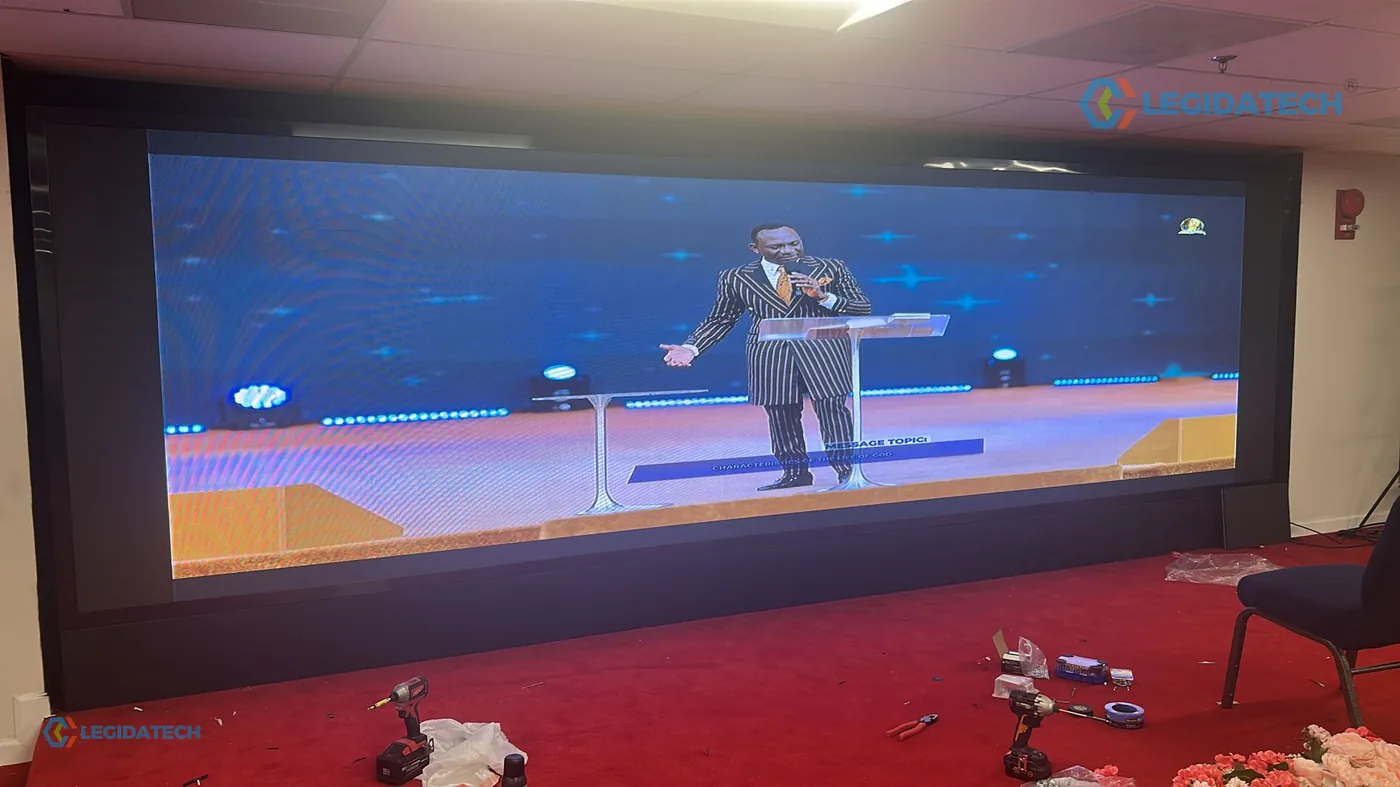
Our US files hold six records, four of them church sanctuaries: Maranatha Scranton in Pennsylvania, Dunamis in Lanham, a church in Orlando, and Christ Embassy. The other two are commercial — a card shop in Arlington, Texas and a DJ booth on a stage in Washington — and we count them separately rather than folding them into a church number.
The point of this page is not to claim more US work than we have. It is to answer the questions a US building committee asks that a UK or Nigerian committee does not: who imports it, who carries the bond, what the electrical inspector wants to see, and who answers the phone after the warranty conversation.
Price Bands, and Why the Landed Cost Moves
The equipment band is the same one we quote in every market, because the factory price does not change with the destination. What changes is everything after the factory door.
| Pixel pitch | Where it is used in a US church | Indicative band (US$/m²) | Typical cabinet |
|---|---|---|---|
| Indoor P2.5 | Sanctuary front wall, 15–25 m viewing depth | 500 – 800 | 320×160 mm module, front service |
| Indoor P3.91 | Stage backdrop and youth rooms, tighter budgets | 450 – 700 | 500×500 or 500×1000 mm |
| Outdoor P4 | Entrance sign or monument sign, close viewing | 450 – 700 | 960×960 mm, IP65 |
| Outdoor P10 | Roadside sign read from 30 m and beyond | 200 – 320 | 960×960 mm, IP65 |
Indicative factory-direct ranges for standard configurations, reviewed November 2026, excluding freight, customs duty, steel structure, control system, permits and installation. These are our own bands for standard builds, not a competitor price list, and not a quotation.
| Line | How it is charged | What to check |
|---|---|---|
| Screen and cabinets | Per m², by pitch | Area must reconcile with the cabinet count |
| Ocean or air freight | Per cubic metre, or per kilogram by air | Carton count; air freight only pays for spares |
| Customs duty | Percent of value, by commodity code | The code on the entry and whether an additional tariff applies to Chinese origin goods |
| Customs bond and broker | Per entry, plus an annual bond | Who is the importer of record — the church or the supplier |
| Steel frame | Fabricated locally | Load, fixing method, and whether a lift is needed |
| Permit and inspection | Local authority fee | Outdoor signs usually need a permit; indoor walls often need an electrical permit |
| Installation labour | Per crew and days | Scaffolding or lift included, and who terminates the power |
Two of those lines are argued about on almost every US project. The first is the importer of record: if the church is the importer it needs a bond and a broker relationship, and it carries the compliance obligation; if the supplier is, the church pays a landed price and loses visibility of the duty line. Either works, but the choice has to be made before the invoice, not after the container arrives.
The second is the frame. Steel fabricated in the US is priced by a local fabricator and is not part of any screen quotation we issue, which means a US church can take that number to three fabricators and treat it separately — usually the single largest saving available on the project.
The pitch bands behind these numbers, with whole-screen budgets for four room sizes, are on our church LED screen price guide, the cabinet itself is described on the Ehonor fixed church screen page, and what a wall costs to run after year one is on the maintenance cost page.
What We Have Delivered in the USA
Four church sites, all P2.5 indoor, between 8 m² and 18.4 m². Resolutions are calculated on a 320×160 mm module. This is the thinnest country file we publish, and the photographs are the reason: two of the four sites produced one usable image each.
| Church | State | Wall size | Resolution | Year |
|---|---|---|---|---|
| Church sanctuary, Orlando | Florida | 5.76 × 3.2 m (18.4 m²) | 2,304 × 1,280 | 2025 |
| Christ Embassy | — | 4.8 × 2.4 m (11.5 m²) | 1,920 × 960 | 2024 |
| Dunamis International Gospel Centre | Maryland (Lanham) | 5.76 × 1.6 m (9.2 m²) | 2,304 × 640 | 2026 |
| Maranatha church, Scranton | Pennsylvania | 4.16 × 1.92 m (8 m²) | 1,664 × 768 | 2026 |
Areas are the wall area of the main screen. Christ Embassy is recorded without site photographs, which is why it has no image below.
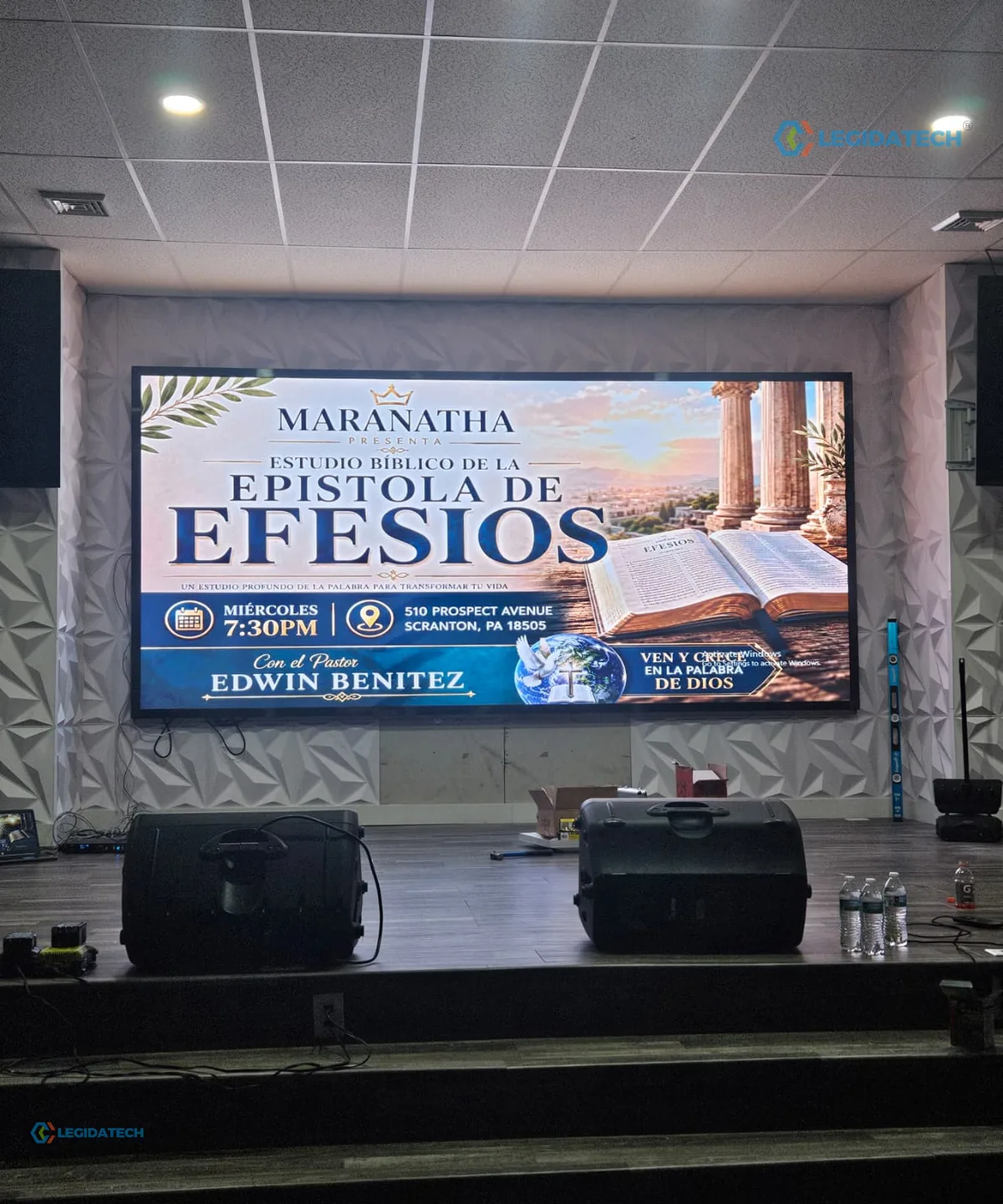
Maranatha, Scranton — 4.16 × 1.92 m at P2.5, the whole wall inside one image.
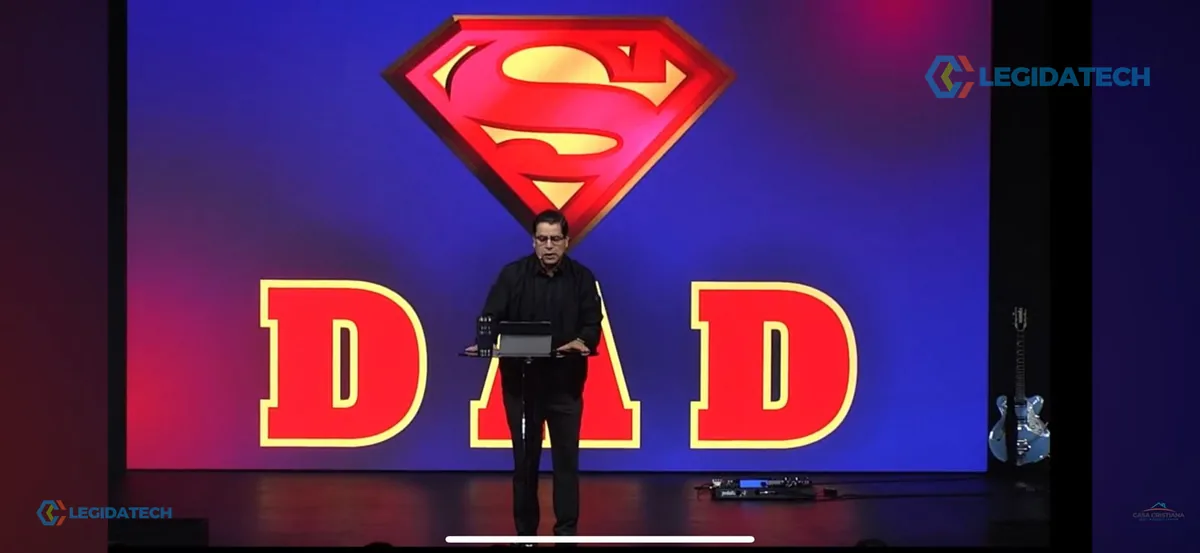
Orlando — 18.4 m², the largest US wall in our files.
UL, FCC, Permits: What a US Installation Actually Needs
A US project reaches handover through three gates that a European or African project does not have in the same form. None of them are marketing points; they are the reason a US integrator’s quote is structured the way it is.
- Electrical inspection. The circuit feeding the wall is installed and inspected under the locally adopted electrical code, which in most US jurisdictions means the National Electrical Code as amended by the state or city. The inspector looks at the installation, not the screen: conductor sizing, disconnect means, bonding, and whether the equipment is listed.
- Listing and EMC documentation. Equipment intended for permanent installation is expected to be listed by a recognised testing laboratory, and the power supplies should carry the corresponding file reference. Separately, the control electronics have to meet the FCC’s unintentional-radiator rules. Ask for the listing file number and the FCC declaration; a datasheet with a UL logo is not either of them.
- Sign permits for anything outdoors. An outdoor church sign is a sign to the local authority: size, height, setback, illumination and, in many places, a separate electrical permit. That process runs on the authority’s clock, not the supplier’s, so it should start before the container is booked.
Ask for the paperwork before the price. A US supplier who has completed permanent installations can produce a listing file reference, an FCC declaration and a sample permit drawing the same day. A supplier who cannot is quoting you a screen, not an installation.
Importing From China in 2026: Duty, Broker and Bond
US-bound screens are imported goods, and the import is a separate transaction from the purchase. Three things decide what lands:
- The commodity code on the entry. LED display modules and finished displays have been classified under different headings depending on whether they arrive as modules, as assembled cabinets, or as a complete unit with a controller. The code decides the duty rate, so it should be agreed with the broker in writing before the invoice is issued.
- Additional tariffs on Chinese-origin goods. Since 2018 the US has applied additional tariff lines to a large share of Chinese-origin electronics, and the lists and rates have changed more than once. We do not publish a percentage, because any number we printed would be wrong within a quarter: ask your broker what applies to your code on the date of entry, and treat the answer as a budget line.
- Who is the importer of record. A church importing directly needs a customs bond and a broker, and takes on the compliance obligation. Buying landed from a US entity moves that work — and the risk — to the seller, at a price.
None of this is exotic, but all of it has to be decided early. The projects that go wrong are the ones where the container sails before anyone has agreed the code, the bond and the importer of record, and the duty lands as a surprise four weeks later.
Who Signs the Contract in the USA
The US market is the most mature church AV market in the world. A church here can choose a national worship-focused integrator, a regional AV house, a manufacturer’s US distributor, or a factory that ships equipment while a local contractor and electrician do the work. Each route has a different failure mode.
A national integrator brings a design, an installation crew, a service contract and a price that reflects all three. A regional house is often cheaper and closer, but may be a one-team business. A distributor gives you a US entity to invoice and a warranty address. The factory route is the cheapest on equipment and the most demanding on the church: you become the project manager, and the electrical and permit work is yours to sequence.
For a wall under about 10 m² in a church with a volunteer technical team, the local route is usually worth the premium. For a multi-site denomination buying several walls with its own facilities director, the factory route is viable and materially cheaper. Our own limitation is the obvious one: no US office, no US spares, and installation done by your contractor or a supervised crew.
The named US suppliers, and where each one is weak, are on our US supplier ranking page.
Six Questions US Church Committees Ask
How much does a church LED screen cost in the USA?
Indoor P2.5 is about US$500–800 per m² factory-direct, roughly US$46–74 per square foot, so an 18 m² wall is about US$9,000–14,500 in equipment. Freight, duty, bond, frame, permits, electrician and installation are additional; a US integrator quoting the same wall usually lands at two to three times the equipment band.
Does the screen need to be UL listed?
For a permanent installation the electrical inspector will expect listed equipment, and the power supplies and control gear should carry a listing file reference from a recognised laboratory. Ask for the file number and the FCC declaration rather than a logo, and pass both to your electrician before the wall is scheduled.
Who pays the duty and who is the importer of record?
Either the church or the supplier can be the importer of record. If the church imports, it needs a customs bond and a broker and carries the compliance obligation; if the supplier imports, the church pays a landed price and does not see the duty line. Decide this before the invoice, because it changes both the price and the risk.
Which pitch suits a US sanctuary?
The depth of the room decides it. Under 15 m P3.91 saves money with no visible difference past the middle rows; between 15 and 20 m P2.5 keeps lyric text crisp to the back row; beyond 20 m or with a balcony, size buys more legibility than a finer pitch. All four US walls in our files are P2.5.
Can our own AV contractor install it?
Yes, and on a US project that is often the better structure: a local contractor handles the frame, the electrician handles the circuit and the inspection, and we supply the drawings, the load schedule and remote commissioning support. Roughly half the walls in our files were installed this way.
What happens when a module fails?
Hold two or three modules, one power supply and one receiving card on site, about three to five per cent of the screen value. On the 320×160 mm module we ship, a module change is magnetic and front-service. A wall with no spares waits for an international shipment, and that wait is measured in weeks, not hours.
What We Need Before We Can Price a US Wall
Four numbers and one photograph: wall width, wall height, distance from the wall to the front row, and the state. A photograph that includes the ceiling and the electrical panel tells us what the drawings cannot, and the state tells us which code cycle and which permit office apply.
LEGIDATECH church LED screens for the USA — factory-direct, front service. Part of the church LED screens range; see also the UK, South Africa and Ghana, and the US supplier ranking.