


“Should we get 4K?” is the question that most often turns a straightforward church screen project into an expensive one. The honest answer is that 4K on an LED wall is not a quality setting you switch on — it is a consequence of screen width and pixel pitch, and in most sanctuaries the money buys more value if it goes into size, structure or spares instead. This article works through the arithmetic, then sets out the small number of situations where 4K genuinely pays for itself.
Quick Answer: Usually Not — But It Depends on Three Things
Quick Answer: A 4K LED wall needs about 3,840 pixels across, which at P2.5 means a wall over 9.6 m wide; most 300-500 seat sanctuaries are better served by P2.5 at 4-6 m.
Three inputs decide whether 4K is worth it, and all three are measurable before you talk to a supplier:
- How wide the wall can be. Width, not budget, is the constraint on pixel count.
- How close the nearest viewer sits. If nobody sits within about 3 m, the extra pixels are invisible.
- What the content pipeline can deliver. A 4K wall fed by 1080p cameras and 1080p slides is a 1080p wall with a bigger invoice.
What “4K” Means on an LED Wall
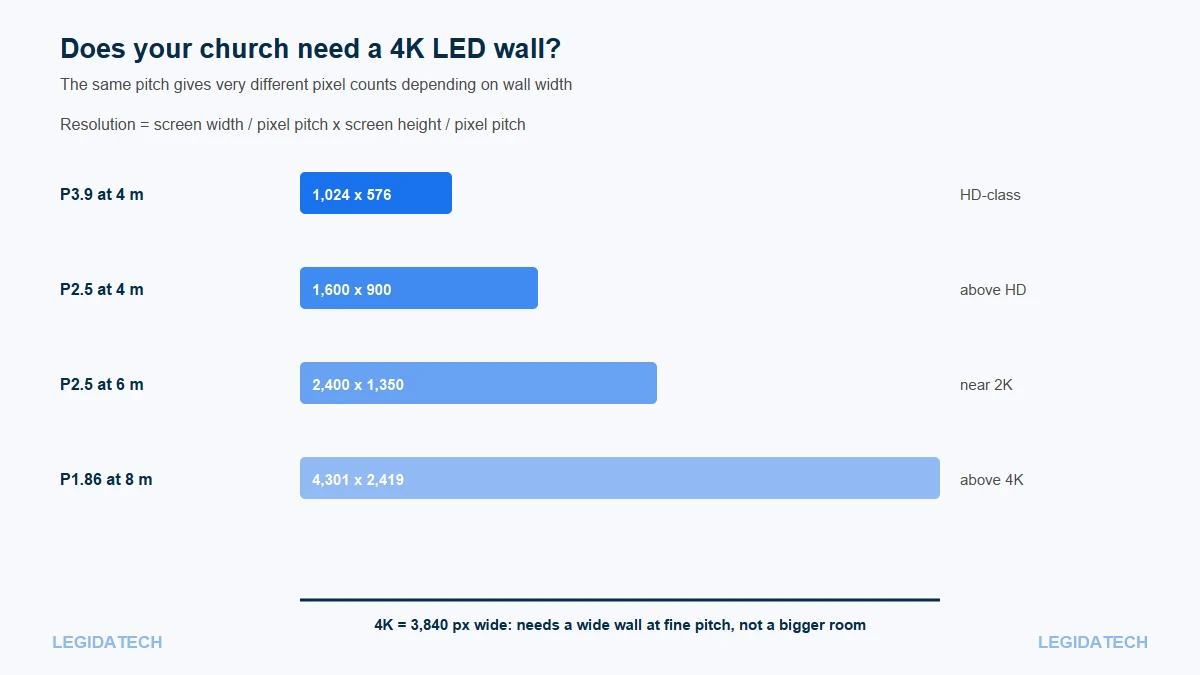
On a television, 4K describes a fixed panel: 3,840 by 2,160 pixels. On an LED wall there is no panel, so the resolution is whatever the cabinets and pitch produce. A wall is 4K when it has roughly 3,840 pixels across, and whether it does depends entirely on how wide you build it and how fine the pitch is.
That is why two churches can both own “a P2.5 wall” and one has 1,920 pixels across while the other has 3,840: the second one is twice as wide. The pitch did not change; the geometry did.
The Resolution Formula
The arithmetic is one division, twice:
- Horizontal pixels = screen width in metres ÷ pitch in metres
- Vertical pixels = screen height in metres ÷ pitch in metres
At P2.5, each pixel is 0.0025 m, so a 4 m wide wall gives 1,600 pixels across and 900 down. A 6 m wall gives 2,400 by 1,350. To reach 3,840 across at P2.5 you need 9.6 m of width — wider than most sanctuary platforms. To reach it at P1.86 you need about 7.1 m, and at P1.5 about 5.8 m.
| Pitch | Width for 1,920 px | Width for 2,560 px | Width for 3,840 px (4K) |
|---|---|---|---|
| P3.9 | 7.5 m | 10.0 m | 15.0 m |
| P2.5 | 4.8 m | 6.4 m | 9.6 m |
| P1.86 | 3.6 m | 4.8 m | 7.1 m |
| P1.5 | 2.9 m | 3.8 m | 5.8 m |
The table makes the trade-off visible: getting 4K at a modest wall width forces a fine pitch, and fine pitch is where the cost curve turns steep, because halving the pitch quadruples the LED beads and driver channels for the same area.
When 4K Actually Pays Off in a Church
There are real cases, and they usually appear in rooms over 700 seats. Our records for those rooms cluster at 20-35 m² and P2.5-P3.9, where the pixel count is set by width rather than by pitch. They are just narrower than the marketing suggests.
Close Front Rows and IMAG
If your front row sits two metres from the platform and you show live camera close-ups, the congregation is effectively inspecting the pixels. At that distance a P2.5 wall starts to reveal its grid, and a finer pitch makes a visible difference. Multi-camera IMAG in a 700-plus seat room is the classic case where the extra resolution earns its keep.
A Genuine 4K Content Pipeline
4K only helps if something upstream is 4K. That means 4K cameras or at least 4K graphics, a processor that handles 4K inputs and scaling, and content prepared at that resolution. A church running 1080p ProPresenter slides and 1080p cameras will see no benefit at all, and may see a softer image if the processor is asked to upscale poorly.
When It Does Not
For the majority of sanctuaries, 4K is the wrong place to spend. If the room is 300-500 seats, the back row is 15-25 m away, and the main content is lyrics and sermon slides, then a 4-6 m P2.5 wall already exceeds what the audience can resolve from the back. Our size chart by seating capacity places most of those rooms in the 10-13 m² band, where 4K is not physically possible at P2.5.
There is also a content reality: detailed 4K imagery demands more production time from volunteers. A wall that shows stretched 1080p content at 4K resolution looks worse than the same content shown at the resolution it was made for.
What 4K Costs Extra
Because price scales with pixel density, moving from P2.5 to P1.86 or P1.5 for the same wall area typically adds a substantial premium per square metre, and it also increases the pixel load on the control system, which may force a larger processor. The cost is not only the screen: it is the processor, the cabling plan and occasionally the structure, since finer modules are handled more carefully.
For a church comparing options, the practical question is what else the same money could do. In our experience the answer is usually one of three things: a bigger wall at the same pitch, front-service cabinets so maintenance does not require dismantling, or a proper spares kit and a training session for volunteers. All three improve Sunday mornings more reliably than an invisible resolution increase.
Viewing Distance and Pixel Visibility
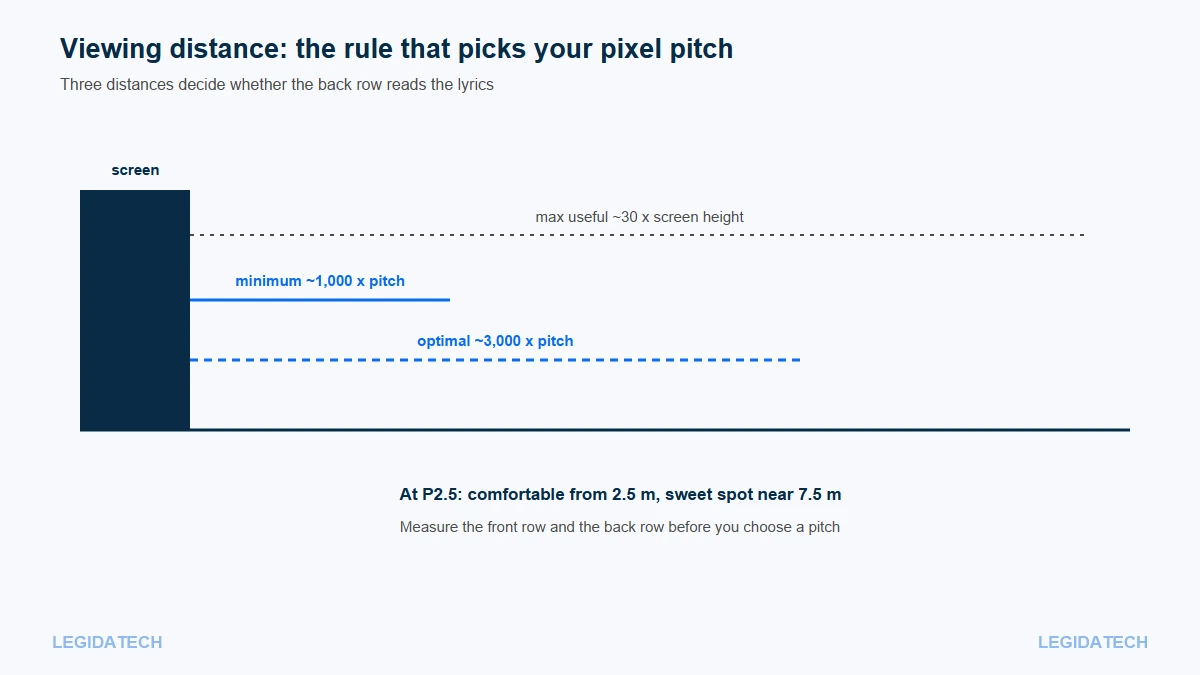
Our church projects show the same pattern: the walls that reach 4K are the wide ones in large rooms, not the fine-pitch ones in small chapels. The reason 4K often goes unused is simple geometry. LED display engineering practice sets minimum comfortable viewing distance at about 1,000 times the pitch value and optimal distance at about 3,000 times. At P2.5 that is 2.5 m and 7.5 m; beyond about 30 times the screen height, the wall stops filling the viewer’s field of view and additional resolution has nowhere to land.
Put differently: for a room where the last row is 20 m away, the wall’s job is to be large and bright enough, not dense enough. That is why we usually recommend sizing up before pitching down. The glossary defines the distance rules, and the pixel pitch explainer shows how pitch and distance interact in practice.
Frequently Asked Questions About 4K Church LED Walls
Do churches really need a 4K LED wall?
Most do not. A 4K LED wall needs about 3,840 pixels across, which at P2.5 requires a wall over 9.6 m wide. For a 300-500 seat sanctuary showing lyrics, slides and occasional video, a 4-6 m P2.5 wall already exceeds what the back rows can resolve. The budget is better spent on size, structure and service access.
How wide must an LED wall be to be 4K?
It depends on pitch: about 9.6 m at P2.5, 7.1 m at P1.86 and 5.8 m at P1.5. The formula is width in metres divided by pitch in metres, so a finer pitch reaches 4K at a narrower width but at a much higher cost per square metre.
Is 1080p enough for a church LED screen?
For most sanctuaries, yes. If your cameras and presentation content are 1080p, a wall at 1,920 pixels across matches the source exactly. Upscaling 1080p onto a 4K wall adds cost without adding detail, and can soften the image if the processor is weak. Match the wall to the source you actually have.
What pitch do I need for 4K in a six metre space?
A 6 m wall reaches 4K only at about P1.56, a fine pitch with a steep price per square metre. In practice a 6 m wall at P2.5 gives 2,400 pixels across, which sits between 1080p and 4K and is ample for lyrics and IMAG at typical sanctuary distances.
Does 4K matter more for IMAG than for lyrics?
Yes. Lyrics are large text that reads clearly even at moderate resolution, while IMAG close-ups of faces reward extra pixels. If your service relies on multi-camera IMAG and the front rows sit close, the case for a finer pitch is stronger; for lyrics-led services it is weak. Decide by content plan rather than by the datasheet headline.
Why is a finer pitch so much more expensive?
Because halving the pitch quadruples the number of LED beads and driver channels for the same area, and it tightens manufacturing tolerances. The control system may also need more capacity. Fine pitch therefore multiplies cost far faster than it multiplies visible improvement at a distance. Ask for the price per square metre at both pitches before deciding.
Can I upgrade a wall to 4K later?
Only by rebuilding it. Resolution is fixed by pitch and physical width, so reaching 4K later means adding width or replacing cabinets with a finer pitch. That is why the size and pitch decision deserves more time than the processor choice, which can often be upgraded on its own.
What should I spend the 4K budget on instead?
Most churches get more value from a larger wall at the same pitch, front-service cabinets for easier maintenance, a spare-parts kit and volunteer training. Those change what happens every Sunday, while resolution beyond the viewing distance changes nothing the congregation can see, however impressive the number looks. Ask what the same budget buys in wall area.
Does a 4K wall need a special processor?
Yes. A 4K wall has four times the pixels of a 1080p wall, so the processor must handle that load and accept 4K inputs if you have them. Budgeting for the screen without budgeting for the processor is a common way for projects to stall at commissioning. Price the processor inside the same envelope.
How do I check whether a quoted wall is really 4K?
Multiply pitch by pixel count: a 4K wall 9.6 m wide at P2.5 gives 3,840 pixels across. Ask the supplier for width, height, pitch and pixel count together and check the arithmetic yourself. A quotation that lists only pitch and area has not told you the resolution. Ask for the pixel count in writing.
Next Step: Check the Arithmetic on Your Room
4K is not a badge, it is a geometry outcome. Once you know your maximum wall width and the distance to the nearest seat, the answer is arithmetic rather than opinion — and in most sanctuaries it points to a larger wall at a moderate pitch rather than a smaller wall at an extreme one.
Send us your maximum available width, the distance to the front and back rows, and whether you film the service, and our engineering team will return the pitch and pixel count your room can actually use — or request a phone call. The buying guide covers the rest of the decision, and the brightness guide covers the setting most churches get wrong on the same screen.


