


Two suppliers can send spec sheets for the same P2.5 church screen and one will be usable while the other is decoration. The difference is rarely the numbers themselves — it is whether each number carries a unit, a test condition and a named component behind it. This guide walks through an LED screen specification sheet line by line, in the order we review a competitor’s quote before answering it, so your committee can compare documents instead of impressions.
Quick Answer: Seven Lines Decide the Quote
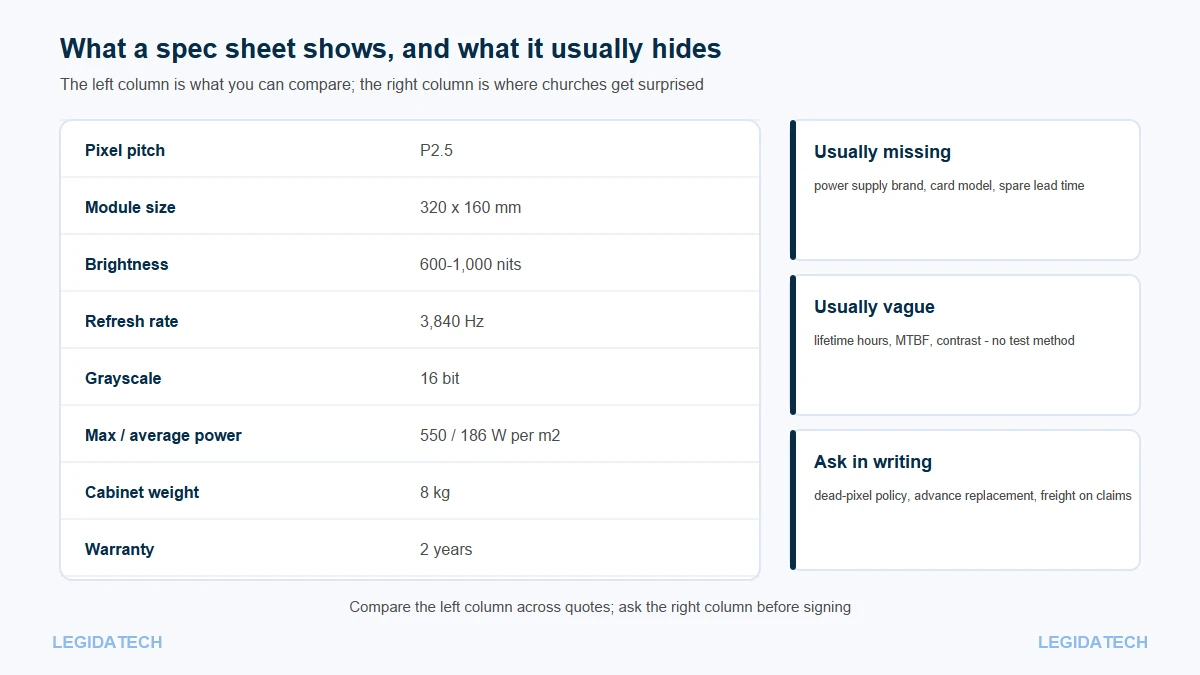
Quick Answer: Pitch, module size, brightness range, refresh rate with scan mode, max/avg power, cabinet weight and warranty terms decide whether two quotes are comparable.
If you only check seven rows, check these. Everything else on the sheet is either derived from them or marketing:
- Pixel pitch — stated as P plus millimetres, and consistent with the quoted wall size.
- Module and cabinet dimensions — they determine the size increments you can actually buy.
- Brightness — a range in nits, not a single headline number.
- Refresh rate — in hertz, with the scan mode beside it.
- Power — maximum and average, per square metre.
- Cabinet weight — because it decides the structure and the lifting plan.
- Warranty — what is covered, for how long, and who pays freight on a claim.
The Numbers You Can Compare Directly
Start with 3 rows: pitch, module size and resolution. They are self-defining, which means two sheets can be compared without asking anyone anything. Pitch, module size, cabinet size, resolution and physical dimensions belong here: they are physical facts that either match the drawing or do not.
Pitch, Module Size and Resolution
Start by checking that the three agree. If the sheet says P2.5 and the quoted wall is 4.8 m wide, the resolution must be 1,920 pixels across, because resolution equals width divided by pitch. When those three numbers disagree, the sheet was assembled from different products, and every other row is suspect. The arithmetic behind that check is set out in do churches need a 4K LED wall.
Module size matters for a mundane reason: it sets the increments in which your wall can grow. A 320 x 160 mm module means sizes step in small slices, while a 500 x 500 mm module steps in larger ones. Ask which module the quote is based on, then check the wall dimensions are multiples of it. Our LED screen glossary defines module, cabinet and pitch if a committee member needs the short version.
The Numbers That Need a Test Condition
Take 700 nits as an example: without a colour temperature and a power level it is a bench figure, not a specification. Four figures on every sheet are meaningless without the condition under which they were measured: brightness, power consumption, contrast and lifetime. A spec sheet that gives “1,200 nits” without saying at what colour temperature and whether that is peak or average is telling you what the factory could achieve on a bench, not what your wall will do on a Sunday.
Ask for three conditions in writing: the brightness range across the wall (not a single point), power as both maximum and average per square metre, and whether lifetime figures refer to the LED beads or to the complete cabinet including power supplies. Those are different numbers and they fail differently.
What a Spec Sheet Usually Leaves Out
Four components that rarely appear
Four components decide how a wall behaves in year two, and they rarely appear. The most expensive gaps on a church specification sheet are not missing numbers, they are missing names. Four components decide how a wall behaves after year one, and they rarely appear:
- Power supply brand and rating. Switching power supplies are the most common failure point in LED walls of any brand; a 100-240 V wide-input branded unit differs from an unbranded one even when both are rated 200 W.
- Receiving card model. It puts a ceiling on how many pixels one cabinet zone can drive and how the wall behaves on camera; makers such as NovaStar publish capacity figures per card.
- Driver IC grade. It decides refresh rate and grayscale at low brightness — the two things church walls are judged on.
- Spare-part lead time. A module that arrives in two weeks is service; one that arrives in two months is a dark rectangle through Christmas.
Units That Get Swapped on Purpose
Unit switching is the quietest way to make a quote look better than it is. These 3 swaps come up repeatedly in church projects:
| What you read | What it may hide | What to ask instead |
|---|---|---|
| Brightness in “cd/m²” next to a projector’s “lumens” | Surface brightness compared with beam output | Wall brightness range in nits, and how it is measured |
| “Power: 550 W/m²” | Whether that is maximum or average | Both figures, and the content assumed for the average |
| “Weight: 8 kg” | Per cabinet or per square metre | Cabinet weight and kg/m² for the structure calculation |
| “Lifetime: 100,000 hours” | Bead rating, not cabinet life | Bead rating plus expected power-supply and card replacement |
| “Contrast ratio: 5,000:1” | Bench measurement, not room performance | Anti-reflective mask type and performance in your room |
Red Flags in the Wording
Wording is where experience shows. If you send us your current quotation, we will mark which of the five phrases below it uses. Here are 5 phrases that deserve a follow-up question every time they appear:
- “Up to” — an upper bound is not a specification; ask what the stated minimum value is.
- “Typical” — acceptable only if the supplier also states the sample size or test method.
- “≥” without a cap — a lower bound invites a cheaper bin; ask what the wall actually ships at.
- “MTBF” — a statistical claim from a lab; ask for the failure policy instead.
- “IP65” for an indoor wall — not wrong, just irrelevant, and often a sign the sheet was written for an outdoor product.
Clauses to Get in Writing Before You Sign
Four clauses worth signing
Four clauses convert a promise into something enforceable, and all four fit on one page:
- Dead-pixel policy. How many dead pixels per module trigger a replacement, and how soon after delivery it applies.
- Advance replacement. Whether a replacement ships before the faulty part returns, and who pays freight each way.
- Commissioning responsibility. Who configures the processor and trains the volunteers, and whether that is included in the price.
- Spares at handover. Which modules, power supplies and receiving cards arrive with the screen.
Our own terms, for comparison: an LED screen specification sheet from us names the part numbers as well as the ratings. Church screens carry a two-year warranty covering dead pixels, driver IC failure and power supply failure, with advance replacement on module and power-supply claims, and spare modules quoted with the screen so the church holds them before the first service. Every cabinet runs a 72-hour aging test plus brightness-uniformity and per-point checks before packing, and test records are available on request.
A Worked Example: Two Quotes for the Same Wall
Here is an illustrative comparison of the kind we see when a church asks us to review competing quotations. The prices are illustrative, the pattern is not:
| Row | Quote A | Quote B | What it means |
|---|---|---|---|
| Pitch / wall | P2.5, 4.8 x 2.7 m | P2.5, 4.8 x 2.7 m | Same physical screen |
| Brightness | 700 nits | 600-1,000 nits | B gives a range; A gives a bench peak |
| Refresh / scan | 3,840 Hz | 3,840 Hz, 1/32 | B states the pair that governs camera behaviour |
| Power | 550 W/m² | 550 max / 186 avg W/m² | A’s figure is likely maximum; B allows a real electrical plan |
| PSU | not stated | branded, 100-240 V, 200 W | The failure point A did not mention |
| Spares | not included | 3 modules + 1 PSU + 1 card | B’s total is higher and its risk is lower |
Read the rows, not the cover page: a specification sheet that answers eleven rows with units and test conditions takes ten minutes to compare, while a four-page brochure takes a week of questions. The lesson is not that the longer document wins; it is that the shorter one leaves you unable to judge. When a supplier cannot answer these rows, the honest conclusion is that the quote is not yet comparable — not that the price is good.
Frequently Asked Questions About LED Screen Specification Sheets
What should an LED screen specification sheet include?
At minimum: pixel pitch, module and cabinet dimensions, brightness range, refresh rate with scan mode, grayscale bit depth, maximum and average power per square metre, cabinet weight, IP rating, control system, warranty terms and the spare-parts list. If any of those is missing, the quotation cannot be compared with another on price alone.
Why do two P2.5 screens have different prices?
Because pitch is only one row of the specification sheet. LED bead grade, driver IC, power supply brand, receiving card, cabinet material and whether spares are included all change cost and failure profile. Two walls that both print P2.5 can differ substantially in price and by years in service life.
Is a higher brightness figure always better?
No. Indoors, a wall specified far above the room’s needs costs more, strains eyes and reduces camera headroom. Our indoor church walls sit in the 600-1,000 nit range, while outdoor signage needs 5,000-6,000 nits. Ask the supplier for the operating brightness they recommend for your specific room. A stated range beats a single headline number every time.
What does refresh rate 3,840 Hz mean for a church?
It means each pixel updates 3,840 times per second, fast enough that cameras do not capture the scanning process as dark bands. For livestreamed services this is the row that prevents flicker across lyrics. Without the scan mode stated beside it, the refresh figure alone is incomplete. Ask for both values on the same line of the quotation.
Why is the power figure sometimes misleading?
Because maximum and average consumption differ by a factor of two or three depending on content. A single figure usually means maximum, which overstates the electrical load and hides the running cost. Ask for both, per square metre, so your electrician can plan circuits and your board can estimate what the wall costs to run.
What is a reasonable cabinet weight for a church wall?
It depends on cabinet size and material, so the useful number is weight per square metre for the structure calculation. Die-cast aluminium cabinets are lighter than iron ones at the same size, which matters when a wall hangs from a truss rather than sitting on a load-bearing wall.
Should I insist on branded power supplies?
Yes. Power supplies are the most common failure point in LED walls, and an unbranded unit is where hidden cost cutting usually appears. Ask for the brand and rating in writing, and ask whether the spare units you receive are the same model as the ones installed in the wall.
What does a warranty need to state?
What is covered, for example dead pixels, driver IC and power supply; how long it runs; whether replacement is advance or after return; who pays freight each way; and what voids it. A five-year warranty with return-to-factory shipping can serve a church worse than a two-year warranty with advance replacement.
Is a 100,000-hour lifetime claim realistic?
That figure normally refers to LED bead depreciation rather than to the complete wall. Churches replace power supplies and occasional modules long before the beads reach their rating, which is why a small spares kit matters more than the headline number. Ask for the failure policy rather than the hours.
What is the fastest way to compare two quotes?
Ask both suppliers to fill the same eleven-row table with units and test conditions, then compare row by row instead of total by total. Where a supplier leaves a row blank, that blank is the risk you are being asked to accept without knowing its size. Fill the blanks before anyone signs.
Next Step: Send Us the Quote You Are Comparing
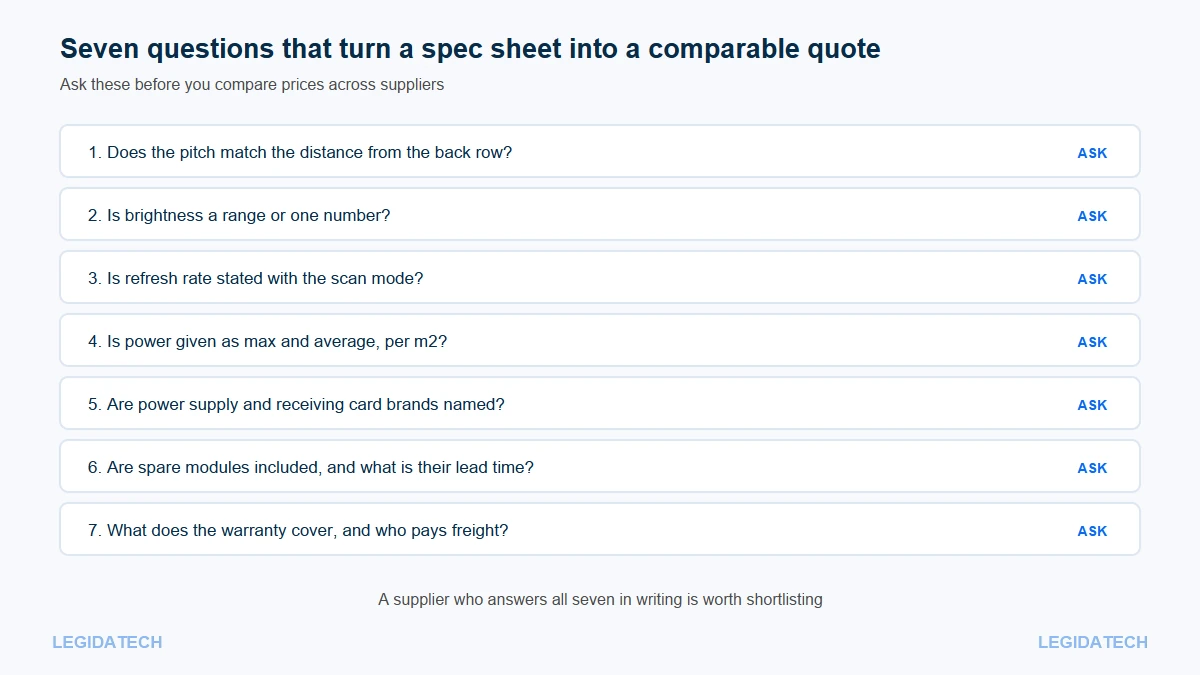
A spec sheet is a negotiating document, not a brochure. The moment you can name the seven rows above and ask for them in writing, quotes stop being comparable by price and start being comparable by risk — which is the comparison a church board actually needs.
If you already have a competing quotation, send it to us and our engineering team will review it line by line, marking what is specified, what is vague and what is missing — or request a phone call. For the wider decision around it, read the complete church LED screen buying guide, the brightness guide, and the price quick guide.


