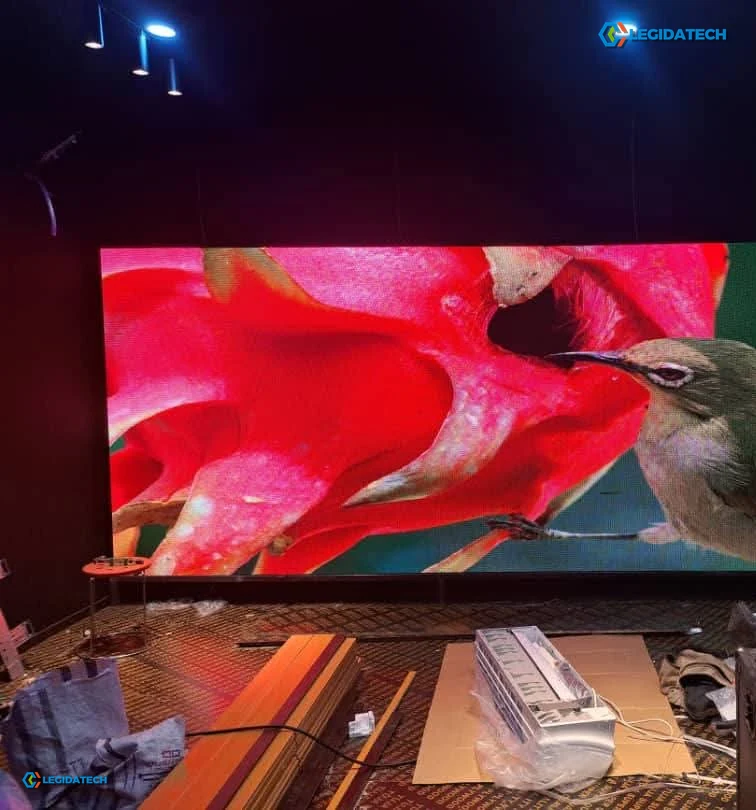


Case study · Ghana
Church of Pentecost Accra: P2.5 Church LED Screen
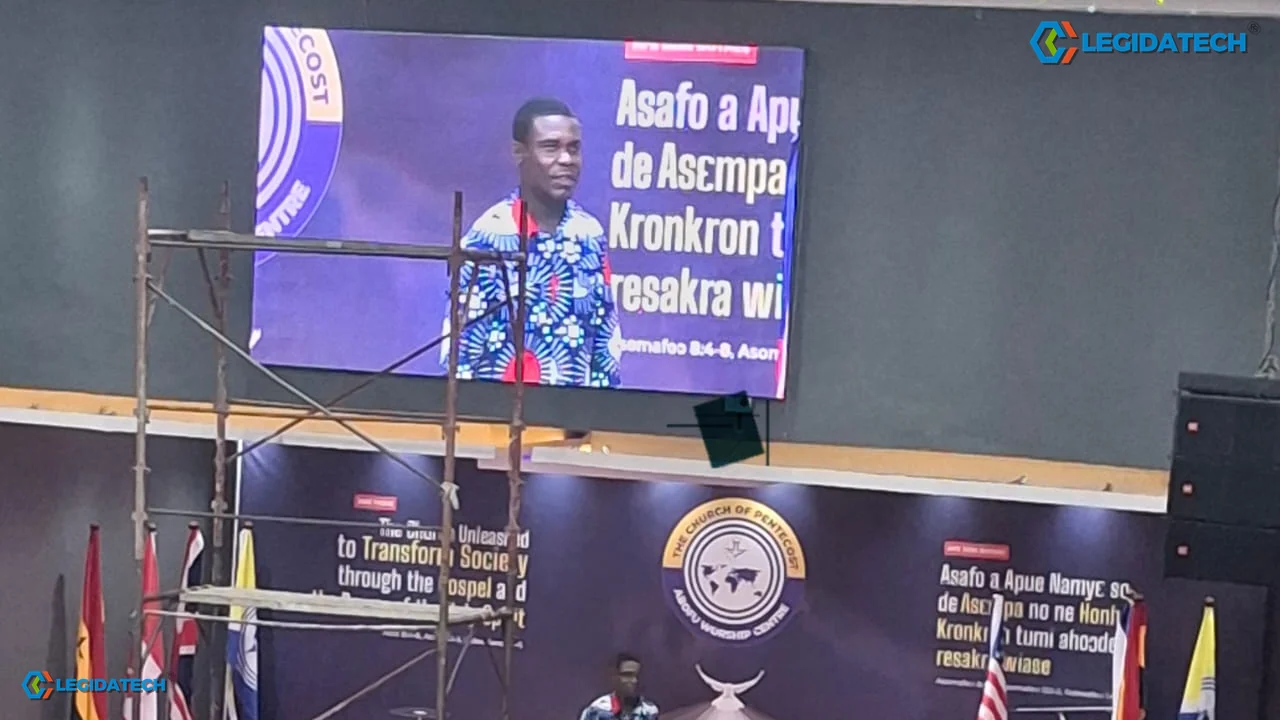
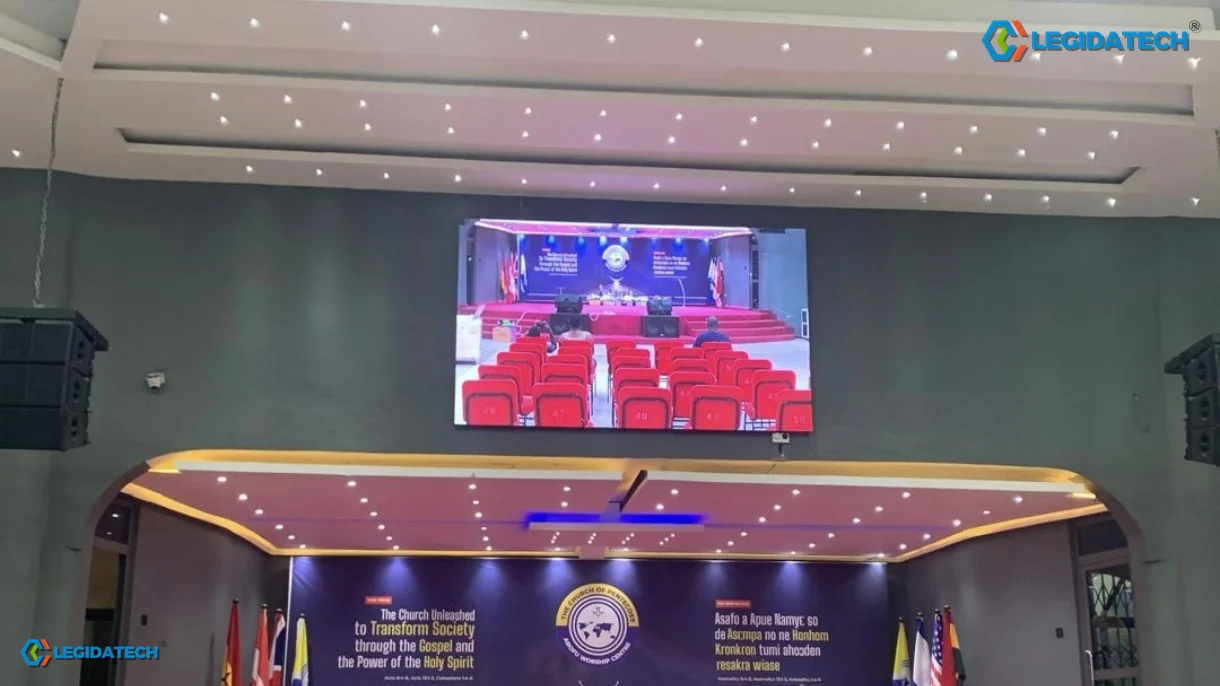
A 3.2 × 1.92 m P2.5 wall installed high on the wall above the stage at the Abofu Worship Centre in Accra — 6.1 m² and 1,280 × 768 pixels, July 2026.
- 3.2 × 1.92 m wall · 6.1 m² · 1,280 × 768 px
- P2.5 Ehonor · 120 modules · 40 cabinets on a portrait layout
- Fitted inside an existing stage header, clear of the banner and the lighting
Quick answer
- How big is the screen?
- 3.2 × 1.92 m, 6.14 m², 1,280 × 768 pixels.
- What pitch and product?
- P2.5 Ehonor series indoor fixed LED display, front service.
- Who supplied it?
- LEGIDATECH, installed in July 2026.
- What is it used for?
- Live camera feed of the preacher plus Twi and English lyric and scripture slides.
The Church of Pentecost — Abofu Worship Centre, Accra, Ghana, installed a 3.2 m × 1.92 m indoor fixed LED wall in July 2026: 6.14 m² of Ehonor P2.5 at 1,280 × 768 pixels, from 40 portrait cabinets and 120 front-service modules. It hangs high on the grey wall above the stage header, clear of the banner and the stage lights. Below is the arithmetic behind them, and what the photos show.
Project Facts
| Item | Detail |
|---|---|
| Client | The Church of Pentecost — Abofu Worship Centre (one local centre) |
| Country / City | Ghana / Accra |
| Application | Stage wall: camera feed and lyric slides |
| Product | Ehonor series indoor fixed LED display, SMD |
| Pixel pitch | P2.5 (2.5 mm) |
| Cabinet | 480 × 320 × 70 mm, 3 kg, portrait at 320 × 480 mm |
| Screen size | 3.2 × 1.92 m = 6.14 m² (published 6.1 m²) |
| Resolution | 1,280 × 768 px |
| Module count | 120 (320 × 160 mm, 10 across × 12 high) |
| Delivered | July 2026 |
| Supplier | LEGIDATECH |
The Client and the Venue
Who they are
The Church of Pentecost is one of Ghana’s largest church denominations. This page is about one congregation inside it: Abofu Worship Centre in Accra, and the hall where it meets.
The room is a working auditorium: sound reinforcement is installed, line arrays hang either side of the stage, and stage lighting runs with ceiling spotlights. A header frames the stage, carrying the Church of Pentecost crest and a bilingual banner, English and Twi.
What the room demanded
Three constraints decided the size of the wall. The header runs the full width at a fixed height, so the screen had to sit inside the header line rather than across it, leaving the banner readable. Stage lighting sits above the platform, so the bottom edge had to clear it. And the grey wall is the only surface: the screen hangs high and centred on it, with nothing beside it to carry the load.
Why P2.5 and Why 3.2 × 1.92 m
The viewing-distance sum
The rule for indoor LED is 1,000 × the pixel pitch in millimetres: the closest distance at which the image reads as continuous. At P2.5 that is 1,000 × 2.5 mm = 2,500 mm, or 2.5 m. The front row sits well beyond that and the rear wall further away, so no seat is inside it, and no measured distance is quoted because none was recorded.
Why not a wider or taller wall
Width came from the header and the side-seat sightlines: 3.2 m fits inside the header and stays in view from the sides. Height came from the header opening and the lights: 1.92 m keeps the screen inside the header and clear of them. That gives 3.2 ÷ 1.92 = 1.67, near 16:9 without being a broadcast ratio.
Why not a coarser pitch
At P3.91 the same 3.2 m would resolve 3,200 ÷ 3.91 = 818.4 pixels, so 819 across, and 1.92 m ÷ 3.91 mm = 491 down. Lyric and scripture slides are text, and text punishes a coarse pitch: at 819 px across 3.2 m the thin strokes of small letters lose definition. P2.5 gives 1,280 across — 1,280 ÷ 819 = 1.56, so 56% more pixels, and 768 down instead of 491.
The Configuration We Delivered
The wall is Ehonor series indoor fixed, SMD, with magnetic front-service modules (indoor fixed church LED screens). Specification:
| Specification | Delivered value |
|---|---|
| Pixel pitch | 2.5 mm (P2.5) |
| Module | 320 × 160 mm, magnetic front service |
| Resolution | 1,280 × 768 px |
| Brightness | 600–800 nits |
| Refresh rate | 3,840 Hz |
| Viewing angle | 160° / 160° |
| Colour | 68.7 billion colours |
| Cabinet | 480 × 320 × 70 mm, 3 kg, CNC aluminium frame with flame-retardant ABS back cover |
| Service | Front service, magnetic modules |
| Protection | IP31, indoor |
Two sums close the geometry. Modules: 0.32 × 0.16 m = 0.0512 m² each; 3.2 ÷ 0.32 = 10 across and 1.92 ÷ 0.16 = 12 high, so 120 modules, and 120 × 0.0512 = 6.144 m². Cabinets: portrait 0.32 × 0.48 m = 0.1536 m²; 10 across and 4 high = 40 cabinets, and 40 × 0.1536 = 6.144 m². Resolution: 3.2 ÷ 0.0025 = 1,280 and 1.92 ÷ 0.0025 = 768.
Installation: What the Site Photos Show
Lifting and fixing
The installation set a scaffold tower on the carpeted floor in front of the stage, and the top photo shows it still standing while the screen is running. The screen does not hang from the stage structure: a support frame is fixed to the grey wall and the cabinets locate against each other on it, the machined edge registering one to the next, so no shims were needed. Forty cabinets at 3 kg each is 120 kg of panel before the frame.
Commissioning
Brightness and colour were then set for the room rather than left at a factory default, 600–800 nits being the indoor range. The 1,280 × 768 canvas went to the media team and the processor inputs were labelled, so the camera and presentation feeds are switched by name, not by guesswork.
The Screen in Action
The wall does two jobs on one canvas: it carries a live camera feed of the preacher, with lyric slides in Twi and English beside him, and a feed of the sanctuary itself.
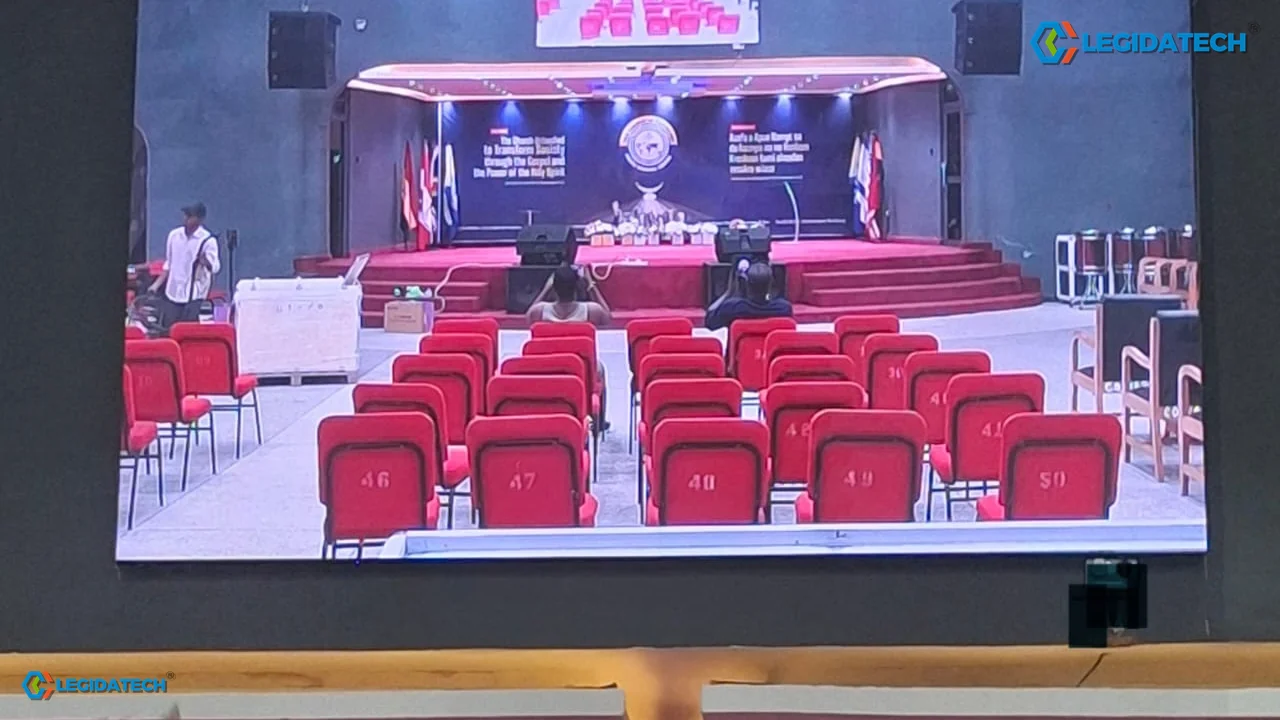
The clip below is a phone video filmed inside the hall after handover: a pan across the room — stage, drums, carpet, side gallery. It is a room walk-through, not a close-up: what it shows is the room the wall works in.
Delivery and Support to Ghana
Ghana is a sea-freight destination: equipment ships into Tema and clears from there to Accra. The electrical standard is 230 V / 50 Hz with type G sockets, which the power supplies are specified for. Lead time is confirmed at order, depending on the production slot and the sailing.
For maintenance the modules are magnetic and front service: a 320 × 160 mm module is released from the face of the wall, so a swap needs no scaffolding behind the screen and no cabinet comes down. Keep spare modules on site so a swap does not wait for a shipment.
What a Similar Wall Costs
Indicative figures for indoor P2.5 sit at about US$500–800 per m², equipment only. For 6.1 m²: 6.1 × 500 = US$3,050 and 6.1 × 800 = US$4,880, the roughly US$3,050–4,900 band, before frame and fixing, processor and control, and freight, duty and clearing.
Four lines move the total. Area and pitch set the panel cost, because both change the number of modules. Frame and fixing depend on the wall. Processor and control covers the video processor and the inputs the media team uses. Freight, duty and clearing depend on port, volume and paperwork. The church LED screen price guide sets out how those lines are built up.
Why Churches in Ghana Choose LEGIDATECH
- Ghana projects are published with measurements: the 46.7 m² Accra stage wall and the 9.8 m² Kumasi wall are both on this site.
- Modules are magnetic and front service, so a failed module is reached from the face of the wall.
- Supply is factory-direct from LEGIDATECH, so panel, frame and processor come from one specification.
- Walls are specified to the room rather than to 16:9: this one is 1.67:1, and the 11.5 m² church wall in Nigeria was sized the same way.
Frequently Asked Questions
What does a 3.2 × 1.92 m P2.5 wall cost in Ghana?
Indicatively about US$500–800 per m² for equipment, so 6.1 m² is roughly US$3,050–4,900 before frame, processor, freight, duty and installation. Planning figures, not a quotation.
Can you ship to Tema and Accra?
Yes. Equipment goes by sea into Tema and clears to Accra; the power supplies are specified for 230 V / 50 Hz with type G sockets. Lead time is confirmed at order.
Is 6.1 m² enough for a church hall?
It is enough for the room it was built for: inside a 3.2 m header, with 1,280 × 768 as the canvas. For another hall it depends on header width and back-row distance, not area.
Yes, and this wall is the example: it hangs above the header, inside the header line, banner visible beneath and lights clear below. The deciding number is the clear height between banner top and lighting.
Will it show banding on phone video?
The panel runs at 3,840 Hz refresh, specified to keep camera capture clean. A phone can still band if its shutter and the panel refresh fall out of step; that is a camera setting, not a panel fault.
Can a module be replaced without scaffolding?
Yes. Modules are magnetic and front service, so a 320 × 160 mm module is released from the face of the wall: the swap happens at the front, with no scaffolding behind it and no cabinet removed.
Get a Quote for a Similar Church LED Screen
Send a photo of the wall above your stage, the height you can use, the distance from the back row to the platform, and whether services are filmed; we will size the wall to those constraints. You will get back a wall size, a resolution and an indicative price band.
While you gather those numbers, the price guide explains what moves the cost, and the quote form is where to send them.
More church LED screen projects
- P2.5 church LED screen in Nigeria: 11.5 m² Living Faith case
- P2.5 church LED screen Kumasi: 9.8 m² Warriors Chapel case
- RCCG Mount Olives Abuja: 8.4 m² P2.5 church LED wall
- A 46.7 m² P2.5 stage wall in Accra, Ghana
- Indoor fixed church LED screens (Ehonor series)
- How much a church LED screen costs: the price framework
Get a quote for a screen like this
Send a photograph of the front wall, the height of the stage opening and the distance to your back row. We will come back with a pitch, a pixel canvas and a price for the room you actually have.
What you get with the quotation: cabinet layout, resolution, processor inputs and an installation sequence your contractor can follow.