


Church LED Screens in South AfricaPrice bands in US dollars, the three installations in our files, and how to specify a wall that survives a generator changeover
What a South African Wall Costs, in One Paragraph
An indoor P2.5 church wall in South Africa runs about US$500–800 per m² factory-direct, outdoor P4 about US$450–700 and outdoor P10 about US$200–320. A 17.5 m² sanctuary wall therefore sits in a US$8,750–14,000 equipment band, before freight to Durban, duty, VAT, the steel frame and installation. We quote in US dollars because that is the currency the factory and the freight forwarder both invoice in; your landed budget is in rand at the rate on the day you pay.
This page is shorter on case evidence than our Nigeria and Ghana pages, and it should be: our files hold three South African projects, not thirty-six. Two of them are churches of 17.5 m² and 32 m². What follows is what those projects and the South African power situation actually change about the specification, rather than a longer version of the same page with a different country name.
Price Bands and the Four Lines Behind Them
The equipment band is the same everywhere we ship: the factory price does not change with the destination. What changes is the freight, the duty assessment, the frame fabricated locally and the electrician. Split them and the budget stops being a guess.
| Pixel pitch | Where it is used in a church | Indicative band (US$/m²) | Typical cabinet |
|---|---|---|---|
| Indoor P2.5 | Sanctuary front wall, 15–25 m viewing depth | 500 – 800 | 480×320 mm die-cast, front service |
| Indoor P3.91 | Stage backdrop, mixed seating, tighter budgets | 450 – 700 | 500×500 or 500×1000 mm |
| Outdoor P4 | Street-facing sign at the church gate | 450 – 700 | 960×960 mm, IP65 |
| Outdoor P10 | Roadside sign read from 30 m and beyond | 200 – 320 | 960×960 mm, IP65 |
Indicative factory-direct ranges for standard configurations, reviewed November 2026, excluding freight, duty, VAT, steel structure, control system and installation. These are our own bands for standard builds, not a competitor price list, and not a quotation.
| Budget line | How it is charged | What to check |
|---|---|---|
| Screen and cabinets | Per m², by pitch | Area must reconcile with the cabinet count |
| Freight to Durban | Per cubic metre | Carton count and sailing date; ask for it as a number |
| Duty and VAT | Assessed at clearing by SARS on the CIF value | The HS code on the invoice, and the assessment in writing before arrival |
| Steel frame | Fabricated locally, per design | Wall load and access; this is the line that usually overruns |
| Electrical work and CoC | Local electrician, per installation | A Certificate of Compliance for the installation, not only for the screen |
| Installation labour | Per crew and days on site | Whether scaffolding and a scissor lift are included |
The pitch-by-pitch bands and the whole-screen budgets behind them are on our church LED screen price guide, and what a wall costs to own after year one is on the maintenance cost page. South Africa has the deepest AV integrator market of the three countries on this site, so installation quotes vary more widely than the equipment does. There is no public index for church LED pricing here that we would rely on; the equipment band is the part we can state, and the local work is where quotes legitimately differ. Two of those lines are worth arguing about before you sign. The steel frame is fabricated locally, so it is the one line a South African church can price independently with three quotes and take out of the supplier’s number. And the electrical work has to end with a Certificate of Compliance from a registered electrician for the installation as a whole; a screen supplied with a CE report does not discharge that obligation, and a supplier who implies it does has not done this before.
The Three Installations in Our Files
Two churches and one multi-surface creative install, all recorded between November 2025 and March 2026. We publish what we hold rather than rounding up to a rounder number.
| Project | Wall size | Pitch | Resolution | Recorded |
|---|---|---|---|---|
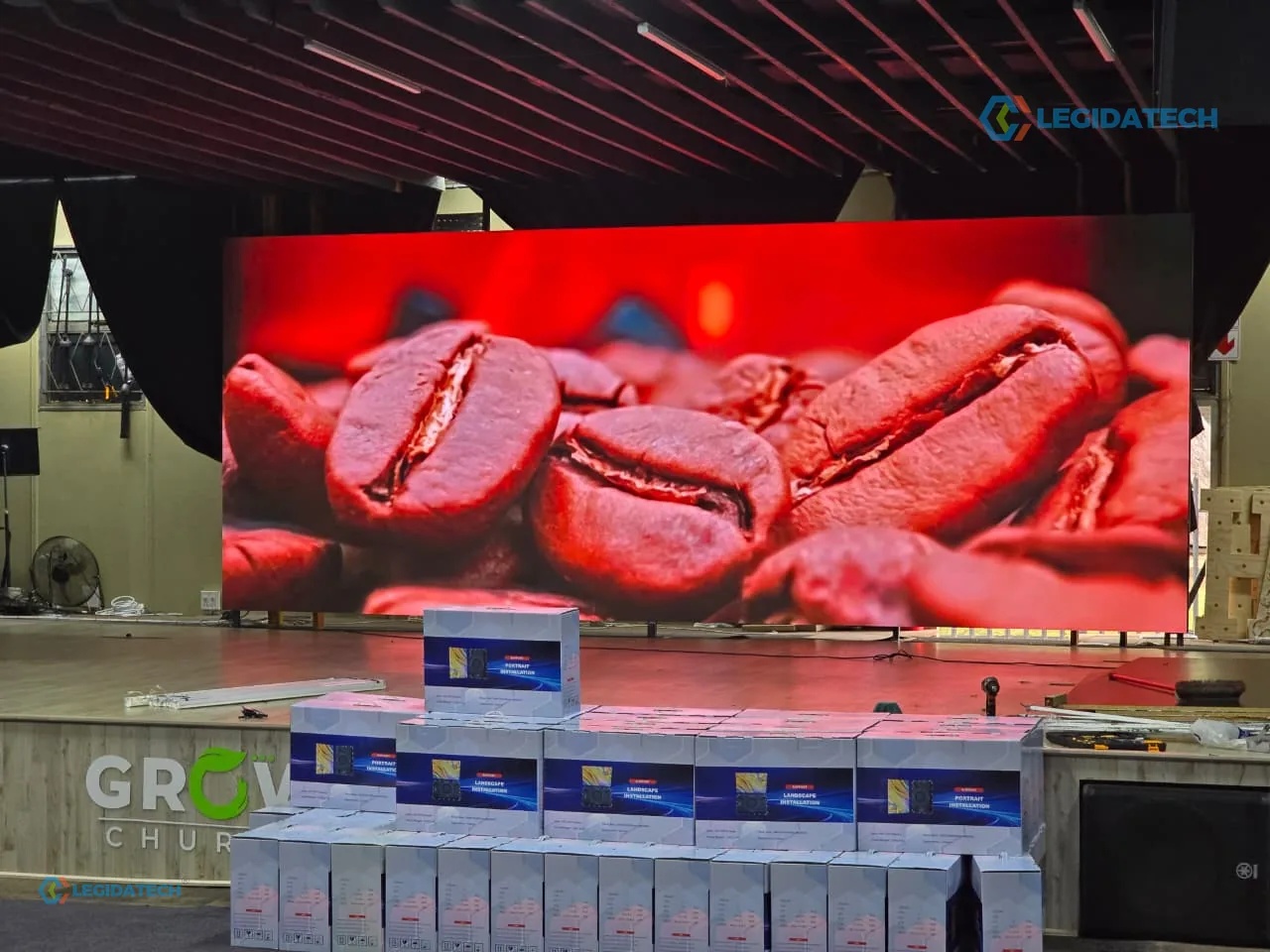
| GROW Church, sanctuary wall | 6.08 × 2.88 m (17.5 m²) | P2.5 | 2,432 × 1,152 | November 2025 |
| Module-built wall, 8 × 4 m | 8 × 4 m (32 m²) | not recorded | module grid, design-dependent | March 2026 |
| Multi-surface creative install | room data not recorded | not recorded | — | December 2025 |
Resolution for the 17.5 m² wall calculated on a 320×160 mm module at P2.5 (128×64 pixels per module): 19 × 18 modules.
The 17.5 m² wall is the useful reference for a South African sanctuary: 6.08 m wide, 2.88 m high, P2.5, 2,432 × 1,152 pixels. That is a 2.1:1 wall rather than 16:9, which is normal when the available band of wall is wide and the platform caps the height. Content for it has to be laid out for 2.1:1, or the top and bottom of a 16:9 feed get cropped.
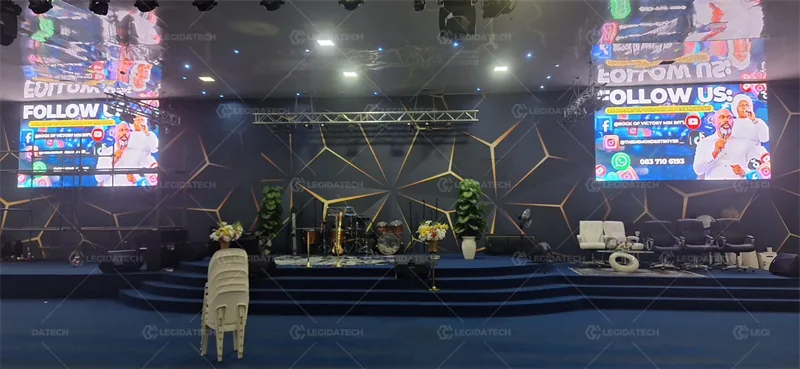
A South African stage with displays either side of the platform.
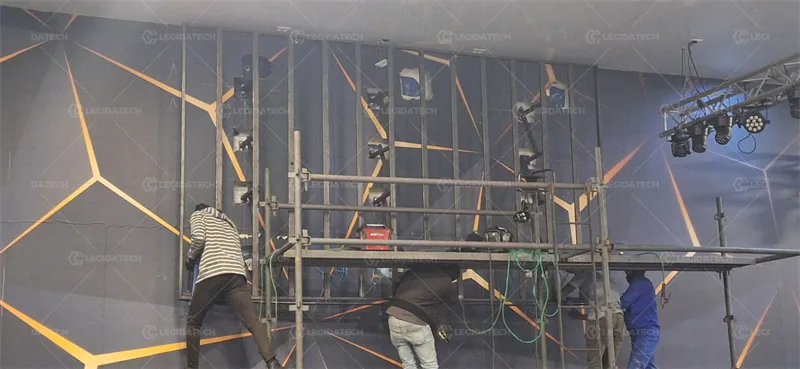
Panels going onto a curved stage wall, installed with scaffolding.
Power: What Actually Takes the Wall Down
South Africa’s grid position has improved to the point that Eskom’s most recent winter outlook again forecasts no load shedding (Eskom media statement). That is good news for operating cost, and it does not remove the design question, because the event that takes a church wall down is rarely a scheduled outage. It is the unscheduled one: a substation trip, a changeover to the generator, or a voltage sag deep enough to reboot the processor while the display itself rides through.
The display and the control system behave differently under those events, and that difference is where the money should go:
- The wall rides through short sags. The switching supplies in the cabinets tolerate a wide input range, so a brief dip usually shows as a flicker rather than a blackout.
- The processor does not. A media processor or a PC running presentation software reboots on a sag, and a reboot in the middle of a service is the failure the congregation actually sees.
- So size the UPS for the control system, not for the wall. A UPS for the processor, the sending card and the network switch is a small unit compared with one sized for the whole screen, and it covers the failure that matters.
- Protect the input side. Highveld thunderstorms make surge protection on the distribution board a cheaper decision than a warranty argument, and it should be part of the electrical quote rather than an afterthought.
- Decide the generator changeover before the wall goes up. If the building changes over to a generator, the changeover time is the number to know. Anything longer than the UPS runtime is a blackout, whatever the generator is rated at.
One specification line worth adding to any tender. “The control system shall ride through a mains interruption of at least ten minutes without loss of content.” It is a concrete, testable requirement, it costs a few hundred dollars, and it separates suppliers who have commissioned a church wall from those who have only shipped one.
Delivery and Clearing: Durban, then Inland
Container freight from Shenzhen lands at Durban, and most Gauteng churches take delivery inland rather than at the coast. The sequence is the same one we run elsewhere, with the port, the agent and the inland leg changed:
- Survey and drawings. Wall width, wall height, platform height and the module count, so the quotation and the delivered area agree.
- Production. Two to three weeks for a standard indoor cabinet.
- Packing. Export cartons with the module count marked on each box and a packing list that matches the invoice line by line.
- Freight to Durban. Charged by volume, so the carton count is the number that moves it. Ask for the sailing date and the transit time in writing rather than accepting “about a month”.
- Clearing. Your agent works from the commercial invoice, packing list and HS code. Duty and VAT are assessed by SARS on the CIF value and depend on the code filed, so confirm the assessment before the container arrives.
- Inland haulage and installation. Durban to Gauteng, then the frame, the cabinets and the electrical connection with a Certificate of Compliance at the end.
One local detail that catches overseas suppliers: a South African church project usually has a nominated electrician before it has a screen supplier, because the building work runs ahead of the equipment. Bring that electrician into the specification early. Their view on the distribution board, the changeover and the earthing is more useful before the wall size is fixed than after.
Choosing a Supplier for a South African Church
The market offers three routes, and they are not interchangeable. A local AV integrator sells the screen inside a service contract: survey, installation, maintenance, one number to call. A factory sells equipment with drawings and remote support and the church arranges installation. A rental house supplies a conference or a crusade and takes the screen away afterwards.
For a fixed wall that will run every Sunday, the factory route is usually cheaper per square metre and the integrator route is faster when something fails. The question to ask is not which is better but which failure the church can absorb: a two-week wait for a spare module, or a margin built into every future service call. Denomination-level buyers usually land on a hybrid — factory equipment, local frame and electrician, and a maintenance arrangement agreed in writing at handover.
Whatever route you take, ask any supplier four things in writing before money moves: the cabinet size and module size the price is built on; the refresh rate, which should be 3,840 Hz if the service is streamed; whether the price is FOB Shenzhen, CIF Durban or landed; and which spare parts ship with the wall. A supplier who answers all four can be compared with another. One who answers none of them cannot, at any price.
The one question that separates suppliers. Ask what the wall resolves, in pixels, for the exact width and height you have been quoted. A supplier who can multiply modules by pixels knows the job. One who answers in inches, or in “4K”, has not designed the wall yet.
Six Questions South African Churches Ask
How much does a church LED screen cost in South Africa?
Indoor P2.5 is about US$500–800 per m² factory-direct, so a 17.5 m² sanctuary wall is roughly US$8,750–14,000 in equipment. Freight to Durban, duty, VAT, the locally fabricated frame and the electrician are additional, and the frame and electrical lines are the ones that most often overrun a budget.
Do you have a warehouse or a service team in South Africa?
No. We ship from Shenzhen against a signed drawing, and the installation is done by the church’s contractor or a supervised crew, with spares held on site and support remote. A supplier who claims a local warehouse should be able to give you the address and let you look at the stock.
What should we do about power interruptions?
Size a UPS for the control system rather than for the wall, add surge protection at the distribution board, and find out the generator changeover time before the wall goes up. The display rides through short sags; the processor is what reboots and takes the service down.
What do we need at handover?
A Certificate of Compliance from a registered electrician for the installation, the as-built cabinet layout and wiring schedule, the processor configuration file, and two or three spare modules with one power supply and one receiving card. Without those six items the church owns a screen it cannot maintain.
Which pitch suits a South African sanctuary?
The depth of the room decides it. Under 15 m, P3.91 saves money with no visible difference from row eight back. Between 15 and 20 m, P2.5 keeps lyric text crisp to the last row — which is what the 17.5 m² GROW Church wall uses. Beyond 20 m, a larger wall buys more legibility than a finer pitch.
Can we buy only the screen and build the frame locally?
Yes, and it is often the cheaper route. The frame is fabricated locally anyway, so a South African steel contractor can quote it independently and you can compare that number against the supplier’s. Send us the wall survey and we will supply the frame drawing the fabricator works from.
What We Need Before We Can Price a South African Wall
Four numbers and one photo: the wall width, the wall height, the distance from the wall to the front row, and the city. A photograph that includes the ceiling, the platform and the distribution board tells us more than a paragraph of description, because the frame fixing and the power are usually the two things that decide the final cost.
LEGIDATECH church LED screens for South Africa — factory-direct, front service. Part of the church LED screens range; see also Nigeria and Ghana, and our earlier South Africa project notes.