

Case study · Ghana
P2.5 Church LED Screen Kumasi Ghana: 9.8 m² Case Study
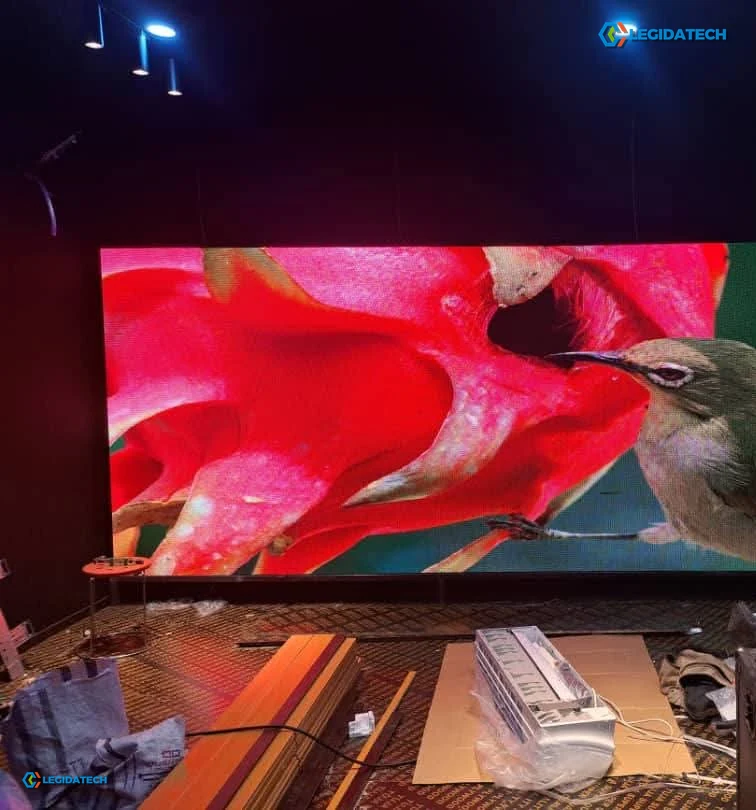
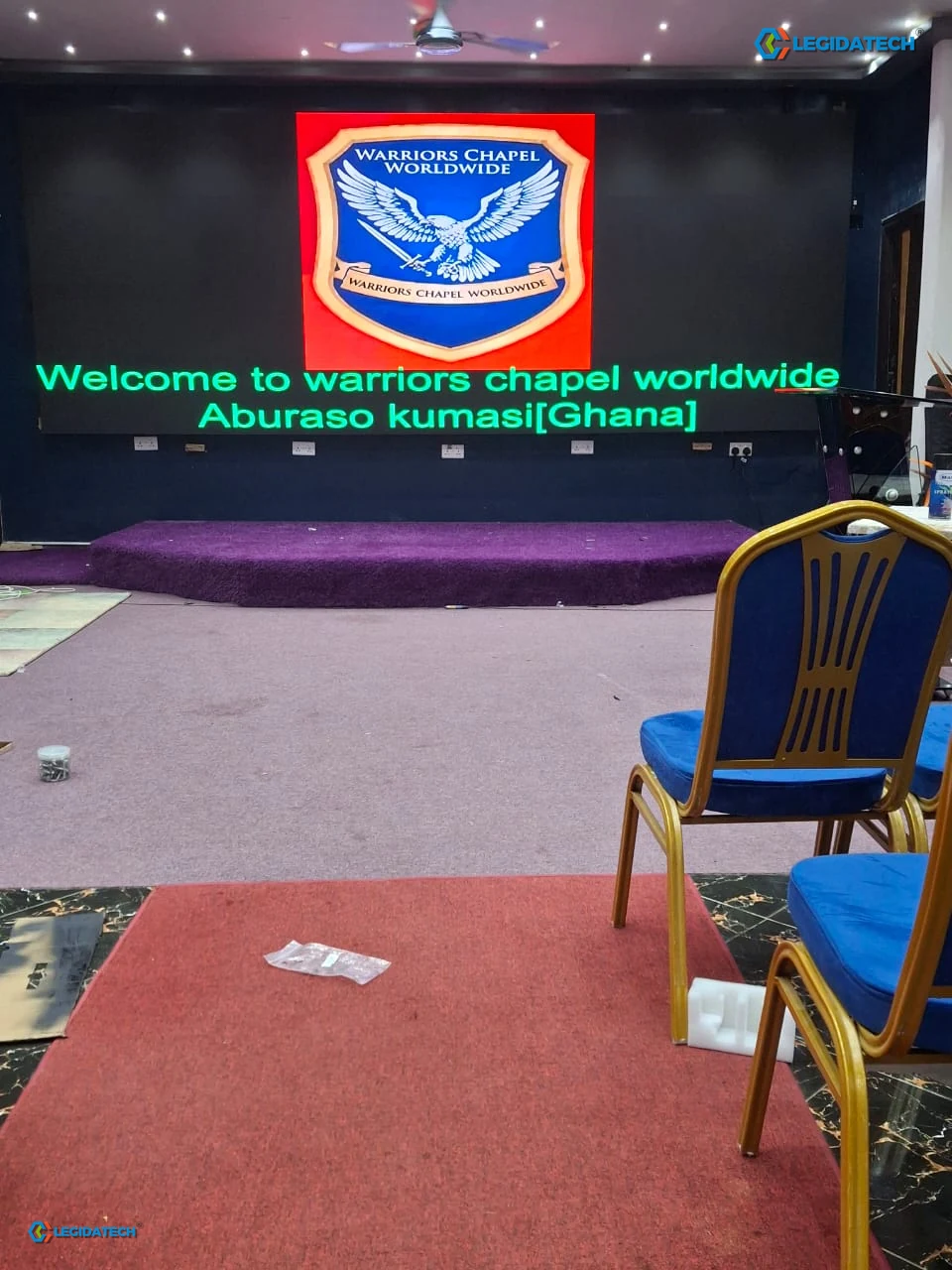
A 5.12 × 1.92 m wall behind the platform at Warriors Chapel Worldwide, Aburaso, Kumasi — 9.8 m² and 2,048 × 768 pixels, installed in April 2026.
- 5.12 × 1.92 m wall · 9.8 m² · 2,048 × 768 px
- P2.5 Ehonor · 192 modules · 64 cabinets · front service
- A 2.67:1 canvas that came from the room, not from a catalogue
Quick answer
- How big is the screen?
- 5.12 × 1.92 m, 9.8 m², 2,048 × 768 pixels.
- What pitch and product?
- P2.5 Ehonor series indoor fixed LED display, front service.
- Who supplied it?
- LEGIDATECH, installed in April 2026.
- Why this shape?
- Width was set by the platform, height by the ceiling fans and the sightline above the stage.
Project Facts
| Client | Warriors Chapel Worldwide, Aburaso assembly |
|---|---|
| Country / City | Ghana / Kumasi |
| Application | Sanctuary wall behind the platform |
| Product | Ehonor series indoor fixed LED display |
| Pixel pitch | P2.5 |
| Module / cabinet | 320 × 160 mm module, mounted rotated (160 mm wide × 320 mm high); 480 × 320 × 70 mm cabinet, 3 kg |
| Panel qty | 64 cabinets (16 across × 4 high), mounted portrait |
| Screen size | 5.12 × 1.92 m (9.8 ㎡) |
| Resolution | 2,048 × 768 px |
| Module grid | 16 columns × 12 rows = 192 modules |
| Refresh rate | 3,840 Hz |
| Service | Front service, magnetic modules |
| Delivered | April 2026 |
| Supplier | LEGIDATECH |
The Hall
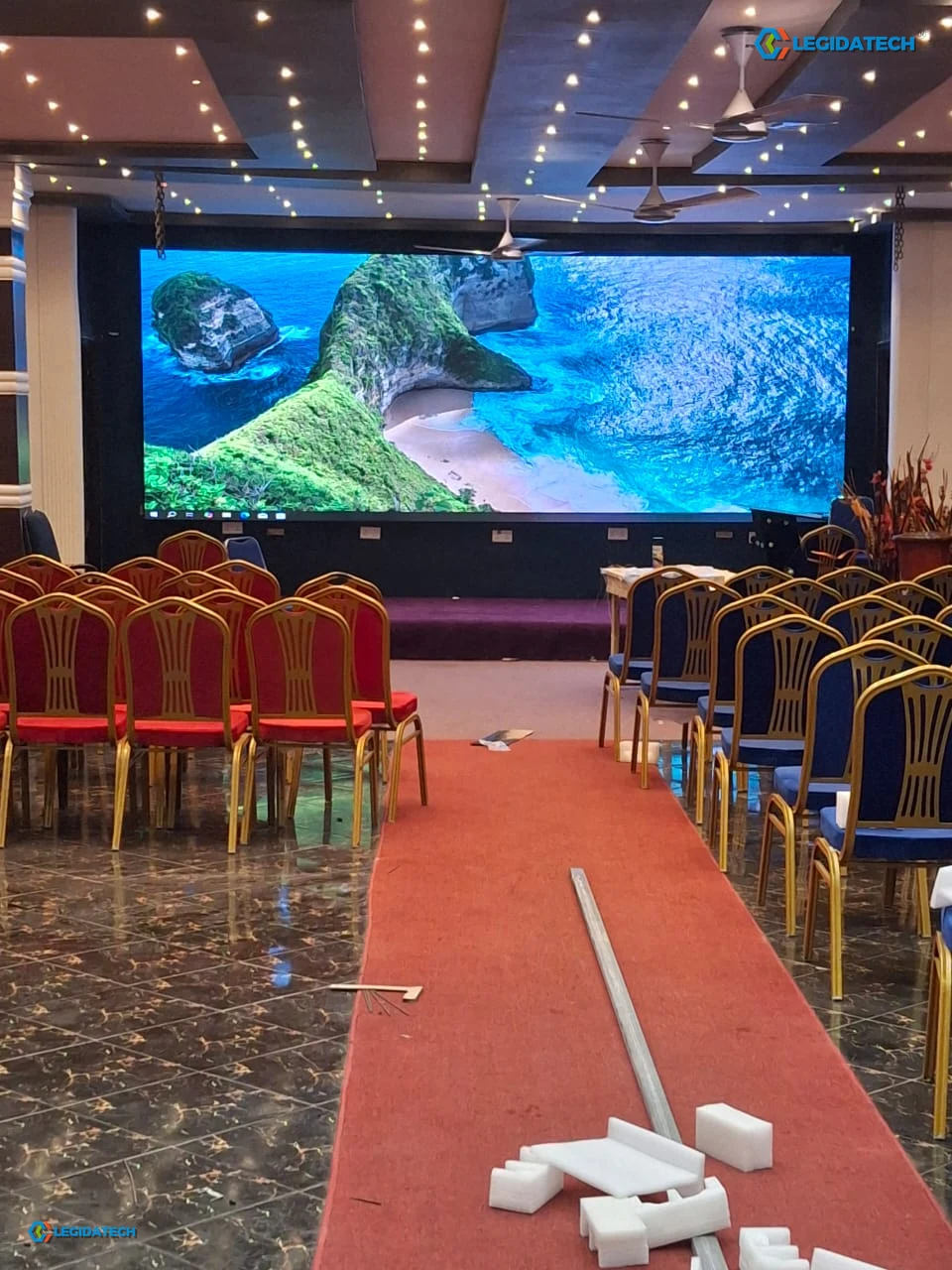
The assembly meets in a hall with a patterned marble floor, a red carpet running to the platform, blue and gold banquet chairs laid out in rows, ceiling fans, and a dark acoustic wall behind the stage. The photographs suggest a hall that was built for another use and fitted out for worship: marble floor, banquet chairs, ceiling fans, a stage dressed in red carpet. That starting point drives every decision on the screen.
Two things follow from a hall you did not build, and they are not technical.
The building is not yours to modify. You can hang a screen on a wall; you cannot cut a service corridor into it, and you cannot assume the landlord will let you bolt a steel structure to the structure. Whatever goes up has to be reversible.
The building may not be the last one. A congregation at this stage moves, or grows into a bigger hall, more often than a cathedral does. A screen bought for a leased hall should be demountable, and the mounting should not be a one-way installation.
Those two constraints are why this screen is specified the way it is: front service, a wall fix rather than a rear corridor, and a wall sized to the room rather than to an aspiration.
Why This Wall Is 5.12 × 1.92 m
A 5.12 × 1.92 m wall is the size that fits this situation. It is wide enough to carry a name, a logo and a verse line legibly from the back of a hall this size, and shallow enough in height that it does not fight the platform or the ceiling fans.
Width comes from the platform
The wall sits behind the platform, centred on the pulpit. 5.12 m is 16 modules of 320 mm — two more than four metres, one less than five and a half. In practice the width is set by the platform: a screen that runs wider than the platform reads as a stage element rather than a backdrop, and at this hall’s proportions 5.12 m covers the platform cleanly with the speakers still visible on either side.
Height comes from the ceiling fans
1.92 m is 12 modules of 160 mm. That is not an arbitrary number either: the hall has ceiling fans and a ceiling height that puts the top of a taller wall into the fan’s wash and into the sightline of anyone standing on the platform. A 2.4 m wall would have resolved 960 px high and looked better on paper; in this room it would have been too tall for the space above the platform.
The ratio nobody planned
5.12 ÷ 1.92 = 2.67, so this is a 2.67:1 wall. It is not 16:9, and it is not the 2:1 of a slightly larger sanctuary wall. It is the shape the hall allowed. As with every church wall we build, the content has to be designed to the canvas rather than the canvas being stretched to the content.
Why P2.5 at 9.8 ㎡
The distance sum
P2.5 resolves 2,048 × 768 pixels on this wall. With the 1,000 × pitch rule, the minimum comfortable viewing distance is 2.5 m. The back of this hall is about 15 m and the front row sits a few metres back from the platform, so the whole room is inside P2.5’s working range with nothing wasted.
The practical test is text. A 70 px line of text is 175 mm tall on this wall and readable at the back of the hall. A name and a verse line at that size fill about two-thirds of the width, which is what the assembly actually puts on screen most Sundays.
Why not a bigger wall
The room cannot use one. A larger wall would either hang past the platform edges, where nobody’s sightline needs it, or grow taller into the fans. Both add cost and neither adds legibility. On a leased hall with a fixed seating layout, the honest answer is the wall that fits the room.
Why not a coarser pitch
P3.91 on the same 5.12 m width would resolve 1,310 px. It would save money, and for full-bleed imagery nobody would notice. But the content here is mostly text — a name, a logo, a verse — and text is exactly where a coarser pitch shows. P2.5 keeps the strokes clean at 15 m, which is the requirement the assembly actually has.
The Configuration Delivered
| Pixel pitch | 2.5 mm, SMD |
|---|---|
| Module grid | 16 columns × 12 rows = 192 modules (320 × 160 mm) |
| Resolution | 2,048 × 768 px |
| Cabinet | 480 × 320 × 70 mm, CNC aluminium frame with a flame-retardant ABS back cover, 3 kg |
| Brightness | 600–800 nits, set for the hall |
| Protection | IP31 indoor |
| Panel weight | about 19.5 kg/㎡ (roughly 190 kg for the wall) |
| Refresh rate | 3,840 Hz |
| Service | Front service, magnetic modules |
| Mounting | Wall fixing, no rear access required |
The arithmetic, so a committee can check a quotation: 5.12 m ÷ 0.32 m = 16 modules across; 1.92 m ÷ 0.16 m = 12 modules high; 16 × 12 = 192 modules; 192 × 0.0512 ㎡ = 9.83 ㎡, which is the 9.8 ㎡ on the invoice. Resolution: 5.12 ÷ 0.0025 = 2,048 px and 1.92 ÷ 0.0025 = 768 px.
Installation Day in a Leased Hall
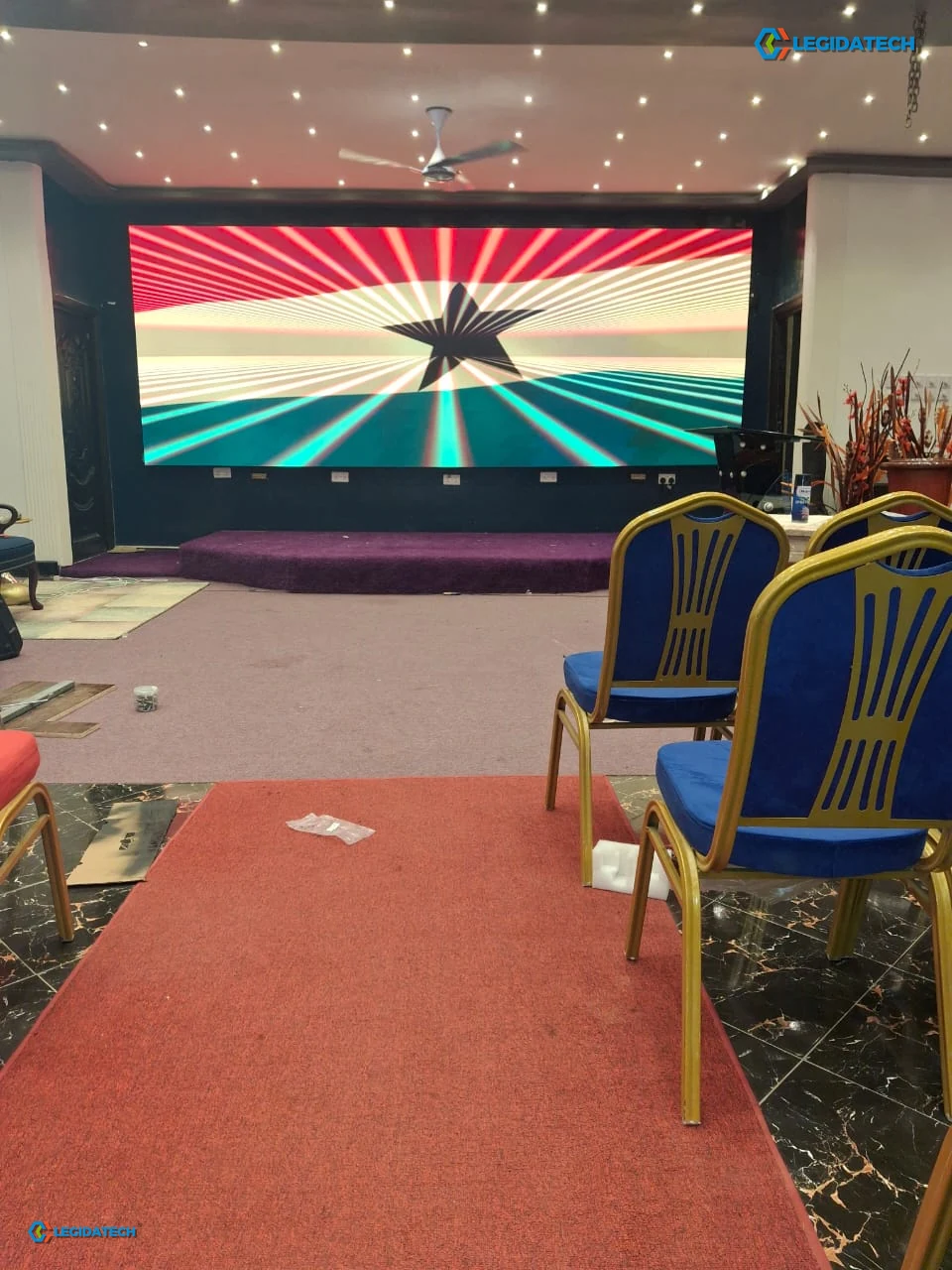
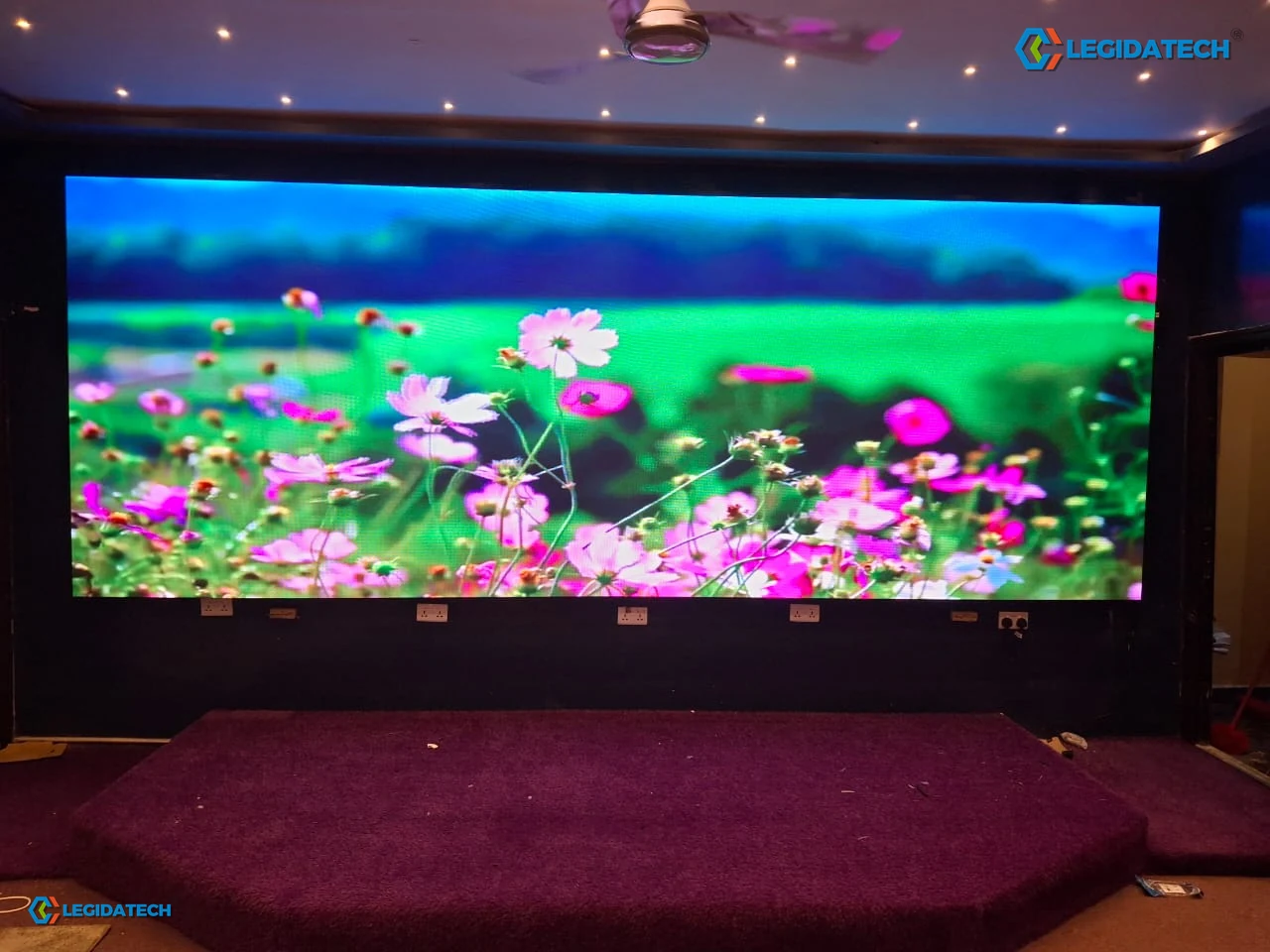
The photographs are from install day, and they show a room that was still in use for other things: chairs in place, carpet down, packing material on the floor, the wall already lit by the time the last frames were taken.
What the building allowed
The screen is a wall fix, not a frame built out from the structure. That matters in a leased hall: no structural steel, no cutting, and nothing that a landlord would object to. The cabinets hang against the wall, cable routing runs in the shallow void behind the panels, and because the wall is front-service there is no need for a corridor behind it.
Why 3 kg cabinets matter here
At 3 kg per 480 × 320 mm cabinet, two people position a panel by hand and the fixing loads are modest. In a hall where the work happens between services and the chairs stay out, that is the difference between an installation that fits the gaps and one that closes the building. The whole wall weighs roughly 190 kg — less than four adults — spread across a wall that was already carrying a backdrop.
Commissioning in a hall with fans
Two things get set on site rather than at the factory: the pixel canvas (2,048 × 768, handed to the media team as a template) and the brightness, balanced against the hall’s lighting and the fans’ movement. A wall set too bright in a room with ceiling fans and white marble reads as glare from the back rows; the same wall at a matched level looks calm.
Content Fit: 2.67:1, Not 16:9
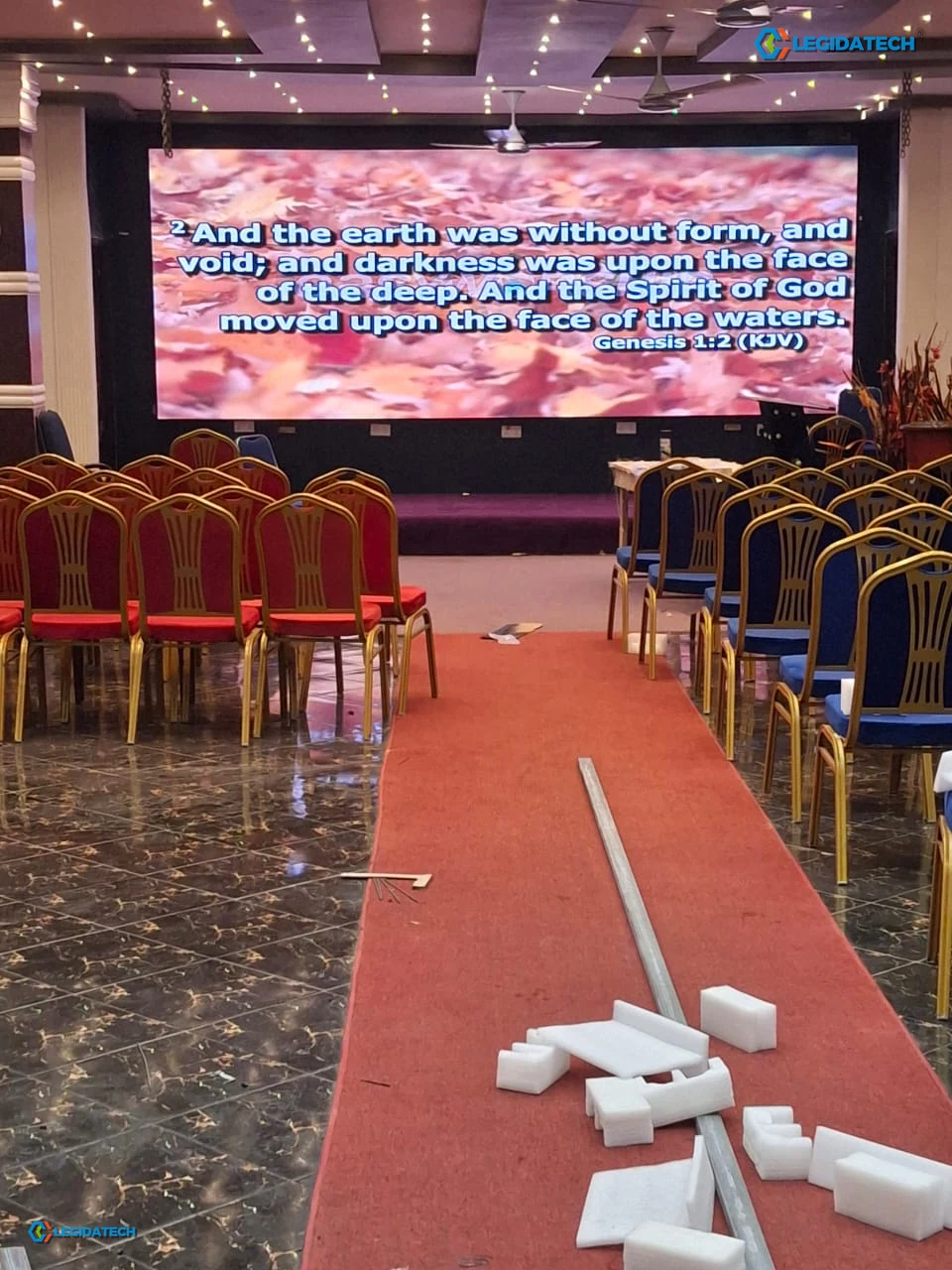
A 16:9 feed on this wall occupies the middle 1,365 px of the 2,048 available, leaving about 340 px of black at each end. That is a third of the wall doing nothing. The assembly’s media team therefore works at native ratio: the church name across the full width, a logo left with the verse right, and single-line scripture that uses the width instead of being squeezed into a 16:9 box.
This is the same lesson as on our wider Ghanaian projects, at a smaller scale. A wall is a canvas with a shape; the shape is decided by the room, and the content has to follow it.
The Screen in Service
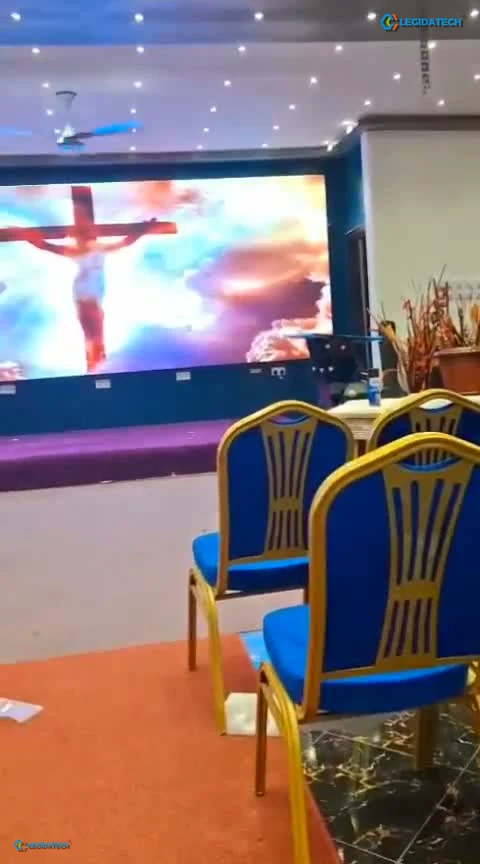
In service the wall carries a name, a logo and a verse, and occasionally a short video loop before the meeting starts. That is a modest content load, and it is worth saying that a wall like this does not need a media department: one operator, a laptop and a template pack cover it. The failure mode on small church walls is not technical, it is content — a wall that only ever shows a static logo stops being read after a month. Even one rotating verse slide per week changes that.
If the Church Relocates
This is the question a leased-hall church should ask before signing, and most suppliers do not raise it. Four things make a wall like this movable.
The cabinets come off the wall, not out of it. Front-service magnetic modules and a wall fixing mean demounting is the install in reverse, not demolition.
The wall was sized in modules, not to the building. The 192 modules can be re-laid in a new hall — 32 module columns by 6 module rows is the same 192 modules in a 10.24 × 0.96 m shape, and it stacks into whole cabinet rows — provided the cabinets, cards and processor travel with the screen. It is a re-layout, not a new wall.
Spares should travel with the wall. We recommend holding two or three modules, a power supply and a receiving card in the church office; that is what a re-install, or a mid-week failure, actually needs.
The processor is the part people forget. It has to be sized for the new canvas, and it is worth keeping the original specification sheet with the screen so a future installer knows what was delivered.
LED Screens in Ghana and Kumasi
Kumasi projects sit inside the same Ghanaian market as Accra and Tema, with the same shipping route through Tema and the same 230 V / 50 Hz supply. Delivery runs through Tema with the same 230 V / 50 Hz supply as the rest of Ghana. A 46.7 m² stage backdrop in Accra shows what the same product family does at four times this size, and the Living Faith wall in Nigeria is a comparable mid-size sanctuary project.
What Drives the Cost of a Small Church Wall
- Area. 9.8 m² is a small wall; at P2.5 the equipment band is roughly US$5,900–7,840 before mounting, control and freight.
- Pitch. P3.91 would cut the panel cost but soften text at 15 m; P1.86 would add resolution the room cannot use.
- Mounting. A wall fix is cheap; a frame or a structural solution is not, and in a leased hall the cheaper answer is usually also the reversible one.
- Control. One processor for 192 modules, sized for inputs rather than area — this is the line item that surprises committees.
- Freight and clearing. Sea freight to Tema, duty, VAT and clearing, quoted as separate lines so the landed number is visible.
Published ranges on this site run US$600–1,300 per m² across pitches, with P2.5 in the lower half; for 9.8 m² the equipment line is roughly US$5,900–7,840, equipment only, before mounting, control, freight and installation. Those figures are indicative, not a quotation.
Four Checks Any Buyer Can Run on a Quotation
Reconcile area, module count and resolution. 5.12 × 1.92 m at P2.5 is 192 modules, 9.8 ㎡, 2,048 × 768 px. Three numbers that must agree.
Ask whether the mounting assumes rear access. In a leased hall, a rear-service design is a design that will need a corridor the building does not have.
Ask for the native pixel canvas. 2,048 × 768 as a template file, so the media team stops producing 16:9 slides for a 2.67:1 wall.
Ask what happens when the church moves. If the answer is “you buy a new screen”, the design was not built for a leased hall.
Frequently Asked Questions
How much does a 5 × 2 m church LED screen cost in Ghana?
A 5.12 × 1.92 m P2.5 wall is 9.8 m². The equipment band is roughly US$5,900–7,840, before the wall fixing, the processor and the landed costs into Tema — indicative, not a quotation.
Is a 5.12 × 1.92 m screen big enough?
For a hall seating a few hundred, yes. What matters is the text height at the back row: at 2,048 px across, a 70 px line is 175 mm tall and reads at 15 m. A bigger wall would not add legibility in this room.
Can it be moved if the church relocates?
Yes. Front-service modules, a wall fixing and a module-based layout mean the wall can be demounted and re-arranged into a different shape in a new hall, provided the cabinets, cards and spares travel with it.
Will a 2.67:1 wall work with 16:9 video?
Only by cropping or letterboxing. The native canvas is 2,048 × 768, so a 16:9 feed uses the middle 1,365 px. Most services run native-ratio graphics and reserve full-width video for atmosphere.
Do you ship to Kumasi?
Yes. Screens ship to Tema and clear into Ghana, then travel inland to Kumasi. Ghana runs on 230 V / 50 Hz, within the Ehonor supply range, so the preparation is plug type and earthing rather than voltage conversion.
Can we extend the wall later?
Yes, if the cabinets and the processor headroom are planned now. Extending a module-based wall is a matter of adding columns or rows; extending a fixed-frame wall is a rebuild.
Get a Similar Church LED Screen Quote
Send the width and height of the wall behind your platform, the distance from the back row, and whether the building is yours or leased. If it is leased, say so — the mounting and the demounting plan change with that answer.
Indoor fixed church LED screens | Accra 46.7 m² stage backdrop | Get your church LED screen quote
More church LED screen projects
- P2.5 church LED screen in Nigeria: 11.5 m² Living Faith case
- Church of Pentecost Abofu, Accra: 6.1 m² P2.5 worship centre wall
- RCCG Mount Olives Abuja: 8.4 m² P2.5 church LED wall
- Indoor fixed church LED screens (Ehonor series)
- How much a church LED screen costs: the price framework
- Church LED screens in Nigeria: the 2026 buying guide
Get a quote for a screen like this
Send a photograph of the front wall, the height of the stage opening and the distance to your back row. We will come back with a pitch, a pixel canvas and a price for the room you actually have.
What you get with the quotation: cabinet layout, resolution, processor inputs and an installation sequence your contractor can follow.