


Every church that builds or renovates a sanctuary reaches this fork, usually with a projector already on the wall and a quote for an LED wall on the table. The debate goes wrong because both sides argue about quality, when the real question is which failure mode your room can live with. After delivering church LED installations in 12 countries and being asked to review projector quotes in the same rooms, we have found that three measurements — ambient light, front-row distance and whether the service is filmed — decide the answer before price is even discussed.
Quick Answer: LED Wins in Lit Rooms, Projectors Win in Dark Ones
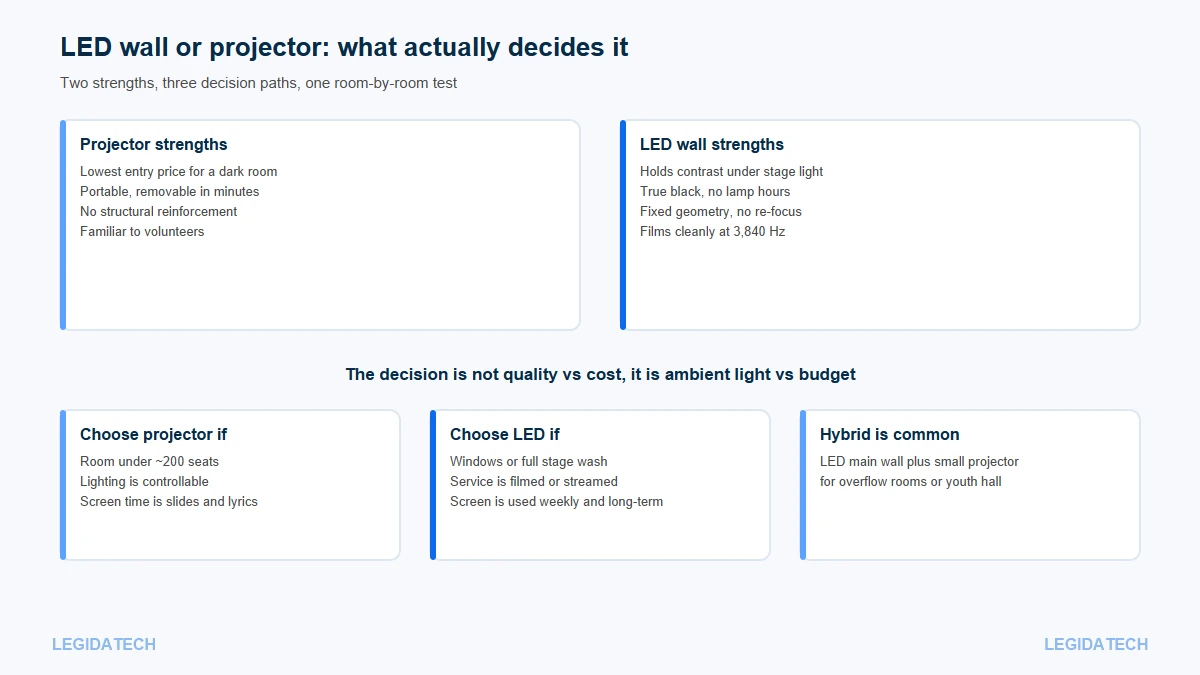
Quick Answer: If the room has windows or full stage wash, or the service is livestreamed, an LED wall wins; a projector still wins in a dark room under about 200 seats with a tight budget.
That is the short version, and it holds for most sanctuaries we see. The rest of this article is the reasoning, because a church that understands why will make a better decision than one that follows a rule of thumb — and will be able to defend it to a board that has heard a projector salesman’s version of the same numbers.
Why the Comparison Keeps Going Wrong
The numbers most churches compare are not comparable. A projector is specified in lumens, which measure light leaving the lens; an LED wall is specified in nits, where 1 nit equals 1 candela per square metre of surface. One describes a beam, the other a surface, so “8,000 lumens versus 700 nits” is not a comparison at all — it is two different questions.
The second confusion is the screen. A projector’s image depends on the surface it hits: a grey or beige wall in a lit room returns far less contrast than a dedicated screen, and a screen 3 m wide in a 20 m room is a different product from a 6 m LED wall in the same room. Comparing a projector’s sticker price with an LED wall’s price compares a device with a system.
- Lumens — total light output at the lens, affected by throw distance and screen size.
- Nits — surface brightness of a self-emissive display, unaffected by throw distance.
- Contrast in the room — what a congregation actually perceives, and what neither datasheet states.
The Three Tests That Settle It
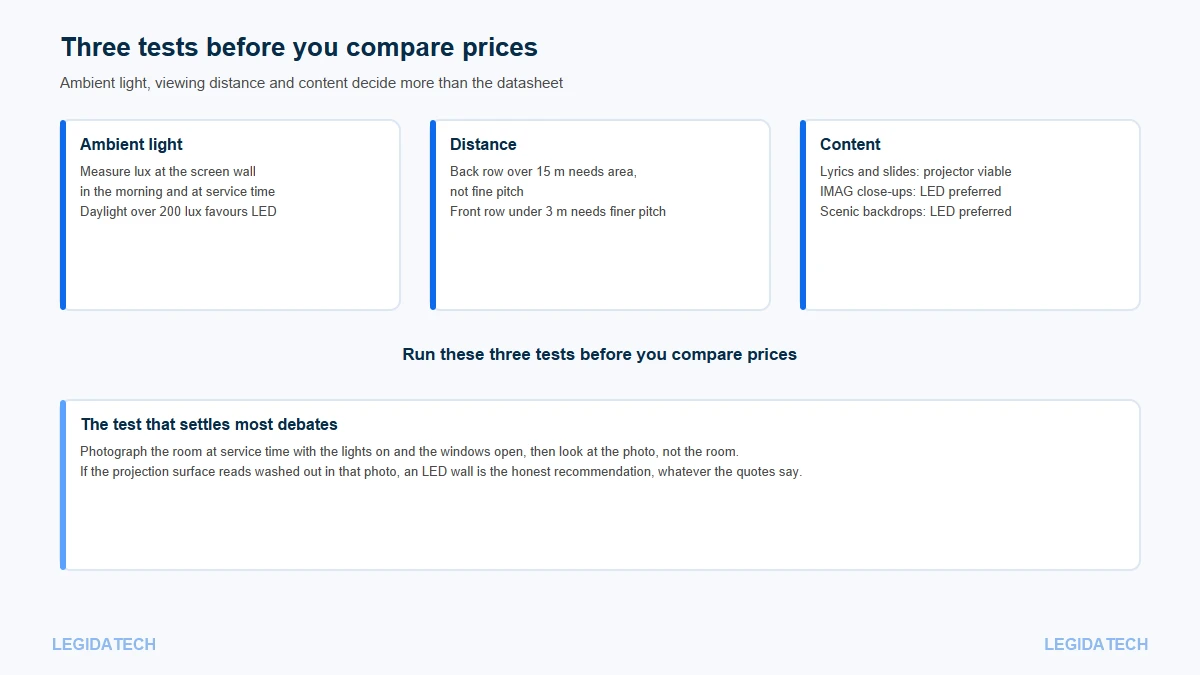
Run these before anyone quotes, because they change the answer more than price does.
Test 1: Ambient Light at the Screen Wall
Measure light at the wall in the morning and again at service time with the room full of people. If daylight or stage wash puts more than roughly 200 lux on the surface, projection loses contrast faster than most churches expect, and an LED wall becomes the honest recommendation. Our indoor church walls run 600-1,000 nits, which exists precisely to hold an image in a lit room; a projector has no equivalent lever.
Test 2: Distance to the Front Row
Projection is viewed as a whole image, so the front row’s closeness matters less. An LED wall is viewed as pixels, so a front row 2.5 m from the screen needs a pitch of about P2.5 or finer to avoid visible dots. That is a cost driver unique to LED, and it is why a room with a very shallow front row sometimes prices itself out of LED at the pitch it needs.
Test 3: Whether You Film the Service
If the service is streamed, the wall joins the camera’s exposure problem. A self-emissive surface at full brightness clips to white while faces sit in shadow, so the wall must run dim — and a dimmed wall needs low-brightness high-grayscale capability to stay smooth. Projectors have a different camera problem: the projected image is often too dim relative to stage lighting, and its flicker can interact with shutter speeds.
Direct Comparison: What Each Does in a Sanctuary
| Factor | LED wall | Projector |
|---|---|---|
| Light source | Self-emissive per pixel | Lamp or laser reflected off a surface |
| Brightness unit | Nits (surface) | Lumens (beam) |
| Performance in a lit room | Holds contrast under stage wash | Washes out; needs lighting discipline |
| Black level | Pixels off = true black | Grey, limited by ambient light |
| Consumables | No lamps; occasional modules and PSUs | Lamps or laser modules on an hour count |
| Alignment | Fixed; no focus or keystone drift | Needs periodic focus and geometry correction |
| Front-row limit | Set by pitch (~1,000x pitch minimum) | Not pixel-based; limited by resolution |
| Structural work | Load-bearing wall or truss required | Ceiling mount plus screen surface |
| Typical entry cost | Higher per room | Lower per room |
| Where it fails | Cost at very fine pitch | Ambient light, lamp hours, washout |
Read the table by column rather than by row: the LED column is consistently better in lit rooms and consistently more expensive, and the projector column is consistently cheaper and consistently dependent on lighting control. There is no row where the answer flips, which is why the argument rarely resolves by comparing features.
Five-Year Cost: Lamps, Service and Spares
The purchase price is the smallest part of this comparison. A projector’s real cost includes lamps or laser modules, filters, cleaning, and the labour to re-focus and re-align; a wall’s real cost includes spares and the occasional module replacement. Neither is free, and the shape of the difference is what matters.
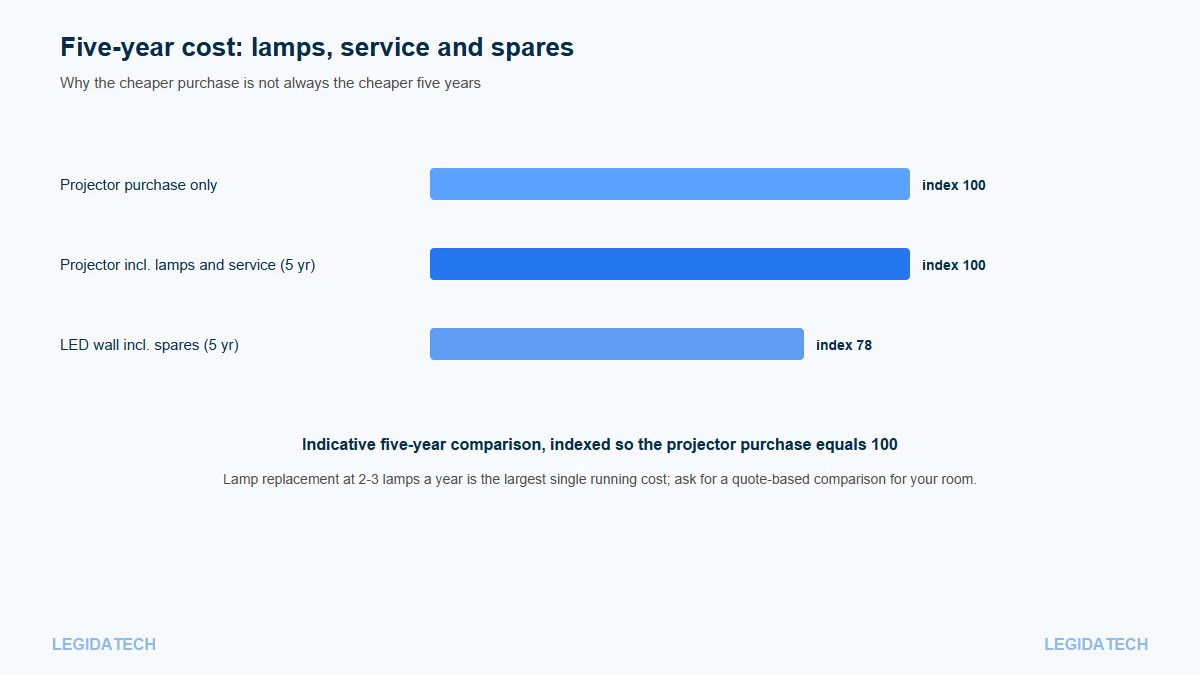
Two cautions on cost comparisons. First, an index is not a quote: the numbers above illustrate the shape of the trade-off, and your own comparison should use real quotes for your room. Second, a projector replaced twice in five years costs more than its sticker price suggests, while an LED wall that is never serviced costs less than its quote implies. Both directions of error are common in church conversations.
What a Projector Still Does Better
An honest comparison has to say where the projector wins, and in some rooms it genuinely does.
- Dark, small rooms. A 120-200 seat chapel with controlled lighting and no streaming is a projector’s natural habitat; the money saved is often better spent on audio.
- Portability. A projector can be removed in minutes, which matters for halls shared with a school or a community group.
- No structural work. No load calculation, no truss, no crane — relevant in heritage buildings where drilling is restricted.
- Familiarity. Volunteers already know how to run it, and a replacement is a purchase rather than a project.
If three or more of those apply, the projector is not a compromise; it is the correct answer for that building. If you send us your room photos we will say so plainly rather than quoting a wall that does not fit.
What an LED Wall Does Better
Our viewing-distance conventions come from LED display engineering practice; the LED display branch of the China Optics and Optoelectronics Industry Association publishes reference material at leds.org.cn. The LED case rests on conditions that churches often underestimate until they live with them.
- Daylight and stage light. A wall at 600-1,000 nits does not care what the room is doing, which changes what services can look like.
- Cameras. At 3,840 Hz the wall stops being a camera problem, and a dimmed wall with deep grayscale keeps the stream clean.
- Zero maintenance rhythm. No lamp hours, no filter cleaning, no re-focus before Easter. The wall either works or it does not, and a spare module fixes the one failure mode that matters.
- Content freedom. Scenic backdrops, IMAG, motion graphics and true black between segments are all possible in the same rectangle.
The trade is real: LED costs more up front and needs structure. Churches that livestream, run contemporary worship with full lighting, or have windows they cannot shade usually find the trade worth making. Our church LED screen buying guide covers the sizing and pitch decisions that follow this choice.
Hybrid Setups: When Both Belong in the Room
A growing number of churches run both, and it is not indecision. Three patterns recur in our projects:
- LED main wall plus projector for overflow. The main room gets the wall; a side room keeps a cheaper projection setup for the 30 people who arrive late.
- LED backdrop plus projector for front projection. The wall carries scenic content behind the worship team while a projector handles a front screen for notes.
- LED wall now, projector retired later. The structure is built for the wall, the projector stays as a bridge for one or two seasons.
The hybrid question is usually a budget-phasing question rather than a technology question, and it is worth asking your supplier to quote both phases at once so the structure is not built twice. Ask us to price both phases together and we will show the structure cost once.
The Practical Decision for Your Room
| Your situation | Recommendation | Why |
|---|---|---|
| Under 200 seats, dark room, no streaming, tight budget | Projector | LED’s advantages do not apply; save the budget for audio |
| Windows, stage wash, or filmed service | LED wall | Ambient light and camera behaviour decide it |
| 400+ seats with IMAG | LED main plus side screens | A projector cannot hold up under stage lighting at that size |
| Shared hall, removable equipment required | Projector or rental LED | Permanent structure is not an option |
| Heritage building, restricted fixings | Projector or floor-mounted LED | Structural constraints dominate |
| Planning to stream within two years | LED wall | Buying for the future service is cheaper than upgrading twice |
One warning on this table: it assumes the room is the constraint. If the constraint is a board that has already approved a projector budget, the honest advice may be to fix the lighting first, live with projection for a season, and revisit LED when the streaming plan exists.
Frequently Asked Questions: LED Wall vs Projector for Church
Is an LED wall better than a projector for a church?
In a room with stage lighting, windows or livestream cameras, yes: the wall holds contrast and never needs a lamp. In a dark chapel under about 200 seats with a controlled budget, a projector can still be the better buy, and the money saved often improves the service more than the screen would.
How many lumens do I need to match a 700 nit LED wall?
There is no fixed conversion, because lumens describe beam output and nits describe surface brightness. A projector’s apparent brightness depends on screen size, screen gain and throw distance. The practical method is to compare both in the same room under service lighting rather than converting between units on paper.
Does a projector work in a church with windows?
It works, but with visible cost: the image washes out whenever daylight reaches the screen, so services become dependent on blinds and lighting discipline. If the windows cannot be shaded, an LED wall is usually the more reliable choice even though it costs more at purchase. In practice that means reading the light at 10 am and again during the service, because the two often differ by a factor of three.
Which is cheaper over five years?
It depends on usage. A projector that runs lamps and filters for five years narrows the gap considerably, while an LED wall with a small spares kit and no consumables widens its advantage the longer it runs. Ask both suppliers for a five-year cost including consumables, labour and spares.
Can I film an LED wall without flicker?
Yes, if the wall is specified with a high refresh rate, commonly 3,840 Hz, together with an appropriate scan mode. Below roughly 1,920 Hz cameras tend to capture scan lines even when the wall looks perfect to the congregation. Specify it before the order, not after commissioning. Ask for a clip filmed at your lens length and shutter angle, since refresh rate alone does not guarantee a clean shot.
Do LED walls need special power?
They need dedicated circuits rather than a building upgrade. Cabinet power supplies typically accept 100-240 V AC at 50/60 Hz with rated output between 150 W and 400 W each, so the electrical plan is a matter of distribution and isolation rather than capacity. Ask for a per-cabinet load schedule.
How much maintenance does an LED wall need?
Very little in normal use. LED beads are rated for roughly 80,000 to 100,000 hours, and the components that fail are power supplies and the occasional module. Keeping three to five percent of the screen area in spare modules, plus one or two power supplies, covers the realistic failure set for the first years.
Can we start with a projector and add an LED wall later?
Yes, and it is a common sequence, but plan the structure now. If the wall will eventually hang on a truss or a load-bearing wall, design that in during the projector phase so the room does not get rebuilt twice. Phasing the screen is easy; phasing the steel is not.
What about laser projectors?
Laser projectors remove lamp replacement and reduce maintenance, which narrows the operating-cost gap with LED. They do not change the ambient-light problem: a projected image still loses contrast when stage lighting and daylight reach the surface. The decision still turns on the room, not the light source. A laser unit still depends on the projection surface, so the ambient-light test applies unchanged.
Which is better for worship lyrics specifically?
Both can show lyrics well. The difference appears at the edges: large white text on an LED wall stays crisp under stage light, while projected white text washes out first because it is the brightest thing on the surface. If lyric legibility is the main complaint today, that is a data point for LED.
How long does an LED wall install take compared with a projector?
A projector is typically an afternoon. A fixed LED wall is usually two to four days on site, plus structure and electrical work beforehand, and it needs commissioning and volunteer training. The calendar cost is real and should be part of the board decision, not a surprise in the final week.
Next Step: Test Your Room Before You Choose
Take three photos of your sanctuary at service time: the wall with lights on, the front row looking back at the screen position, and the camera’s framing of the platform. Those three images answer more than any specification. If the wall reads washed out in the first photo, LED is the honest answer; if the room is dark and the budget is tight, projection still has a place.
Send us those photos and your seating plan, and our engineering team will return a comparison of both options with indicative costs for your room — or request a phone call. For the alternatives to projection in more detail, read LED screens for the sanctuary and the brightness guide.


