


Church LED Screens in GhanaPrice bands, twelve delivered projects in Accra, Kumasi and Tema, and why nine of them ended up at P2.5
What a Ghanaian Wall Costs, in One Paragraph
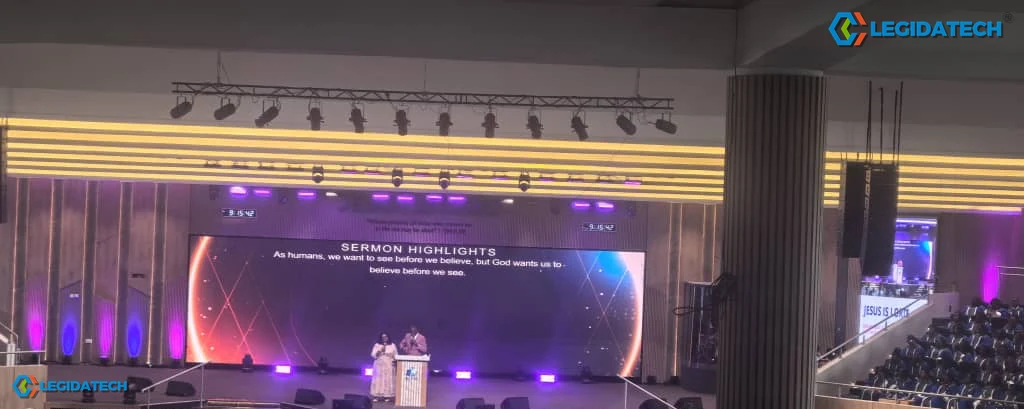
An indoor P2.5 church wall in Ghana runs about US$500–800 per m² factory-direct, and an outdoor P10 sign about US$200–320. A 6 m² chapel wall therefore sits in a US$3,000–5,000 equipment band; a 12–20 m² sanctuary wall in the US$6,000–16,000 band. Ghana clears most of these screens through Tema, so the freight and the duty assessment are the two lines that change the landed number from the equipment number. Everything here is indicative and none of it is a quotation.
Twelve of our projects are in Ghana, from a 2.8 m² panel in Accra to a 46.7 m² stage backdrop, also in Accra. Ten of the twelve have site photography in our files. That is a small enough set to describe honestly, and large enough to show a pattern: nine of the twelve are P2.5, and the three that are not are two outdoor P10 signs and one wall where the pitch was not recorded.
Price Bands, and What Lands at Tema
The equipment bands are the same as anywhere we ship: the factory price does not change with the destination, only the freight, the duty and the installation do. Ghana has no public per-square-metre price data that we would trust, which is why this table is split into the part we can quote and the part only your clearing agent can price.
| Line | How it is charged | What to check before signing |
|---|---|---|
| Screen, indoor P2.5 | Per m², US$500–800 indicative | Area must reconcile with the cabinet count |
| Screen, outdoor P10 | Per m², US$200–320 indicative | Brightness, IP rating and whether it is single or double sided |
| Control system | Per processor, quoted separately | Input count: camera, ProPresenter, playback, spare HDMI |
| Steel frame | Per design, usually fabricated locally | Wall load, and access for a frame that is welded on site |
| Ocean freight to Tema | Per cubic metre | Carton count and total volume, not weight |
| Duty and VAT | Assessed at clearing by the Ghana Revenue Authority | The HS code on the invoice, and the assessment in writing before arrival |
Equipment bands are our own factory-direct ranges for standard configurations, reviewed November 2026, excluding freight, duty, VAT, structure, control system and installation. They are not derived from a competitor price list. Duty and VAT rates depend on the HS code used at clearing and are not quoted here.
The pitch bands, the whole-screen budgets and the lines that sit outside the equipment price are on our church LED screen price guide. There is no public price index for church LED screens in Ghana that we would rely on, and the Tema lines are the part that moves: the equipment band above is the same one we quote to any market, while freight, duty and haulage are Ghana-specific. Two habits make the landed number predictable. Ask for freight as a separate line with a sailing date rather than as “included”, and ask the clearing agent for the duty assessment before the container leaves Shenzhen. A church committee that approves an equipment figure and discovers the landed figure later is the most common way these projects stall.
Why P2.5 Keeps Winning in Ghanaian Sanctuaries
Ghanaian church buildings tend to run deep rather than wide: a long nave, a raised platform, and a back wall that ends up 18–25 m from the front row. That geometry decides the pitch almost by itself, and it is the reason nine of our twelve Ghanaian projects are P2.5 rather than P3.91.
P2.5 puts 2.5 mm between pixel centres. The rule we use is that a comfortable seat is about 1,000 × the pitch away, so 2.5 m for P2.5 and 3.9 m for P3.91. In a 20 m-deep nave both clear that bar optically. The difference appears at the back of the room on lyric text, and it appears much more strongly on camera: if the service is streamed, the pitch that looks fine in the room can read as soft on a phone screen.
| Nave depth (wall to last row) | Pitch we would propose | Why | What you give up |
|---|---|---|---|
| Under 15 m | P3.91 | Saves money with no visible difference from row 8 back | Loses sharpness on camera at the closest zoom |
| 15–20 m | P2.5 | Text stays crisp to the back row | Higher cost per m² than P3.91 |
| 20–30 m | P2.5, with the wall built as large as the room allows | Size buys more legibility than pitch does beyond 20 m | Structural and power work for the larger wall |
| Over 30 m, or balconies | P2.5 plus side screens for IMAG | The back rows watch people, not the centre wall | Two screens, two signal paths |
The thing to check before agreeing to P2.5. Ask what the wall actually resolves. A 6.08 × 1.92 m wall at P2.5 on a 320×160 mm module is 19 × 12 modules, which is 2,432 × 768 pixels — not 4K, and not full HD. It is the correct wall for that band of space, but a supplier who calls it 4K has not done the arithmetic.
What We Have Delivered in Ghana
Eight of the twelve, with the room data we hold. Where the original build used a module size we cannot confirm, the resolution column shows the cabinet design rather than a guessed pixel count.
| Church | City | Wall size | Pitch | Resolution | Year |
|---|---|---|---|---|---|
| Accra auditorium stage backdrop | Accra | 12.16 × 3.84 m (46.7 m²) | P2.5 | 4,864 × 1,536 | 2025 |
| ICGC MAINS | Tema | 8.64 × 3.84 m (33.2 m²) | P2.5 | 3,456 × 1,536 | 2025 |
| International Central Gospel Church | Accra | 10.24 × 1.92 m (19.7 m²) | P2.5 | 4,096 × 768 | 2026 |
| Church of Pentecost — Ebenezer | Accra | 4.48 × 2.88 m plus a 1.92 × 1.44 m panel (12.9 m² main wall) | P2.5 | 1,792 × 1,152 | 2026 |
| Church of Pentecost — Royal Temple | Tema | 6.08 × 1.92 m (11.7 m²) | P2.5 | 2,432 × 768 | 2026 |
| Warriors Chapel Worldwide | Kumasi | 5.12 × 1.92 m (9.8 m²) | P2.5 | 2,048 × 768 | 2026 |
| PNEUMA Christian Center | Accra | 3.84 × 1.92 m (7.4 m²) | P2.5 | 1,536 × 768 | 2026 |
| Church of Pentecost — Abofu | Accra | 3.2 × 1.92 m (6.1 m²) | P2.5 | 1,280 × 768 | 2026 |
Resolutions calculated on a 320×160 mm module at P2.5, which is 128×64 pixels per module. Areas are the wall area; the Ebenezer project also included a separate secondary panel.
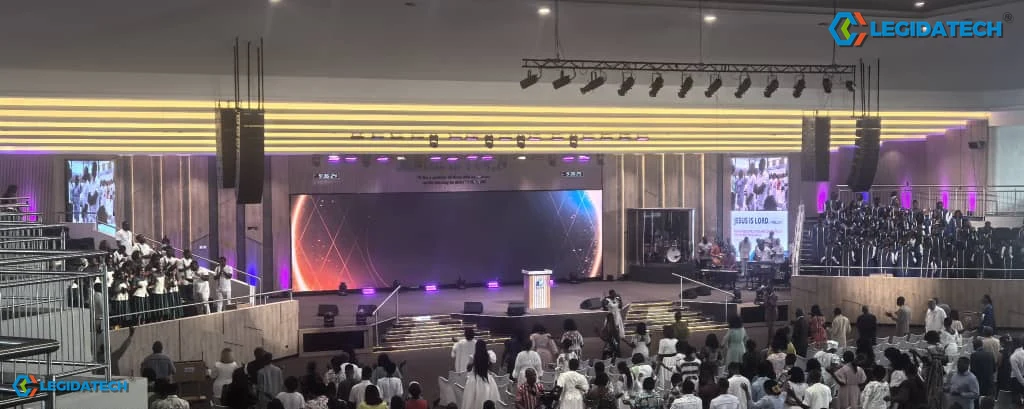
The Accra wall from the side balcony — 46.7 m² at P2.5.
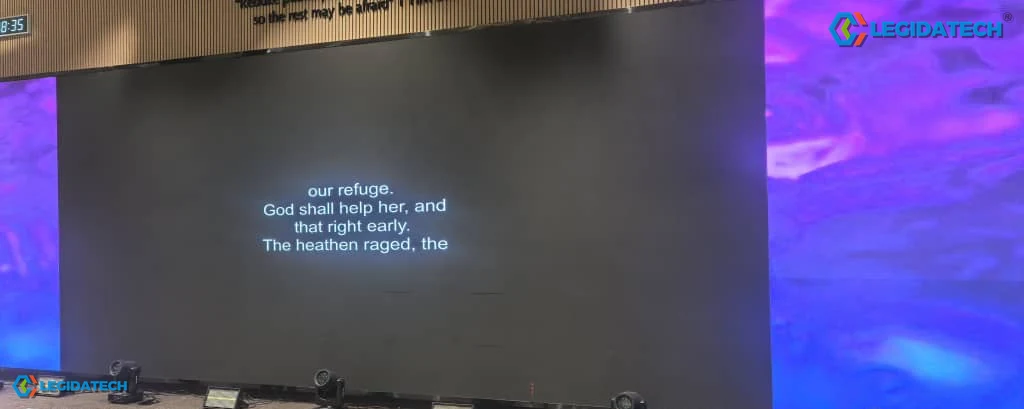
P2.5 at close range: the pitch that keeps lyric text crisp from the back row.
The Repeat Pattern: Four Church of Pentecost Sites
The most useful evidence in our Ghanaian files is not a single large wall, it is that four Church of Pentecost sites appear in them: Abofu and Ebenezer Worship Centres in Accra, Royal Temple in Tema, and Kasoa Akwele Central. A denomination that buys the same cabinet system for a 6.1 m² chapel wall and a 11.7 m² hall wall is telling you something about the supply chain, not about the screens.
Three things make that repeat purchase work, and they are worth asking any supplier about. The cabinet is the same across sites, so a module from one church fits another and the spare-parts box is one box. The control system is the same, so a volunteer trained at one site can operate the next one. And the pitch is decided by the room rather than by the catalogue, so a smaller hall gets P2.5 at 6 m² rather than an oversized wall it cannot fill with content.
If your denomination is adding screens across congregations, the practical sequence is to fix the cabinet and the control system first, then let each site choose its wall size within that system. The alternative — a different supplier for each site — leaves you with four spare-parts boxes and four sets of drawings.
Delivery and Clearing Through Tema
Most Ghanaian church screens clear through Tema and travel on to Accra, Kumasi or Takoradi by road. The sequence is the same one we run for Nigeria, with the port and the agent changed:
- Survey and drawings. Wall dimensions, platform height, frame position and the module count. This is the step that makes the quotation and the delivered area agree.
- Production. Two to three weeks for a standard indoor cabinet; longer for a fine pitch or a custom cabinet.
- Packing. Export cartons with the module count marked on each box, and a packing list that matches the invoice line by line.
- Freight to Tema. Charged by volume. The carton count is the number that moves this line, not the weight.
- Clearing. Your agent works from the commercial invoice, packing list and HS code. Duty and VAT are assessed on the CIF value; confirm the current assessment with the agent before the budget is approved.
- Haulage and installation. Tema to Accra is a short haul; Kumasi and the north add a day. Installation is either the church’s contractor or a supervised crew.
One Ghana-specific point about the room rather than the port: many of the sanctuaries in our files have a suspended ceiling and a plasterboard back wall. The frame has to be tied into structure behind the plaster, not into the plaster, and that has to be decided before the wall size is finalised. A survey photo of the wall with the ceiling in shot saves a week.
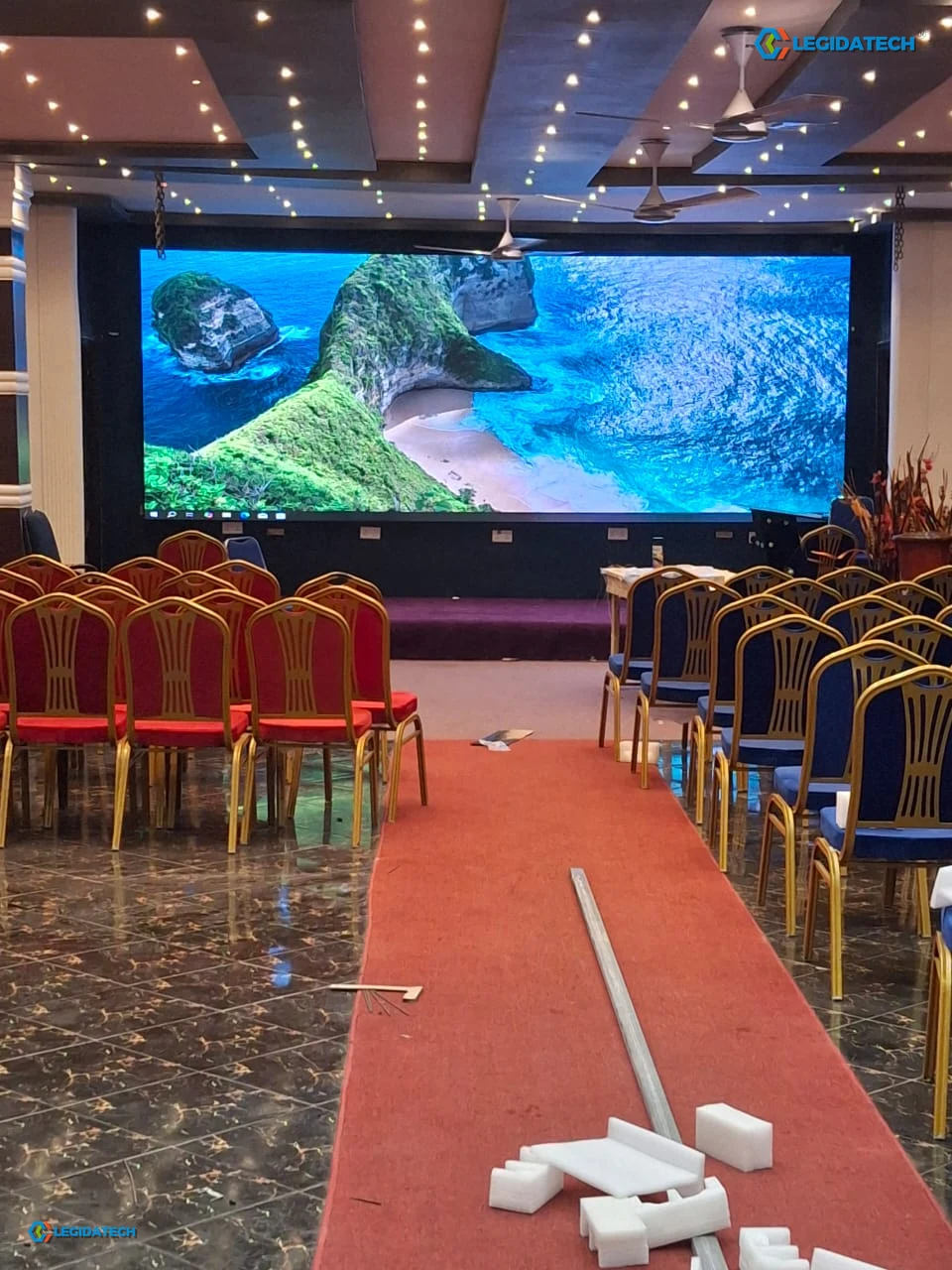
Warriors Chapel Worldwide, Kumasi — 5.12 × 1.92 m at P2.5.
Who Actually Signs the Contract in Ghana
The market has the same three routes as Nigeria, and the same trade-off. A local AV or IT integrator in Accra sells the screen inside a service contract and is the right answer when the church needs someone on site within a day. A factory sells equipment with drawings and remote support and is usually the cheaper route for a fixed wall. Rental houses supply crusades and conventions and take the screen away afterwards.
What is different in Ghana is how often the integrator is a multi-service contractor rather than a dedicated AV house. That is not a weakness — a firm that already handles electrical work, CCTV or solar can be a better partner for a church with an unstable supply than a pure screen dealer — but it does mean the screen is not necessarily their core product, so the specification has to be written down rather than assumed.
The named comparison, including where each supplier is weak, is on our Top 10 church LED screen suppliers in Ghana page.
What we do not have in Ghana. We do not run a warehouse or a service team in Accra. Ghanaian projects ship from Shenzhen against a signed drawing and are installed by the church’s contractor or a supervised crew, with spares held on site and support remote. If a supplier claims a local warehouse, ask for the address and go and look at the stock.
Six Questions Ghanaian Churches Ask
How much does a church LED screen cost in Ghana?
Indoor P2.5 is about US$500–800 per m² factory-direct, so a 6 m² chapel wall is roughly US$3,000–5,000 and a 12–20 m² sanctuary wall US$6,000–16,000 in equipment. Freight to Tema, duty, VAT, the frame and installation are additional, and they are the lines that decide the landed cost.
Can we start with one wall and add a second screen later?
Yes, and it is cheaper if the control system is decided now. A processor with spare outputs lets a second screen or a side-screen pair be added without replacing the first wall’s electronics. Deciding the processor on price alone is the most common reason a church has to buy twice.
Will the screen run on a generator?
The display will; the processor is the part that reboots. Size a small UPS for the processor and the sending card so a changeover between mains and generator does not take the service down. That is a few hundred dollars and it is the difference between a wall that survives a Sunday and one that does not.
Is P3.91 acceptable if we want to save money?
In a room under 15 m deep with the closest seat beyond about 6 m, yes — the congregation will not see the difference. In a 20 m nave, the back rows notice softer lyric text, and a streamed service will show it more than the room does.
How do we handle duty and clearing at Tema?
Duty and VAT are assessed on the CIF value when the container clears, and the rate depends on the HS code your agent files under, so we do not quote a tax figure. Ask the agent for the assessment in writing before the container sails, and keep the clearing fee and the haulage from Tema as separate budget lines.
Can our own contractor install the wall?
Yes, and it is common in Ghana. We supply the frame drawing, the cabinet layout, the wiring schedule and a commissioning checklist, and stay reachable through the first power-up. The contractor needs to be comfortable with steel fixing into structure behind any plasterboard, and with three-phase distribution.
What to Send Us for a Firm Ghana Quote
Four numbers and one photo: the wall width, the wall height, the distance to the front row, the city, and a photograph of the wall that includes the ceiling and the platform. From those we can recommend a pitch, lay out the cabinets, quote the equipment with freight to Tema as a separate line, and give a delivery estimate for Accra, Kumasi or Takoradi.
LEGIDATECH church LED screens for Ghana — factory-direct, front service. Part of the church LED screens range; see also Nigeria and South Africa, and the P2.5 Dansoman case study for a single wall told in full.