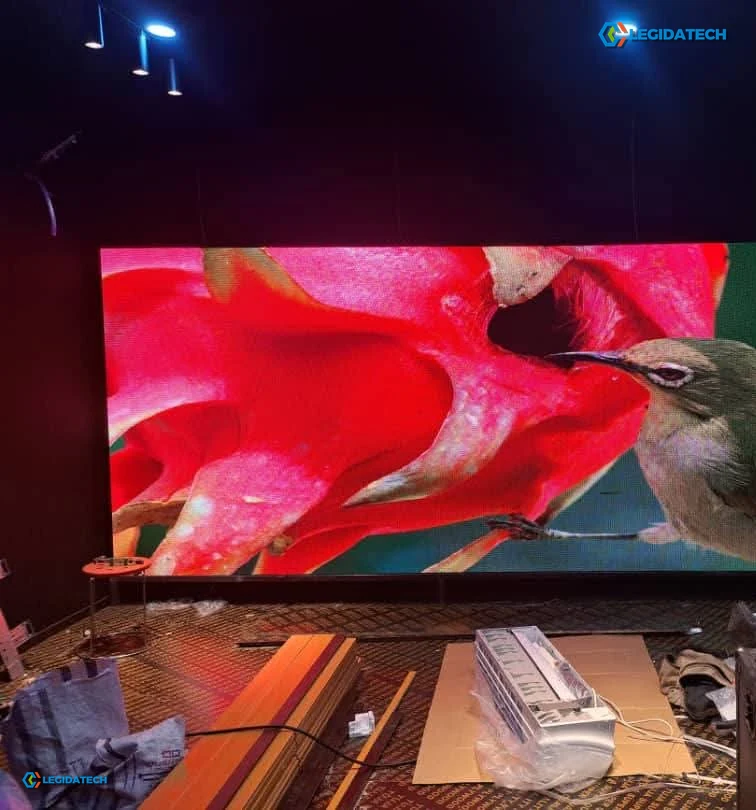


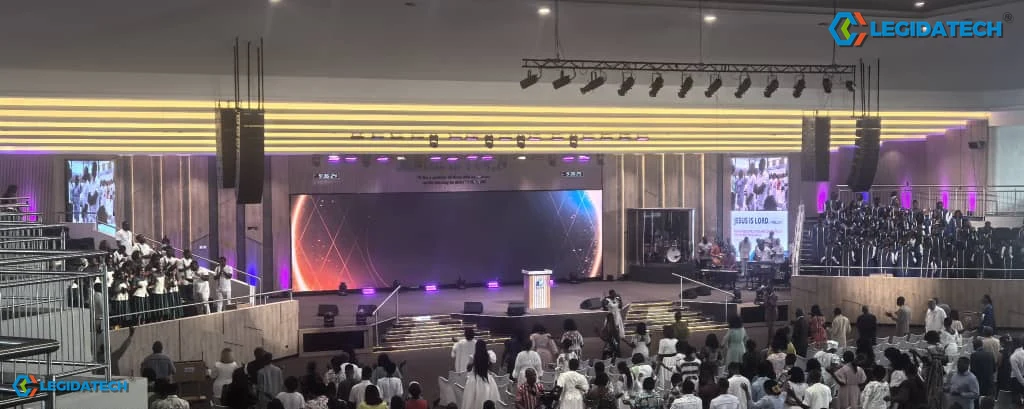
This is a 12.16 × 3.84 m P2.5 church LED screen installed in Accra, Ghana, in December 2025: 46.7 ㎡ of stage wall resolving 4,864 × 1,536 pixels, roughly 3.2:1. It is the widest church led screen Ghana has taken from us so far, and the shape of it — not the pitch — is the interesting part.
Project Facts
| Client | A church auditorium in Accra (client name withheld) |
|---|---|
| Country / City | Ghana / Accra |
| Application | Main stage backdrop, behind the pulpit |
| Product | Ehonor series indoor fixed LED display |
| Pixel pitch | P2.5 |
| Module / cabinet | 320 × 160 mm module, mounted rotated (160 mm wide × 320 mm high); 480 × 320 × 70 mm cabinet, 3 kg |
| Panel qty | 304 cabinets (38 across × 8 high), mounted portrait |
| Screen size | 12.16 × 3.84 m (46.7 ㎡) |
| Resolution | 4,864 × 1,536 px |
| Module grid | 38 columns × 24 rows = 912 modules |
| Refresh rate | 3,840 Hz |
| Service | Front service, magnetic modules |
| Delivered | December 2025 |
| Supplier | LEGIDATECH |
The Room
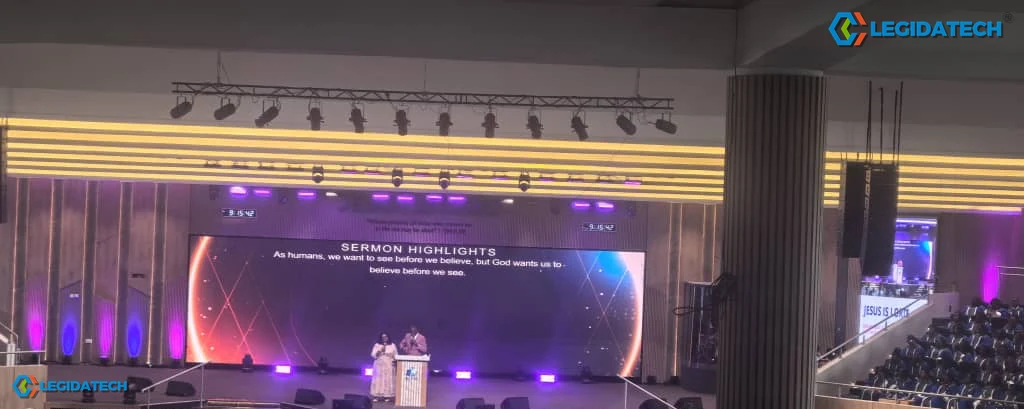
The auditorium is a modern hall with a raked balcony on three sides, warm timber panelling, exposed ceiling trusses carrying a lighting rig, and a stage deep enough for a full band and a choir. Seating runs to four figures. The screen is the wall behind the pulpit, and it is very wide relative to its height.
That proportion is the whole design constraint. A 12.16 m span at 3.84 m high is what the architecture offers once you clear the stage floor, the platform steps and the lighting positions. Nobody chose 3.2:1 for aesthetic reasons. The room did, and the screen had to follow.
Two consequences follow immediately, and they drive everything below. First, the wall is wider than any standard video ratio, so content has to be designed for it rather than cropped into it. Second, a wall of this span cannot hang off the existing stage structure; it needs its own sub-frame, which is an engineering line item rather than an installation detail.
Why This Wall Is 3.2:1
Church screens are usually specified as 16:9 because that is what a projector or a television does. A stage backdrop is a different problem: it is a wall, and the wall has a shape that exists before the screen does.
What the architecture allows
Between the stage wings there is a clear span of about 12.2 m. Below the lighting rig, the usable height is about 3.84 m — taller than that and the top of the screen sits inside the lighting positions and starts catching spill from the front truss. Those two numbers are not negotiable; they are what the building gives.
A 16:9 wall at 3.84 m high would be 6.83 m wide: roughly 56% of the available span, with 2.7 m of bare wall on each side. Building to the full 12.16 m at 3.84 m gives 46.7 ㎡ instead of 26.2 ㎡ — 78% more screen for the same height and the same lighting constraint.
What that means for the pixel canvas
4,864 × 1,536 is not 16:9 and it is not a cinema ratio. A 16:9 feed occupies only the middle 2,730 px of the 4,864 available, leaving roughly 1,000 px of black at each end — a waste of almost 20 ㎡ of glass. So the media team designs at native ratio: wide lower-thirds, panoramic scripture backgrounds, and two-up layouts (speaker on one side, translation or lyrics on the other) that simply do not fit on a 16:9 wall.
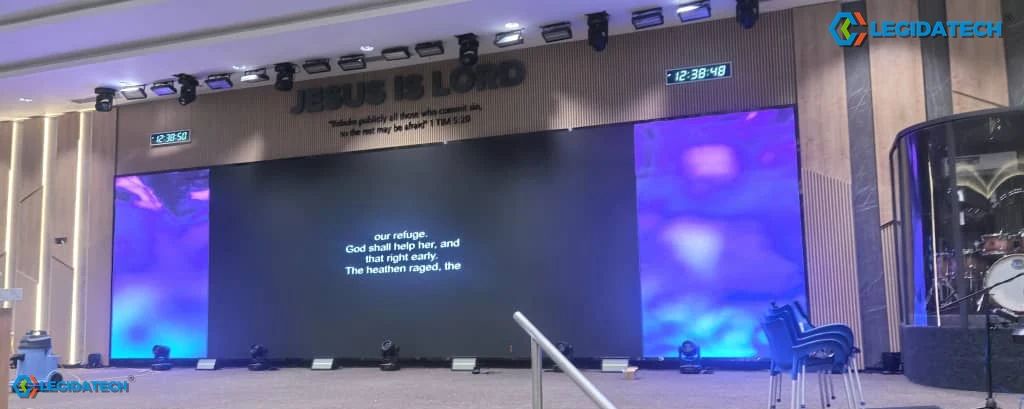
This is the part buyers underestimate. A wide wall is not a bigger television. It is a different canvas, and a church that buys one and keeps producing 16:9 slides has paid for 46.7 ㎡ and is using 26.2 of them.
The Requirement: Why P2.5 at This Width
Viewing distance
The back of the balcony is roughly 30 m from the stage. The working rule for pixel visibility is about 1,000 × the pitch, which at P2.5 is 2.5 m — far closer than anyone sits. So the pitch here is not being set by the eye at the back row. It is being set by what the content needs to contain.
At 60 px, a caption is 150 mm tall on the wall and still readable from the balcony 30 m away. At 4,864 px across, small type stays legible; on a P4 wall of the same width the count drops to 3,040 px and the same caption turns chunky. That is the real argument for P2.5 at this size: the wall is a teaching surface as much as a backdrop, and teaching needs small type.
Camera and refresh
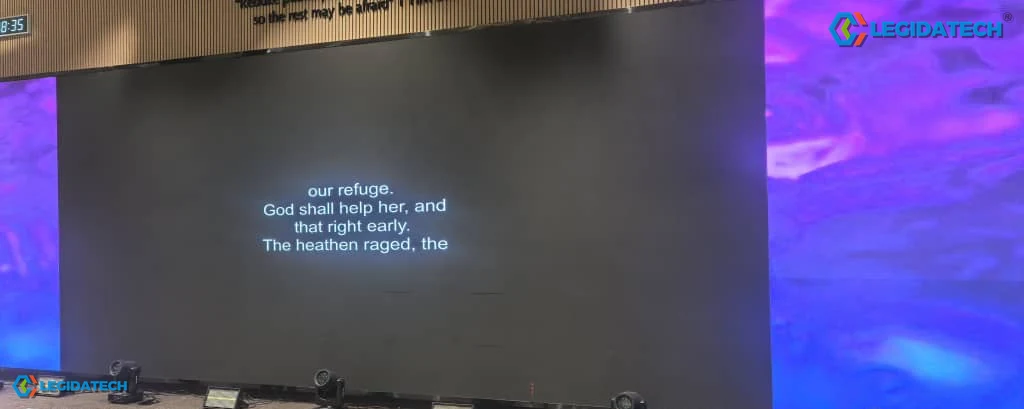
The church films its services and the wall appears inside the broadcast frame. At 3,840 Hz there is no banding on camera. This matters more on a wall this wide than on a small one, because the wall fills the frame behind the preacher for most of the service; any banding is not a corner artefact, it is the background of the whole recording.
Weight and structure
912 modules at 320 × 160 mm give 46.7 ㎡. The panel weight works out at about 19.5 kg/㎡, so the wall itself is roughly 0.9 tonne before the sub-frame. That is the number that decides the mounting: a wall this heavy and this wide is an engineered structure, not a set of brackets.
The Configuration Delivered
| Pixel pitch | 2.5 mm, SMD |
|---|---|
| Module grid | 38 columns × 24 rows = 912 modules (320 × 160 mm) |
| Resolution | 4,864 × 1,536 px |
| Cabinet | 480 × 320 × 70 mm, CNC aluminium frame with a flame-retardant ABS back cover, 3 kg |
| Brightness | 600–800 nits, set for a stage backdrop |
| Protection | IP31 indoor |
| Panel weight | about 19.5 kg/㎡ (roughly 0.9 t for the wall) |
| Refresh rate | 3,840 Hz |
| Service | Front service, magnetic modules |
| Mounting | Purpose-built sub-frame tied back to the wall |
The arithmetic is worth writing out, because it is the check a buyer can run on any quotation. 12.16 m ÷ 0.32 m = 38 modules across. 3.84 m ÷ 0.16 m = 24 modules high. 38 × 24 = 912 modules. 912 × 0.0512 ㎡ = 46.7 ㎡. And 12.16 m ÷ 0.0025 m = 4,864 px, 3.84 m ÷ 0.0025 m = 1,536 px. If a quotation’s area, module count and resolution do not reconcile like this, the wall has not been designed — it has been estimated.
Installation: Sub-Frame, Cable Void and Front Service
A 12.16 m wall cannot be carried by the existing stage structure, so the mounting is a purpose-built sub-frame tied back to the wall behind, with the cabinets hung in 38 cabinet columns of 8 rows, each cabinet carrying three modules — 912 modules in total. Cable routing runs in the void behind the panels, and the screen is front-service, so no access corridor is needed behind the backdrop — which matters when the stage set is built tight against it.
Why the sub-frame is the real project
On a sanctuary wall, the mounting is usually a fixing detail: sound wall, brackets, done. Here it is a structure. The sub-frame carries about 0.9 tonne of panel plus its own weight, spans 12.16 m without a mid-support that would block the stage, and has to be installed without closing the auditorium for weeks.
That is also why a wall this size is a scheduled build rather than an afternoon job. The programme has to sequence steel, cable routes, panel hanging, commissioning and a full test service, and it is agreed before shipping rather than improvised on arrival.
Commissioning on a wide canvas
Commissioning is where a wall this wide is either finished or merely mounted. The pixel canvas is fixed at 4,864 × 1,536 and handed to the media team as a template file, so nobody discovers on the first Sunday that their slides are 16:9. Brightness is balanced against the stage lighting rather than left at factory defaults, because on a backdrop the wall is competing with the lighting rig, not with daylight. Processor inputs are labelled: camera, playback, graphics.
One Wall, Two Very Different Sundays
The photographs show two kinds of service on the same wall. One is a communion service — a single large graphic of the cup behind the minister, one message, no clutter. The other is a conference-style service with a full choir, a band and a stage set, where the wall carries branding and a live feed at the same time.
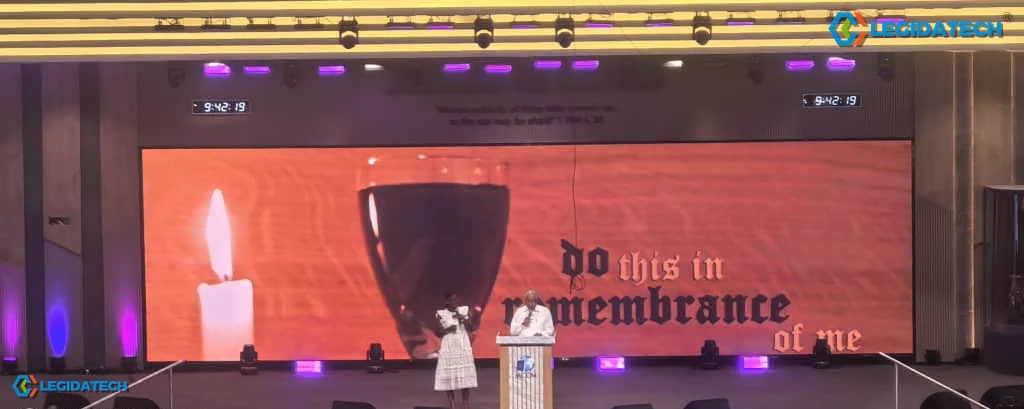
Those two modes pull in opposite directions. A single graphic wants the whole canvas and even brightness edge to edge; a live feed wants camera-safe refresh and a colour temperature that matches the stage lighting. A wall this wide is seen by the cameras as well as the congregation, so the operator has to think about how the screen looks inside the broadcast frame, not only in the room.
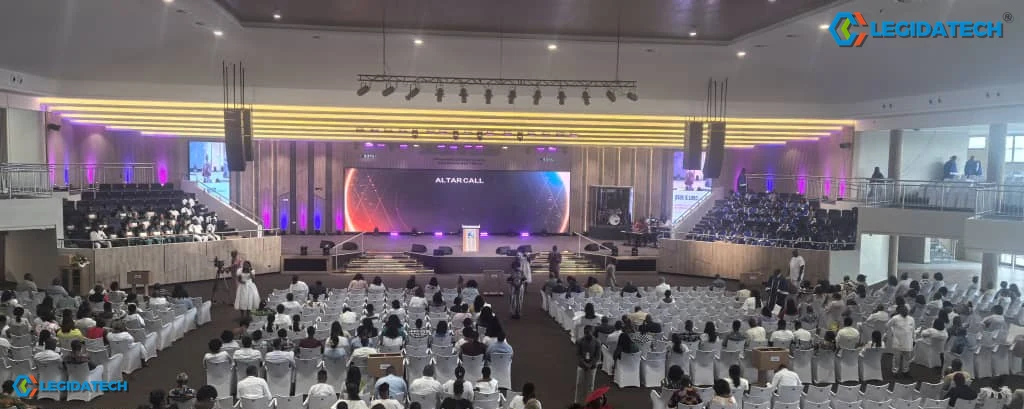
Practically, that means two presets rather than one: a service preset for teaching and communion, where the wall is relatively calm and text-led, and an event preset for conference nights, where brightness and saturation can go higher because the room is louder and the cameras are further back. Both are set during commissioning.
Why Front Service Matters Behind a Stage Set
The wall sits behind a stage set that is built tight against it. If the screen were rear-service, replacing one module would mean taking the set down, moving the band’s risers and re-rigging — a day of disruption for a component that costs very little.
Front service turns that into a ten-minute job from the stage floor: a suction tool, one module out, one module in. On a wall of 912 modules, the question is not whether a module will ever fail, but what the church does on the Saturday night before a Sunday when one does. The answer is designed into the cabinet, not into the warranty.
LED Screens in Ghana: Where This Project Sits
This wall is the widest of our Ghanaian projects, but not the only one, and the pitch decision repeats across them. A 9.8 m² P2.5 wall in Kumasi shows the same product family at a sanctuary scale, and the Living Faith wall in Nigeria shows a mid-size sanctuary build.
If you are comparing this wall with a sanctuary wall, the difference is not the pitch. It is the ratio, the sub-frame and the content strategy. A 46.7 ㎡ backdrop and an 11.5 ㎡ sanctuary wall can use the same cabinet and the same pitch and still be entirely different projects.
What Drives the Cost of a Wall This Size
- Area, first and always. 46.7 ㎡ is roughly four times a typical 11.5 ㎡ sanctuary wall. Everything else scales from there — modules, receiving cards, power supplies, sub-frame.
- Sub-frame and rigging. At this width the mounting is engineered, not incidental. It is a real line item, separate from installation labour.
- Pitch. P2.5 at 46.7 ㎡ is already a significant budget. P1.86 would raise it sharply and is rarely justified at a 30 m viewing distance.
- Control. 912 modules need a processor sized for 4,864 × 1,536 with headroom for a live feed and graphics running at the same time.
- Freight and clearance to Ghana. Shipping 46 ㎡ to Tema, plus duty, VAT and clearing, is a material share of the landed cost.
Published ranges on this site run US$600–1,300 per m² across pitches, with P2.5 in the lower half of that band. For 46.7 m² the equipment line is therefore roughly US$28,000–37,000 at P2.5 — equipment only, before the engineered sub-frame, the processor, freight, duty and installation. Those figures are indicative, not a quotation: at this size the sub-frame and the control path move the total more than the panels do.
Four Checks Any Buyer Can Run on a Quotation
Reconcile area, module count and resolution. 12.16 × 3.84 m at P2.5 is 912 modules, 46.7 ㎡, 4,864 × 1,536 px. Three numbers that must agree.
Ask what carries the weight. A wall of this size needs a sub-frame design, not a bracket schedule. If the quotation has no mounting line, the mounting is being improvised on site.
Ask for the native pixel canvas in writing. 4,864 × 1,536, delivered as a template file. Without it, the media team will produce 16:9 content and the church will use half the wall.
Ask how a module is replaced. Front service from the stage floor, or rear service behind the set. On a backdrop with a stage set against it, that answer decides the cost of every future repair.
Frequently Asked Questions
How much does a 46 ㎡ church LED screen cost in Ghana?
It depends on the pitch, the sub-frame, the control system and freight. At P2.5, 46.7 m² is roughly US$28,000–37,000 of equipment, before the engineered mounting, the processor and the landed costs into Tema. The range is indicative and covers pitch and encapsulation differences.
Is P2.5 right for a wall seen from 30 m away?
Yes, because the limit at that distance is not the pitch but the resolution the content needs. At 4,864 px across, small type stays legible from the balcony. A coarser pitch would work for full-bleed imagery but lose captions.
Can the wall show 16:9 video without black bars?
Only by cropping. The native ratio is about 3.2:1, so a 16:9 feed either letterboxes or loses the sides. Most churches run native-ratio graphics for teaching and full-width video for atmosphere.
Can you ship and install in Accra?
Yes. Screens ship to Tema or Takoradi by sea with air freight available, and installation runs with a local crew against our mounting drawings, with remote commissioning support. Ghana runs on 230 V / 50 Hz, within the Ehonor supply range.
How long does a wall this size take to install?
Longer than a sanctuary wall, mainly because of the sub-frame. Mounting, cabling, commissioning and a full test service are a multi-week programme agreed before shipping, not days.
What happens if a module fails behind the stage set?
It is swapped from the front. Front-service modules mean the stage set does not have to come down to replace one module.
Get a Similar Church LED Screen Quote
For a wall this wide, three numbers decide the design: the clear span between the stage wings, the height available below the lighting rig, and the distance from the back row or balcony. Send those and we will return a layout with the native pixel canvas and a landed price for Ghana.
Indoor fixed church LED screens | What a church LED wall costs | Get your church LED screen quote | Church LED screens in Ghana: price and delivery