


COB LED Screen for Church
600×337.5mm Flip-Chip COB Panels · P1.25–P1.875 · 39.75mm Slim · Front Service
A COB LED screen for church is the indoor display where the LED chips are sealed inside the board instead of sitting on top of it. That single change is why a COB wall looks smooth from the front row, survives a microphone stand knocked into it, and photograph clean on a phone camera. Ours uses 600×337.5mm die-cast cabinets, 39.75mm deep and about 4kg each, from P1.25 to P1.875.
- Flip-chip COB packaging — chips bonded to the PCB and covered by a sealed surface, not exposed lamps
- 4H surface hardness and a washable module face; no lamp to shear off when a chair or stand is pushed into the wall
- 600×337.5×39.75mm cabinets at roughly 4kg — hung on the wall, no steel structure behind it
- Full front service, with dual signal and power backup supported across the range
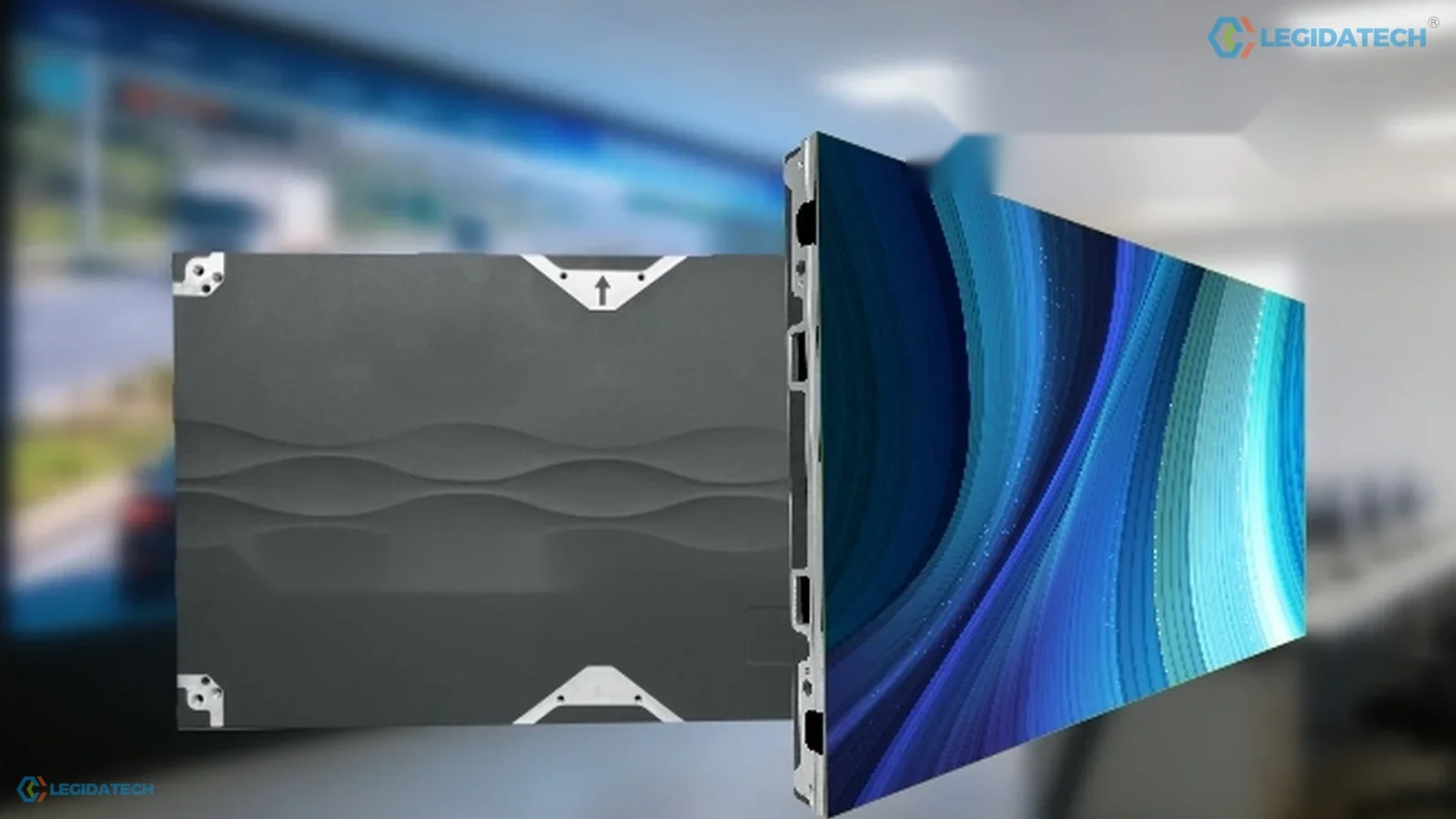
COB 600×337.5mm panels — sealed surface, 39.75mm cabinet depth
Quick Answers Before You Scroll
What is a COB LED screen? COB means chip-on-board: the red, green and blue LED chips are bonded directly to the circuit board and then covered with a protective layer. There is no plastic lamp package standing proud of the surface, which is the main structural difference from a standard SMD display.
Why do churches choose COB over SMD? Three practical reasons: the front row does not see a grid of plastic lamps, the surface cannot be broken by a bump the way exposed lamps can, and the matte sealed face reflects less stage light back into the camera. The cost is a higher price per square metre at the same pitch.
What does a church COB wall cost? There is no honest single price per square metre, because four things move it: pixel pitch, total area, control system, and how the wall is fixed to the building. A P1.25 wall of the same size as a P1.875 wall is a different budget. We quote against your wall drawing rather than publish a headline figure that would not survive contact with your room.
Can a dead pixel be repaired? Yes, and it is done from the front. The module is released with a suction tool, replaced with a spare, and the wall is back on screen in minutes. That is why we recommend buying a spare module allowance with the screen rather than after a failure.
How far back should the front row sit? Our engineers use a working rule of thumb: minimum viewing distance in metres roughly equals the pixel pitch in millimetres. P1.25 is comfortable from about 1.25m, P1.875 from about 1.9m. Treat that as a floor, not a target — most churches sit further back and could use a coarser pitch for less money.
What a COB LED Screen Actually Is, and What It Is Not
A conventional indoor display uses SMD packaging. Each pixel is a small plastic-bodied LED lamp soldered onto the board, and those lamps stand a millimetre or two above the surface. This is a mature, low-cost way to build a screen, and it is fine for many churches. It also explains the three complaints we hear most often from churches that already own an SMD wall.
COB packaging removes the lamp body. The chips are bonded straight onto the board and the whole area — chips, traces, gaps — is encapsulated. The finished module face is a single sealed surface with a matt finish. There is nothing protruding to catch a fingernail, a microphone stand or a chair being carried past the stage.
What COB is not: it is not a brightness upgrade, it does not replace the control system, and it does not make a badly specified pitch look good from 2m. It is a packaging technology. It improves the surface, the close-view appearance and the physical durability of the same underlying pixel. Everything else — processor, receiving cards, power design, structure — still has to be specified correctly.
The panels on this page measure 600×337.5mm, are 39.75mm deep and weigh about 4kg. Because a church sanctuary usually gets its wall in one of two ways — a shallower wall hung directly on the structure, or a deeper wall recessed into a frame — the thin cabinet matters as much as the packaging. A 20m² wall of these panels is roughly 99 cabinets and about 396kg of screen; the same area in a conventional indoor cabinet of 80–100mm depth adds both weight and standoff from the wall.
One number to check before you specify COB. Ask for the cabinet resolution, not just the pitch. At 600×337.5mm the P1.25 cabinet is 480×270 pixels and the P1.875 cabinet is 320×180. If a supplier quotes you a cabinet resolution that does not divide evenly into your planned screen size, the wall will not close cleanly and you will end up with a bespoke size.
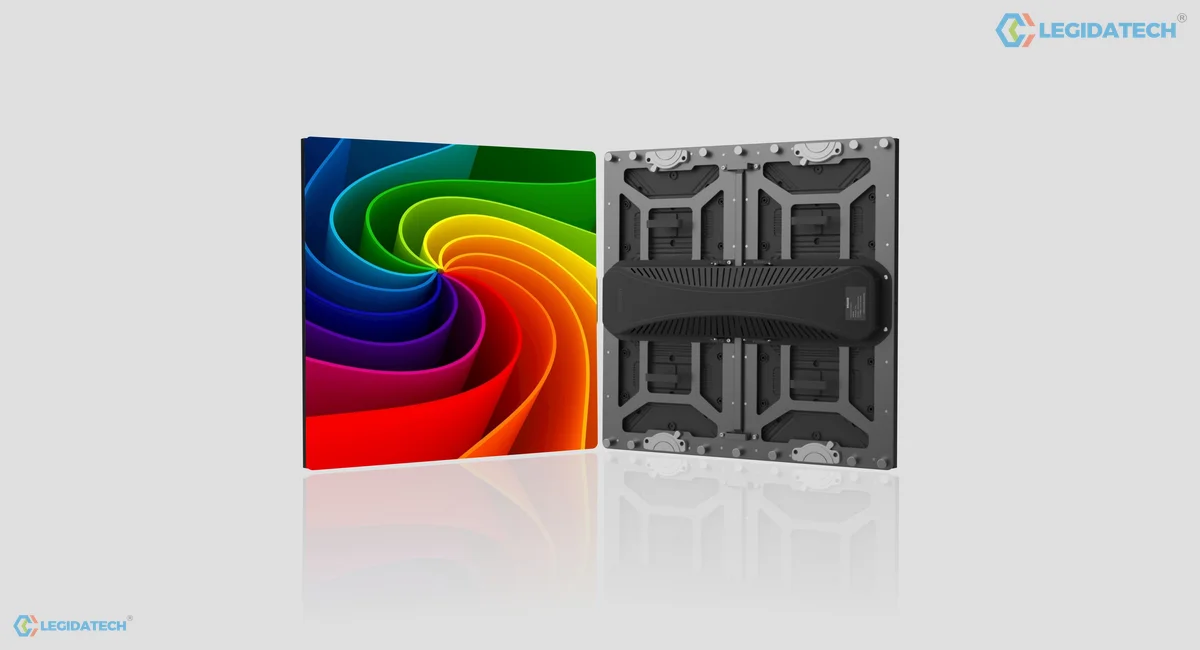
Face and rear of the COB cabinet — a sealed module face in front, a die-cast chassis with the carrying handle behind it
Three Complaints That Push Churches Toward COB
Most of the churches that ask us about COB already own a display. The question is rarely “what is the newest technology” — it is “why does ours look like that from the second row”. These are the three answers we hear most.
The front two rows can see the screen structure
On an SMD wall at P2.5 or coarser, a viewer within 2.5m sees individual lamps and the dark gap between them. The image reads as a bright grid rather than a picture. COB at P1.25 or finer, with no lamp body between pixels, closes that gap enough that the front row stops being a design constraint.
A lamp gets knocked off and the wall has a black dot forever
An exposed SMD lamp is a small plastic part on a solder joint. It survives normal use, not a chair leg, a flight case or a broom handle. A sealed COB face has no lamp to remove; the failure mode changes from “broken part” to “surface scuff”.
Stage lighting washes the picture out on camera
Under stage wash, an SMD lamp array returns a share of the light straight back at the lens. A matt sealed COB surface reflects less. The visible result is deeper blacks in the recording and less haze over the lyrics, without changing the brightness setting.
Flip-Chip COB: What the Sealed Surface Buys You in a Sanctuary
Flip-chip refers to how the LED die is bonded. The die is turned over and connected directly to the board pads without wire bonds, then the assembly is encapsulated. Fewer wire bonds means fewer failure points inside the pixel, and the encapsulation turns the module face into one continuous surface.
4H surface hardness and a washable face
The module surface is rated at 4H pencil hardness and the module face carries an IP54 protection rating, which means it can be cleaned with a damp cloth or a light water rinse rather than dry-dusted only. In a church this matters for two reasons: candles, incense and dust film build up on any horizontal-ish surface, and volunteers clean it, not trained technicians. A sealed face tolerates both.
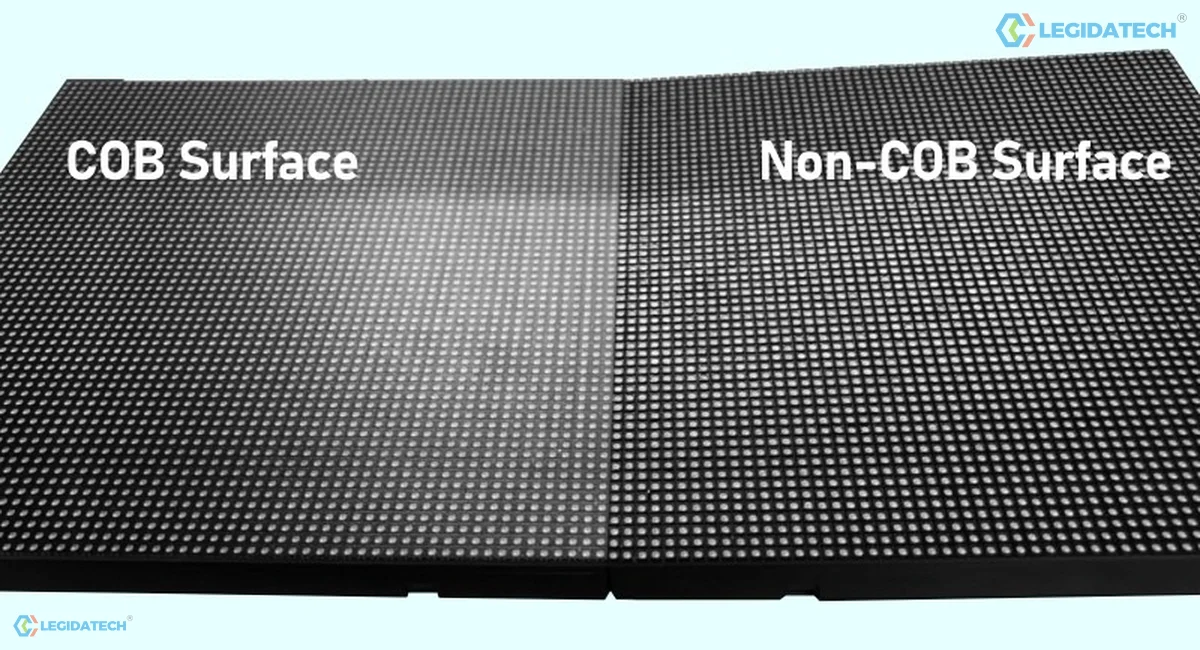
Same pitch, two surfaces: the COB face on the left is sealed and matt, the non-COB face on the right still shows individual lamps
What 4H does not mean. It is a pencil-hardness rating, not an impact rating. A sealed COB face resists scuffs and cleaning far better than exposed lamps, but it is still a screen — do not let a trolley run into it and expect nothing.
Matte Surface, Low Reflectance and a Cleaner Camera Image
Worship recording is now a normal requirement, not a bonus, and it changes what “good” means for a screen. The camera does not care about on-axis brightness. It cares about what the screen does with the light that lands on it from the rest of the room.
Why the sealed face reads darker on camera
On an SMD array, each lamp has a clear or semi-clear lens and a visible dark gap between pixels. Stage light striking the array is partly returned at the camera. On a COB module the surface is continuous and matt, so less light comes straight back at the lens. Nothing in the electronics changed — the reflectance of the surface did.
The part COB cannot fix: shutter and pitch
If your camera shutter or the screen refresh cause scan bars, the fix is refresh rate and shutter, not packaging. All panels on this page run ≥3840Hz, which clears scan bars at normal broadcast and mirrorless shutter speeds. If the camera shows a fine moiré pattern from close range, the fix is a finer pitch or moving the camera — that is a pixel-density problem, and it is the reason we publish the ultra-fine P0.62–P0.9 band on a separate page.
39.75mm Cabinets, 4kg Panels and What That Does to Your Wall
A 600×337.5mm panel is 0.2m². That is the number to design with, because everything else follows from it: cabinet count, weight, power drops and the dimensions your wall has to accept.
Wall loading you can check with a calculator
At about 4kg per panel, a 20m² wall is roughly 99 panels and 396kg. Spread over the wall area that is around 20kg/m² for the screen alone, before steel, cabling and truss. A stud partition will not take that without specific fixing design; a masonry or concrete wall usually will. Get the number from your contractor before the screen is ordered, not after.
Common anode and common cathode, in plain terms
P1.25 and above in this family are built on a common-anode circuit; the finer P0.78–P0.9375 panels in the same cabinet switch to common cathode. Common cathode reduces power loss in the driver circuit, which shows up as lower heat on a wall that is often enclosed behind a fascia. The practical difference for a church is heat and running cost, not picture quality. Per-panel maximum power on this page ranges from 65W to 70W depending on pitch.
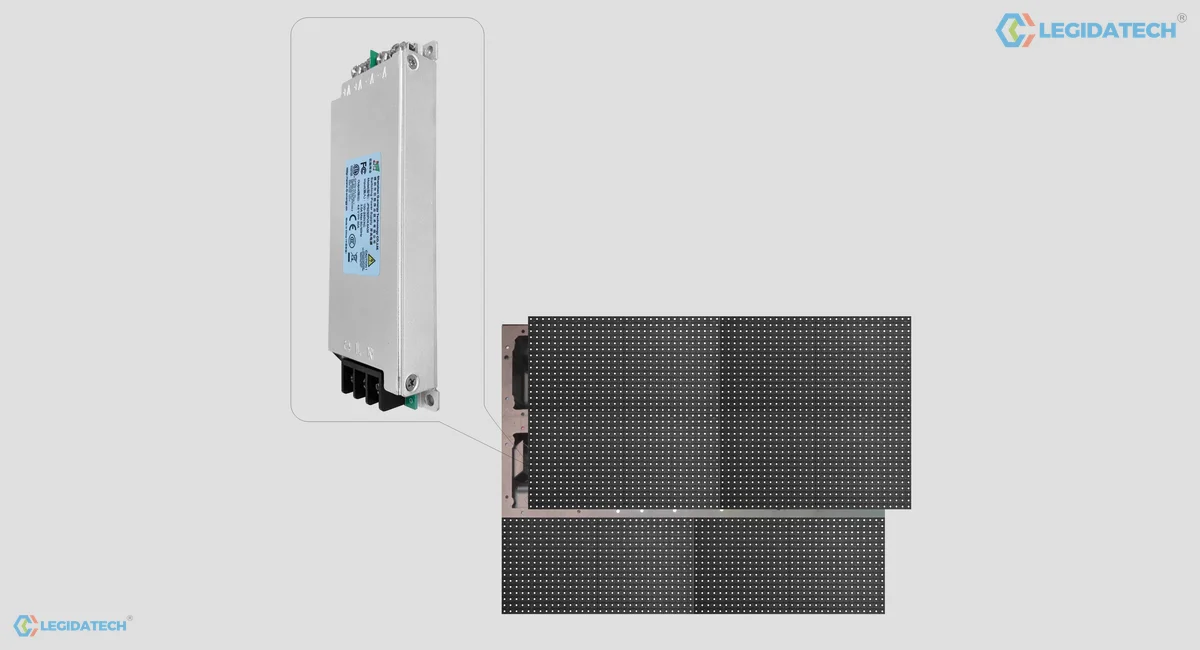
The power supply and two module strips, shown outside the cabinet — the two parts a front-service swap replaces
Front Service and Dual Backup: Designed Around a Sunday Deadline
The failure that matters in a church is not the one that costs money. It is the one that happens at 8am on a Sunday with the room filling up. Two features are specified for that scenario.
Front access from a ladder, not a scaffold
Modules, receiving cards and power supplies are all reachable from the front. There is no requirement to remove the screen from the wall or to leave a maintenance corridor behind it. On a wall hung at 2.5m, that means one person with a step ladder and a suction tool.
Dual signal and dual power across the range
Dual backup lets a second receiving card and a second power path take over from a failed one without the wall going black. The trade-off is real: more components, more cost, and more to commission. It is supported on P1.25, P1.5625 and P1.875. On a wall that carries the whole service we treat it as a default rather than an option; on a secondary display it can be left out to save cost and components.
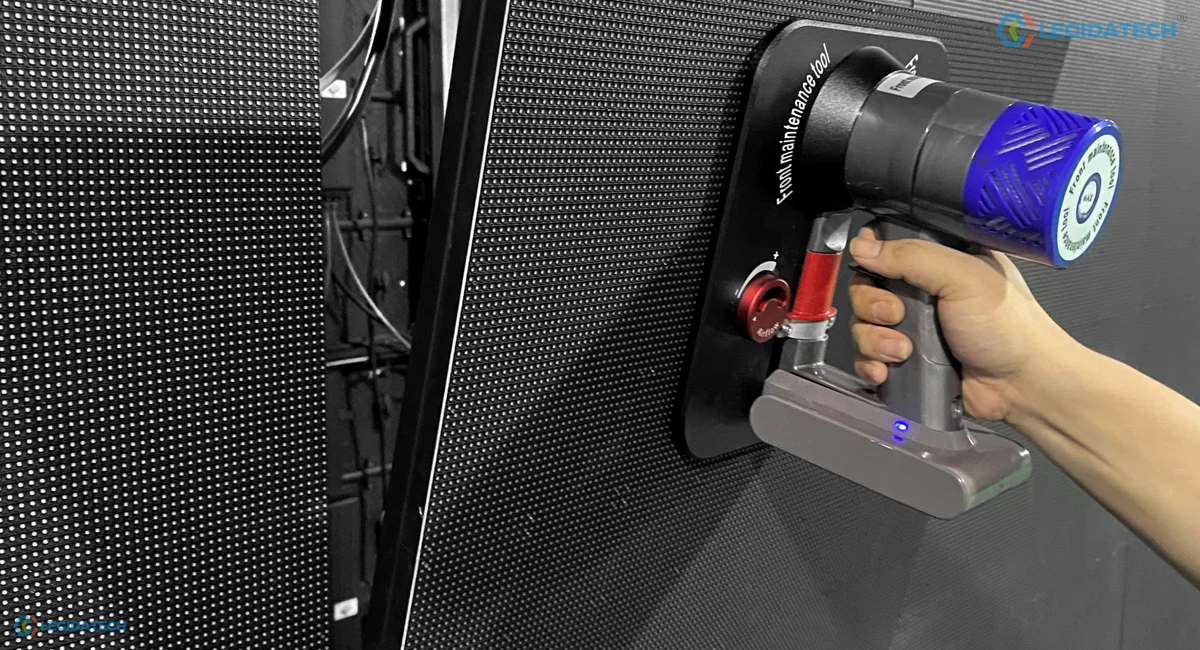
Front service with the wall still on the wall — a module comes out with a suction tool, with no rear access needed
COB vs GOB vs SMD: Which Packaging Belongs in Which Room
These three are the indoor packaging options we build, and the choice between them is a decision about the room, not about which one is newer. The three subsections below are the practical difference; the comparison table after them is the summary.
COB — sealed board, matte face, finest close-view appearance
Structure: chips bonded directly to the PCB and encapsulated; no lamp body. Surface: one sealed matt surface, 4H, washable module face. Contrast: the highest of the three, because there is no reflective lamp lens and no visible gap. Pitch range: this page covers P0.62–P1.875, with P1.25–P1.875 documented below. Service: front, module swap. Belongs in: a sanctuary where the front row is inside 3m, the wall is at risk of contact, or the service is recorded close-up.
GOB — SMD with a protective glue layer over the whole module
Structure: conventional SMD lamps, then a transparent glue layer poured over the entire module face. Surface: protected and reasonably tough, but the glue over a lamp array is not optically flat the way a sealed COB face is. Contrast: better than bare SMD, below COB. Pitch range: practical from about P1.56 upward, and cost-effective at P2.5–P3.91. Service: front, module swap. Belongs in: a hall or multi-use room where the display is larger, viewings are further back, and budget per square metre matters more than close-up detail.
SMD — exposed lamps, the widest choice and the lowest cost at any pitch
Structure: discrete LED lamps soldered to the board, standing proud of the surface. Surface: exposed; the lamp is the weakest point physically. Contrast: depends on lamp quality and the mask; generally the lowest of the three. Pitch range: widest, and the lowest-cost route at P2.5 and above. Service: front or rear depending on cabinet. Belongs in: a balcony-front or large hall install viewed from 4m+, where fine pitch and surface toughness are not the binding constraints.
Decision in one line. If viewers sit inside 3m or the screen is in reach of people and equipment, pay for COB. If the room is deep and the budget is fixed, GOB or SMD at a coarser pitch buys more screen for the same money — and a bigger screen at P2.5 usually serves a congregation better than a smaller one at P1.25.
Where a COB Wall Earns Its Price in a Church
COB is not the right answer for every room. It earns its premium in three specific places.
The main sanctuary wall, where the front row is inside 3m
This is the classic case. A 6–8m wide wall at P1.25 or P1.5625, hung flat on the front wall, with the first row 2.5–3m from the screen. The wall is the main teaching surface, it appears in every recording, and it is physically close to people moving on and off the platform. All three COB advantages apply at once.
Chapels and smaller rooms, where the screen is proportionally closer
A 4m wide wall in a 12-row chapel puts the back row closer to the screen than the front row of a 600-seat room. The smaller the room, the more the pitch has to do the work of the distance, and the more COB’s sealed face matters at close range.
Foyers and welcome areas, where it has to look like furniture
A lobby screen is seen at 1m by everyone who walks in, in mixed daylight, from an angle. A matt sealed face with a slim 39.75mm cabinet reads as an installed panel rather than a rig. It is also the screen most likely to be touched, wiped and leaned against.
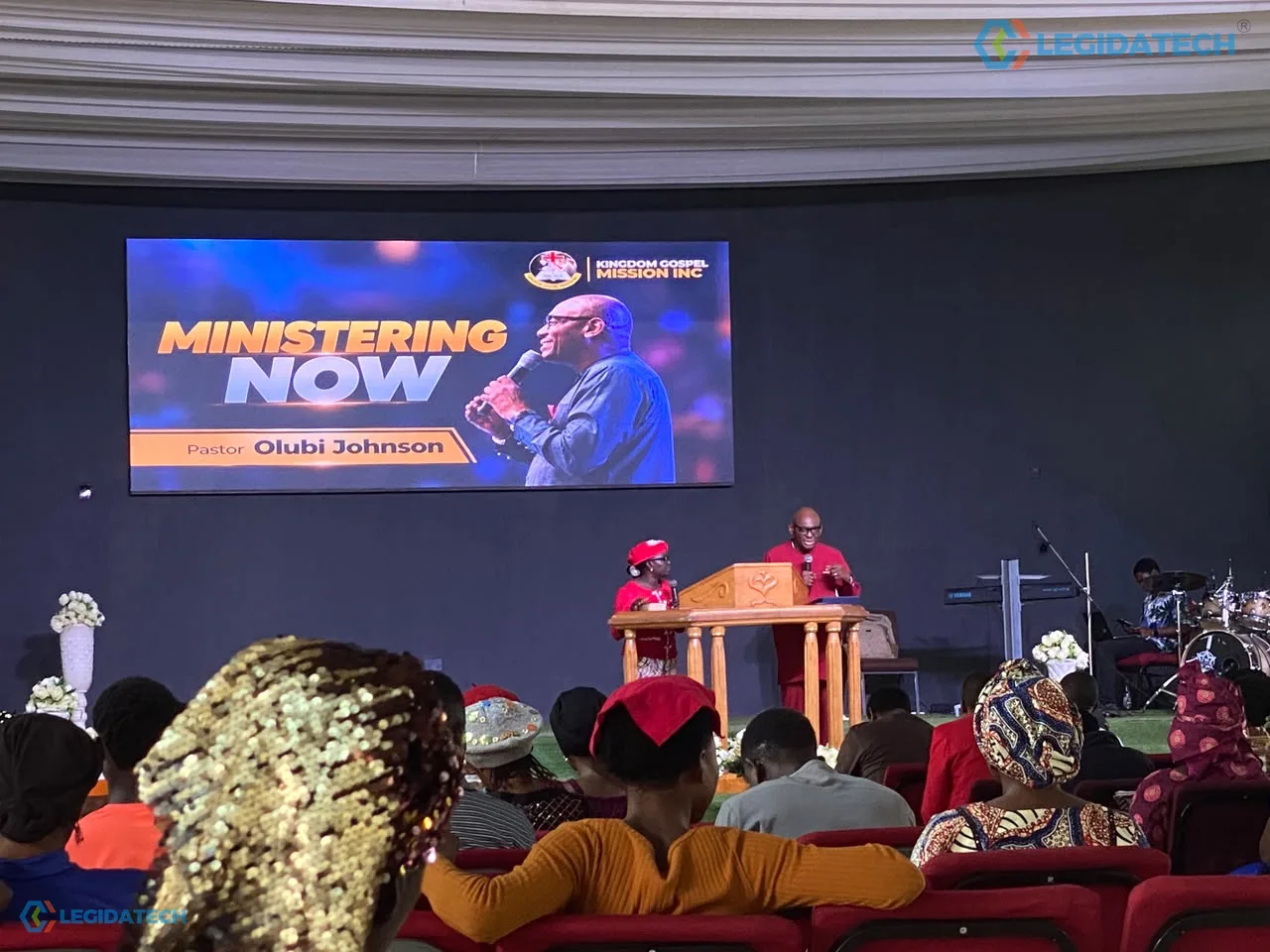
Sanctuary wall seen from the congregation — LEGIDATECH church installation
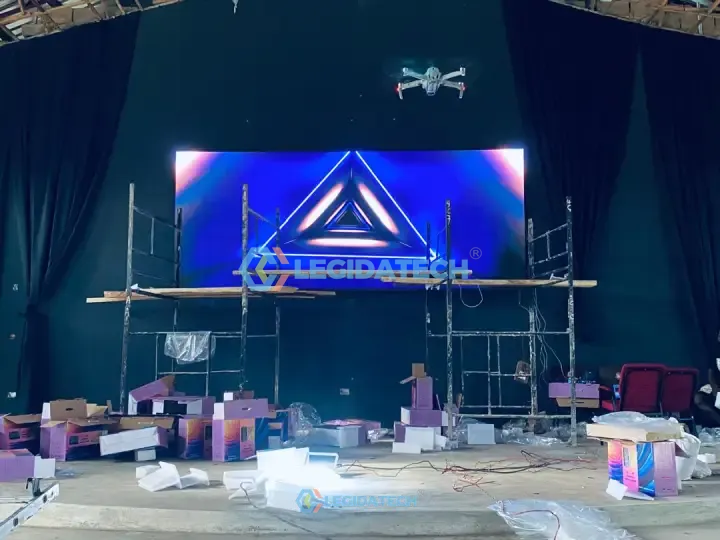
A wall above a stage during fit-out — LEGIDATECH church installation, shown for the mounting geometry and sight lines rather than the module surface
COB Panel Specifications, 600×337.5mm Cabinet
Rows are parameters, columns are the three pitches we specify for church sanctuaries. All three use the same 600×337.5×39.75mm cabinet, so a wall can be re-pitched in the same frame at a later stage if the room is re-planned. The figures are the platform values for this cabinet. Where a value is not yet confirmed for a specific pitch it reads To be confirmed rather than carrying an assumed number, and the datasheet issued with your quotation is the final reference for your configuration.
| Parameter | P1.25 | P1.5625 | P1.875 |
|---|---|---|---|
| Nominal pitch (mm) | 1.25 | 1.5625 | 1.875 |
| Cabinet size (mm) | 600 × 337.5 × 39.75 (die-cast aluminium) | ||
| Cabinet weight | ≈ 4 kg per panel | ||
| Cabinet resolution | 480 × 270 | 384 × 216 | 320 × 180 |
| Resolution per m² | 640,000 | 409,600 | 284,444 |
| Module size (mm) | 150 × 168.75 | 150 × 168.75 | 150 × 168.75 |
| Module resolution (px) | 120 × 135 | 96 × 108 | 80 × 90 |
| Modules per cabinet | 8 (4 across × 2 down) | ||
| White balance brightness | 600 nit | To be confirmed | To be confirmed |
| Refresh rate | ≥ 3840 Hz | ||
| Scan mode | 1/60 | 1/54 | To be confirmed |
| Power circuit | Common anode | Common anode | To be confirmed |
| Max power per panel | 70 W | 70 W | 65 W |
| Driver IC / receiving card | Specified per pitch and fixed on the datasheet issued with your quotation — not interchangeable between pitches | ||
| Dual signal / power backup | Supported | Supported | Supported |
| Module surface | Flip-chip COB, 4H hardness, IP54 module face, washable | ||
| Viewing angle (H/V) | 160° / 160° (typical) | ||
| Input voltage | AC 100–240 V | ||
| Maintenance | Front service — module, receiving card and power supply | ||
| Control system | NovaStar-based platform; processor and receiving cards confirmed on the datasheet for your configuration | ||
How to read these numbers. Cabinet resolution, resolution per m², scan mode, driver IC and receiving card are the figures that vary by pitch. Everything else is shared across the three models because it is the same cabinet. If a quotation you receive lists a different cabinet depth or weight for this family, ask which cabinet it refers to — the 600×337.5mm die-cast cabinet is 39.75mm and about 4kg, and a heavier number usually means a different cabinet has been substituted. Driver IC and receiving card are specified per pitch; the part numbers are fixed on the datasheet issued with your quotation, and are not interchangeable between pitches.
Choosing the Pitch From Your Seating, Not From a Spec Sheet
The pitch should follow the closest viewer, not the average one. Measure from the front row of seating to the screen face, then use the table as a starting point and confirm against your actual wall width.
| Closest viewer distance | Pitch that works | Typical church case | What you are buying |
|---|---|---|---|
| < 2 m | P0.9375 or finer | Platform confidence monitor, small chapel first row, studio close-up | Close-view detail; see the fine pitch page for the P0.62–P0.9 band |
| 2–3 m | P1.25 | Main sanctuary wall with a front row on the platform edge | Front row sees a picture, not a grid |
| 3–4 m | P1.5625 | Main wall in a mid-size room, front row behind a walkway | The balance point for most 200–500 seat rooms |
| 4–6 m | P1.875 | Larger room, deep front section, balcony seating | Lower cost per m² with no visible structure from the nearest seat |
| 6 m + | P2.5 or coarser | Very large hall, gym-style multi-use room | COB is usually the wrong purchase here — compare GOB or SMD first |
What Drives the Cost of a Church COB Wall
We do not publish a price per square metre, because four variables change the number enough that a headline figure would mislead. Here is what actually moves a quotation, in order of impact.
1. Pitch. The single largest factor. Doubling pixel density more than doubles the LED and driver cost per square metre, and the driver IC and receiving card are specified per pitch with it — do not assume the P1.875 configuration matches P1.25, because the card is confirmed per pitch and P1.875 is not yet fixed.
2. Area, and how it closes. Panels are 600×337.5mm, so the screen is a whole number of panels. A wall that needs 99 panels but the room only allows 96 costs less than one that needs 102 and a bespoke cabinet. Sending us the wall width and height before finalising the design is worth real money.
3. Control and signal. The receiving cards are in the panel price; the processor, the video input path and how many sources you need to switch are not. A church running ProPresenter with a confidence monitor and a live-stream feed needs a different processor from a church playing one HDMI source.
4. Structure and access. Hung flat on masonry, recessed into a stud wall with a frame, or floor-standing in front of a wall — three different costs. So does whether the room has a lift or a service corridor.
We return a quotation with the panel count, the pitch options at two or three grades, the control list and the freight split, so your board can see what it is approving line by line.
When COB Is the Wrong Purchase
Your nearest seat is 5m back and the budget is fixed. You are paying for close-view performance nobody in the room will see. The same money buys a larger screen at a coarser pitch, and a bigger picture serves the congregation better than a finer one.
The room is lit by daylight or your lobby faces glass. 600 nit is comfortable in a controlled sanctuary and marginal in a bright foyer. If the wall will sit under skylights all morning, look at a higher-brightness build rather than a standard COB panel.
You are planning a video wall for a rental or travelling ministry. This is a fixed-install cabinet. For a screen that goes up and down every week, a rental cabinet with quick locks and flight cases is the right product — the COB surface advantage does not outweigh a stage crew assembling a fixed cabinet on a Sunday morning.
Your real problem is the processor, not the panel. If the picture is washed out because the source is being scaled badly, or the level is clipping because the signal chain is wrong, a new screen will not fix it. We will say so.
You need an outdoor wall. Indoor COB panels are not weather-rated. Outdoor signage and festival screens are a different product with different brightness and IP requirements.
COB 600×337.5mm Against the Other Indoor Options We Build
Every page in this site should make the choice between products easier rather than push one. These are the three alternatives a church normally weighs against a COB sanctuary wall.
| Option | Cabinet | Strength | Where it wins |
|---|---|---|---|
| COB 600×337.5mm (this page) | 600×337.5×39.75mm, ≈4kg | Sealed matt surface, finest close-view appearance, washable, front service | Sanctuary walls where the front row is inside 3m and the service is recorded |
| CPS 640×480mm | 640×480mm, front maintenance | 800 nit brightness, larger cabinet, GOB option | Brighter rooms, larger walls at P1.25–P3.07, budget-led projects |
| PS 1000×250mm slim | 1000×250mm, 20.6mm deep | Very slim, curved and corner builds, magnetic modules | Recessed walls, columns, baptistery and creative stage shapes |
| Fine pitch COB, P0.62–P0.9375 | Same 600×337.5mm cabinet, finer pitch | Native 4K in a 2.4–3.6m wall, closest camera work | A camera at the platform edge, or a screen read from under 2m |
| All-in-one 108–162″ COB | 600×337.5×35.5mm, integrated frame | No steel structure, no rack, mobile stand or wall bracket | Halls of 6–30 people where a wall would be a building project |
If two of these look plausible, send the room dimensions and the seating plan and we will tell you which one we would install — including the case where the answer is the cheaper cabinet. The full set of indoor church formats sits on one page: see all indoor church LED screens.
One line worth keeping from this table: COB wins on the front row. If nobody in the room is inside 3m of the wall and the room is dark, the SMD cabinet does the same job for less money per square metre.
Church Walls We Have Already Built, and the Paperwork That Ships With This One
Before a quotation goes to a board, two questions come up: what have you built, and what will you hand us in writing. Both have concrete answers, and the second one is the part most suppliers leave until the order is signed.
| Installation | Country | Built with |
|---|---|---|
| House of Miracle Ministry | Accra, Ghana | P2.5 indoor fixed |
| Ehonor series church screen | Peru | P2.5, 5.12 × 2.88m |
| Church LED wall | United Kingdom | P2.5 indoor |
| H3 stage screen | Nigeria | P3.9, 13 sqm |
| Magic series church wall | Nigeria | P3.91, 6 × 2m |
Each project above links to the case page on this site. Dimensions and pitch are as published there.
What this table does not show. None of the installations above is the 600×337.5mm COB cabinet this page describes. They are Ehonor, H3 and Magic series walls, which is what our named church case pages document today, and those pages are where each build is described. The COB cabinet is the newer line, and we would rather say that than present an older fixed-wall project as a COB reference. What the list does establish is the range we build and ship into churches as routine work, from a single 5.12×2.88m wall to a 13 sqm stage screen.
Documentation issued with the quotation
- Shop drawing with the cabinet layout, mounting points and power and signal routing for your wall dimensions, approved by you before production starts.
- Datasheet for the exact pitch in your order, with every cell on this page that reads To be confirmed filled in.
- Certificate copy for your destination — CE, RoHS and FCC as applicable, with UL on specific configurations.
- Spare parts list, module-swap procedure and the packing list.
- Warranty terms in writing, and the payment structure on the proforma invoice.
Lead Time, Spares, Warranty and Certification for a 600×337.5mm Cabinet Order
Lead time. Standard production is 15–25 working days after the deposit and the approved shop drawing, plus freight. Rush schedules are possible and are quoted with the order rather than promised and re-cut later.
What ships with the screen. Panels, receiving cards, power supplies, cabling, spare module allowance, and the control system you selected. Spares are quoted with the screen: one or two spare modules and a spare receiving card per control run solve the failure that would otherwise wait on international freight.
Warranty. Two years on modules, receiving cards and power supplies as standard, with extension available on the order. Dead pixels, driver IC failure and power supply failure are the three failure modes the warranty is written around, because they are the three that actually occur.
Certification. CE, RoHS and FCC documentation is available for the models we ship, with UL for specific configurations. The exact certificate set for your destination is confirmed in the quotation — we will not list a certificate we cannot produce for your model.
Who hangs it. The wall ships with the shop drawing its mounting points come from. Many churches hang it with their own contractor against that drawing; where the room is awkward we quote an installation package or a supervised install. A panel is about 4kg, so two people can place one by hand, and front service means no rear access corridor has to be kept behind the wall.
Payment terms. The deposit and balance structure is set out in the proforma invoice; T/T is the normal route and L/C is available on larger orders. Ask for the terms in writing with the quotation so there is no ambiguity later.
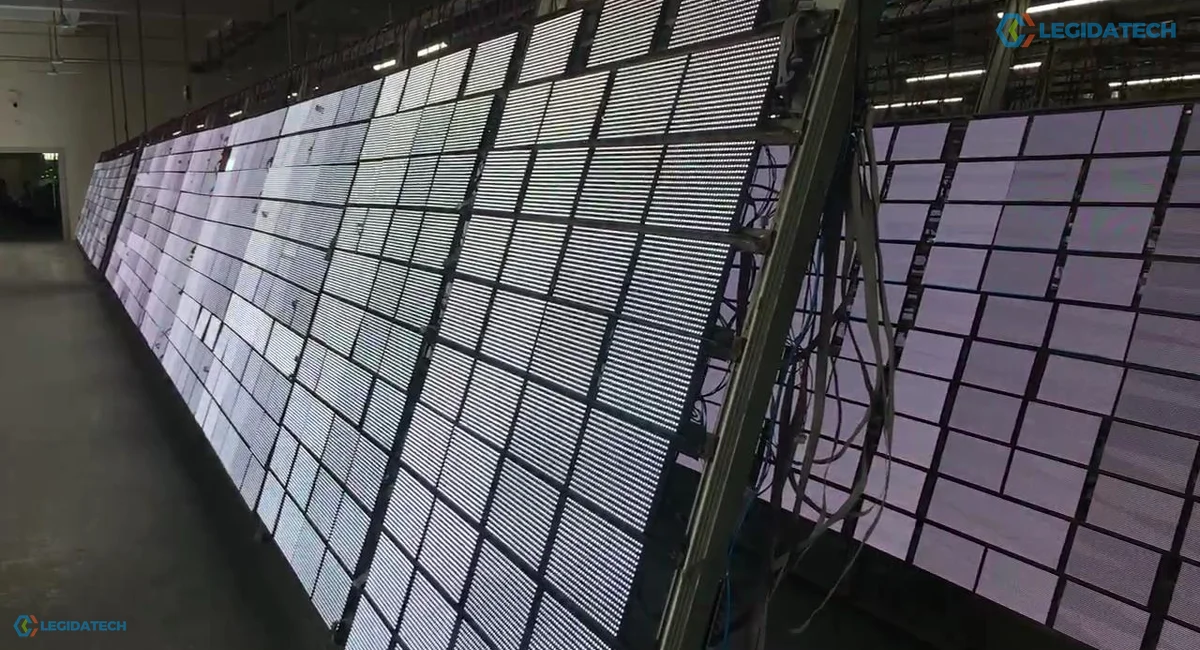
Panels run on the ageing rack before dispatch
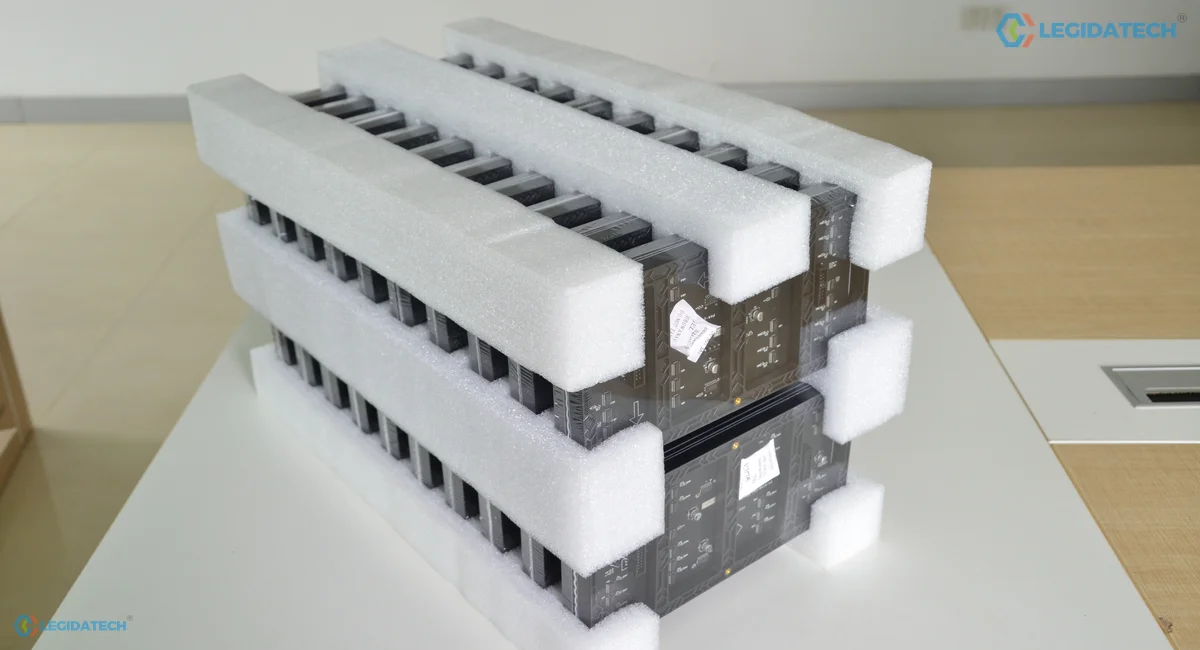
Modules in foam trays before the carton and the export crate
Installing a COB LED Screen for a Church: What the Clip Shows
Installation labour is a line in every church LED budget, and it is the line suppliers describe rather than show. This clip is a COB LED screen installation from LEGIDATECH: watch how the panel is handled. With a sealed COB face there is no lamp-level protection to remove and refit at each step, which is where the repeated handling time goes on an SMD wall.
What the clip does not show is the part that decides the schedule: the wall survey, the fixing points and the power route. Those are fixed at drawing stage, before production starts.
COB LED screen installation, filmed on site by the LEGIDATECH team.
Questions Churches Ask Before Ordering a COB Wall
Q1What is a COB LED screen and how is it different from SMD?
COB means chip-on-board: the LED chips are bonded directly to the circuit board and encapsulated, so the module is one sealed matt surface. SMD uses individual plastic-bodied lamps standing above the board. On a COB wall the front row sees fewer pixel gaps, the surface cannot lose a lamp to a bump, and less stage light reflects back into the camera.
Q2Is a COB LED screen for church worth the extra cost over GOB?
It depends on your closest seat. If the front row is inside about 3m, or the wall is in reach of people and equipment, COB earns its price on appearance and durability. If the nearest seat is 5m back, GOB or SMD at a coarser pitch buys more screen area for the same budget, and more area usually serves the congregation better.
Q3What brightness do we need in a sanctuary?
600 nit is comfortable where lighting is controlled, which covers most sanctuaries during a service. If the wall faces windows, sits under skylights, or is in a bright foyer, treat 600 nit as marginal and look at a higher-brightness build. Brightness is stated per pitch on the datasheet for each model; where a pitch is not yet confirmed we mark it rather than quoting the P1.25 figure across the range.
Q4How close can the congregation sit before the pixels show?
A working rule from our installs: minimum comfortable distance in metres roughly equals pitch in millimetres. P1.25 from about 1.25m, P1.875 from about 1.9m. In practice most churches could sit closer than they think, but the front row sets the specification, so measure from the nearest seat, not the average one.
Q5Can we repair a COB panel ourselves?
Module replacement needs no soldering and no rear access: the module is released from the front with a suction tool and replaced with a spare. We supply a spare module allowance and walk your technician through the first swap. Component-level repair inside a module is a factory job.
Q6Does COB stop camera moire patterns?
Not by itself. Moire comes from the relationship between pixel pitch, camera distance and sensor, so the fix is a finer pitch, moving the camera, or both. COB does reduce reflection haze from stage lighting and closes the visible pixel gaps at close range, which is why it records cleaner than SMD at the same pitch.
Q7What cabinet size and weight are we dealing with?
Each panel is 600 x 337.5 x 39.75mm and about 4kg, which is 0.2 square metres. A 20 square metre wall is roughly 99 panels and about 396kg of screen, or around 20kg per square metre before steel and cabling. Give that figure to your contractor before the screen is ordered.
Q8What is the minimum order and how long is delivery?
There is no container-level minimum: a single sanctuary wall is a normal order, and the only structural constraint is that the screen is a whole number of 600 x 337.5mm panels. Production is 15 to 25 working days after the deposit and approved shop drawing, then freight.
Q9Which control system comes with the screen?
The panels run on the NovaStar-based control platform our indoor range is built on, and the exact receiving cards are confirmed on the datasheet for your configuration. The processor is specified to your source list: how many inputs, whether you run ProPresenter, a confidence monitor and a live-stream feed, and whether the audio desk needs a video feed. The processor is quoted as a line item rather than bundled, so you can see what it costs.
Q10What warranty and certificates are included?
Two years on modules, receiving cards and power supplies as standard, with extension available on the order. CE, RoHS and FCC documentation is available, with UL on specific configurations; the exact certificate set for your destination is confirmed in the quotation.
Q11Can the wall be curved or shaped to our architecture?
These are flat 600 x 337.5mm cabinets, so the wall is flat. If you need a curved wall, a 90 degree corner wrap, or a shape around a column or cross, the slimmer PS cabinet at 1000 x 250mm is the better starting point and is built for corner and curve configurations.
Q12What happens if a panel arrives damaged?
Report it with photographs before installation begins and the panel is replaced. Shipping damage is a freight claim, and it is settled far faster when the carton is photographed before unpacking and the damage is reported within the window stated on the packing list.
Written by the LEGIDATECH church display team from church installations in Africa, Europe and Latin America. Specification values on this page are the platform figures for the 600 x 337.5mm COB cabinet; the datasheet issued with your quotation is the final reference for your configuration.