


Slim LED Video Wall for Church Walls & Stages
PS Series — 1000×250mm Cabinets · 20.6mm Ultra-Slim · Front Service · P1.56–P3.91
A 1000×250mm slim indoor LED display that mounts flush against your sanctuary wall — just 20.6mm deep and 2.4–4.8 kg per cabinet depending on width (500mm: 2.4 kg, 1000mm: 4.8 kg), so it hangs on the wall like framed art instead of standing on a steel structure. Magnetic modules mean every part is serviced from the front, and the platform bends into 90-degree corners and gentle curves for baptisteries and creative stage sets.
- 20.6mm slim aluminum cabinets in 500 / 750 / 1000×250mm widths — wall-mount or recessed, no steel frame
- Full front maintenance — modules, power supplies and receiving cards all come out the front with a magnetic tool
- Dual power and dual signal redundancy — built so a single PSU fault never ends a Sunday service
- 90° corner and curved configurations — wrap a baptistry, column or stage edge seamlessly
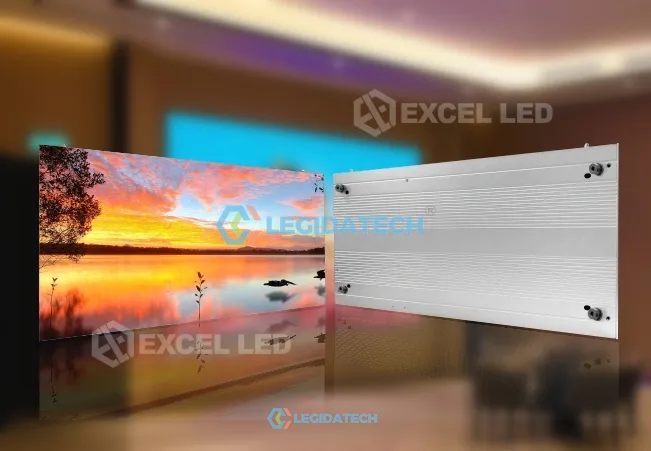
PS Series 1000×250mm cabinets — lit display face with 20.6mm back structure
Quick Answers Before You Scroll
What is the PS Series? A family of ultra-slim indoor LED cabinets (500, 750 and 1000×250mm, all 20.6mm deep) that splice into seamless church LED walls from P1.56 to P3.91 — built for wall-hugging installs where a deep cabinet or a steel frame will not work.
Will it really sit flush on our wall? Yes — the cabinet is 20.6mm deep and the 1000×250mm version weighs about 4.8 kg (the 500mm-wide version just 2.4 kg). Most sanctuary walls take it on a simple wall-mount bracket; there is no rear access corridor to build.
How is it maintained? Full front service: modules, power supplies and receiving cards are all magnetic and come out from the front. A volunteer team can swap a module with a suction tool — no ladder behind the screen, no dismantling.
Is it bright enough for a sanctuary? The platform is rated at 600 nits — right for lobbies, chapels, fellowship halls and moderate-ambient sanctuaries. If your stage runs strong lighting wash across the wall, our CPS Series small pitch display at 800 nits is the better fit; see when the PS Series is not the right choice.
Will it flicker on our livestream camera? No. The 3840Hz refresh rate keeps the wall flicker-free at normal camera shutter speeds — clean for IMAG, livestream and archive recordings.
A 20.6mm Slim LED Wall Family Built to Disappear Into Your Wall
The PS Series is a slim indoor LED video wall platform built from long aluminum-profile cabinets in three widths — 500, 750 and 1000×250mm — all sharing the same 20.6mm depth. Inside each cabinet sits a bottomless 250×250mm LED module design with a thick PCB, eleven magnets and two copper positioning pins per module, so the display face stays flat and true while staying thin enough to mount like a picture frame.
For church buildings, that geometry solves a real problem. Traditional indoor LED cabinets run 60–100mm deep and often need a support frame, a recess, or a rear service corridor. The PS Series hangs directly on the wall — which matters most in the buildings churches actually have: historic sanctuaries with shallow walls, pillars exactly where you wanted the screen, and budgets that did not include a steel structure.
The PS Series is part of the LEGIDATECH Official Website indoor display family, alongside two sibling ranges you can compare on this site: the Ehonor Series fixed church screen (the 480×320mm workhorse) and the CPS Series small pitch LED display (the 640×480mm fine-pitch range).
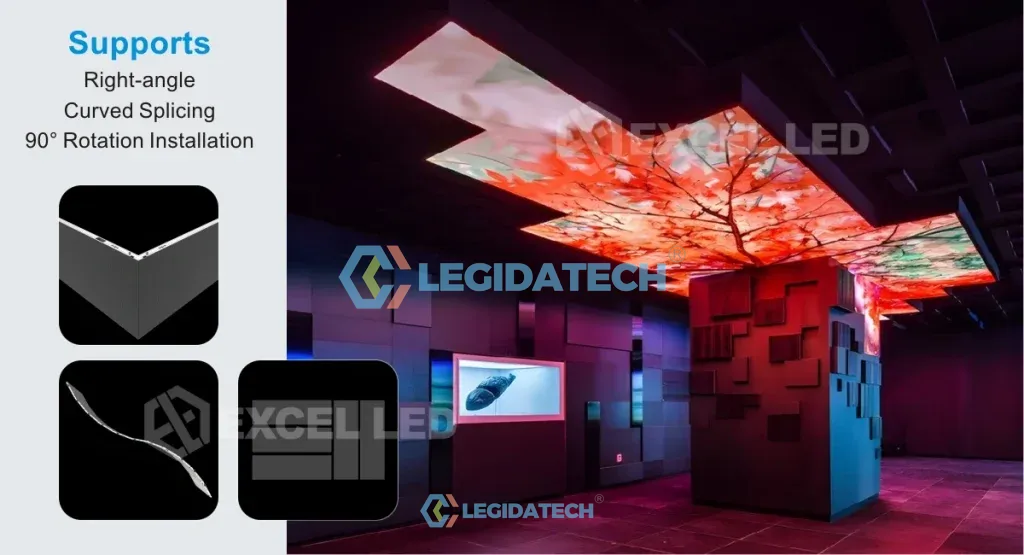
PS Series lit wall — right-angle, curved splicing and 90° rotation installation options
Four Church Building Problems a Slim LED Wall Solves
Most church screen projects stall on the building, not the pixels. Here is where the slim format changes the conversation.
“Our wall is shallow — and there is a pillar”
Historic sanctuaries and repurposed buildings rarely offer 100mm of depth plus rear access. At 20.6mm the PS Series mounts on the wall face you have, and the 500mm-wide cabinet variant threads the narrow wall sections that pillars leave behind.
“A steel structure was not in the budget”
The three cabinet widths weigh 4.8 / 3.6 / 2.4 kg (1000 / 750 / 500mm) — a typical 4m × 2m wall lands in the low hundreds of kilograms including brackets, comparable to the large displays churches already hang. That usually removes the secondary steel frame line item entirely; your board sees one honest number instead of a mounting surprise.
“We want the wall to wrap the baptistry”
Standard boxes tile flat only. The PS platform builds 90-degree corners and gentle curves, so a baptistry wall, a column wrap or a stage-edge set piece reads as one continuous image instead of three angled panels.
“Nobody wants to service a screen on a ladder”
Because every module, power supply and receiving card is magnetic and front-accessible, service happens standing in front of the wall — and in many installs the cabinet can be lifted down and worked on at table height. No rear corridor, no rigging crew.
Magnetic Front Service: Fix the Wall Without Reaching Behind It
On a wall-hugging LED screen, front service is not a luxury — it is the only service. The PS Series is engineered so that the entire signal and power chain is reachable from the front face:
- LED modules attach with eleven magnets and two copper positioning pins each — a suction tool pulls a module free in seconds and the pins realign the replacement.
- Power supplies and receiving cards sit on front-extractable carriers, so the two components that age first in any LED wall are replaceable without pulling cabinets off the wall.
- Board-to-board locking connectors mean no loose ribbon cables for a volunteer to mis-seat during a swap.
The practical translation for a church team: a failed module between the early service and the late service is a five-minute fix by whoever is least afraid of a suction cup — not a warranty claim that waits on a technician’s flight.
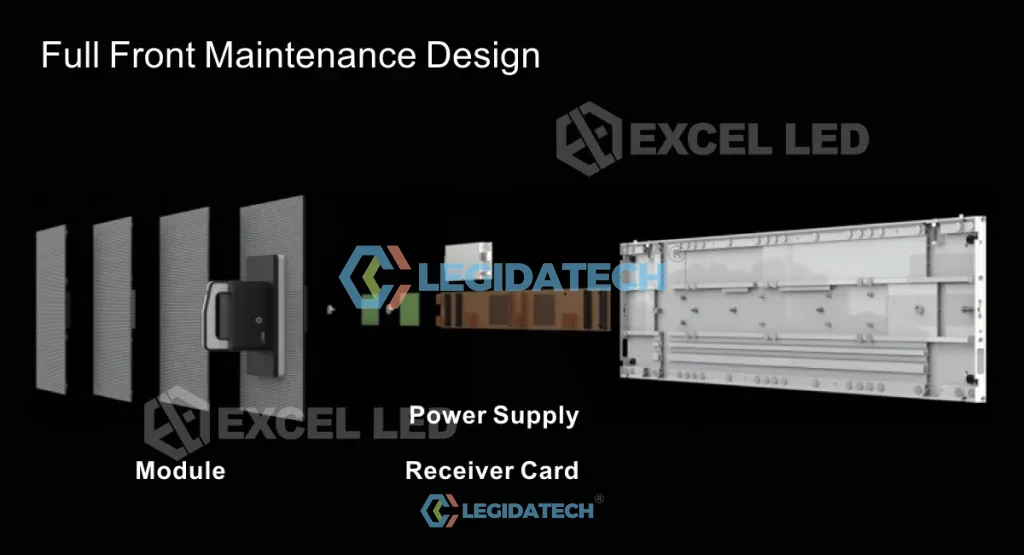
Full front maintenance — module, power supply and receiver card all extract from the front
Why this matters for your board’s decision: serviceability is where LED walls quietly cost money after year two. A front-service wall keeps maintenance in-house for the small failures and keeps warranty visits short. Ask us to walk your tech team through a live module swap on a video call before you commit — request it with your quote.
Flush Wall Mounting Without a Steel Structure
The PS Series installs in two ways: wall-mounted on simple brackets, or recessed into a shallow alcove so the display face sits nearly flush with the wall surface. Because the aluminum cabinet body is its own heat sink, there is no fan wall or ventilation box to build around it.
Weight is the number most church building committees ask about first. The cabinet widths weigh 4.8 / 3.6 / 2.4 kg (1000 / 750 / 500mm), so a typical 4m × 2m wall of PS cabinets carries roughly the same load as a commercial display mounted on the same wall — not the kind of load that triggers structural work. (For listed or historic buildings, have your structural engineer confirm the wall; we supply the mounting drawings for that conversation.)
Cabinets splice in any combination of the three widths, so the wall matches your architecture instead of your architecture matching the screen: one 1m-wide column beside the pulpit, a 3m × 2m lyric wall, or a full 5m backdrop built from 1000×250mm and 750×250mm sections.
Wall-mounted without a steel frame — 20.6mm cabinet depth keeps the profile tight
Curved Walls and 90-Degree Corners for Baptisteries and Stage Designs
Worship spaces are not rectangles. The PS platform includes corner and arc cabinets that let a wall turn a true 90-degree corner or sweep in a gentle curve — the difference between a screen installed in a room and a screen designed into it.
Where churches use it:
- Baptistry wrap — a curved LED wall behind the font turns baptisms into the visual moment of the service, with the water, the screen and the light in one composition.
- Stage corner sets — a 90-degree return turns a flat backdrop into a set piece that reads with depth on camera — noticeably better on the IMAG feed.
- Column and pillar wraps — the structural elements you cannot remove become display surface.
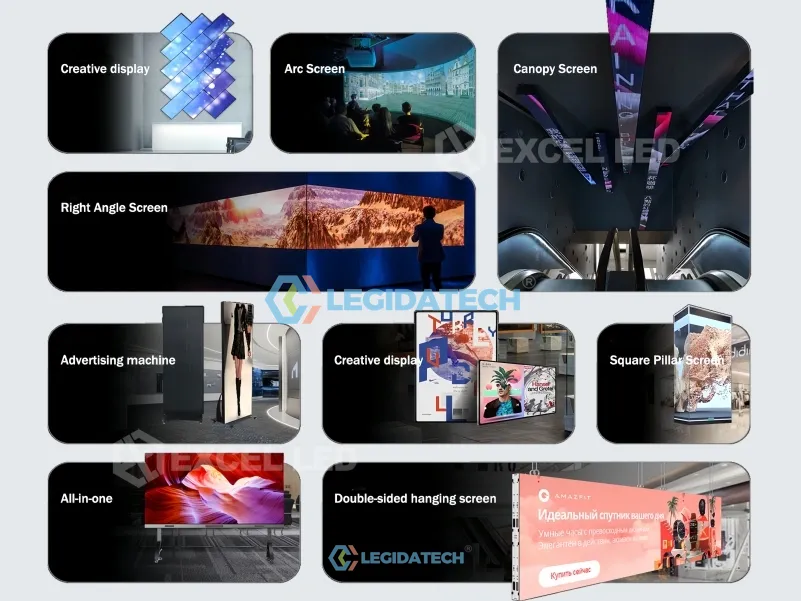
- Double-sided signs — slim enough to hang as a two-faced welcome wall in a lobby or corridor junction.
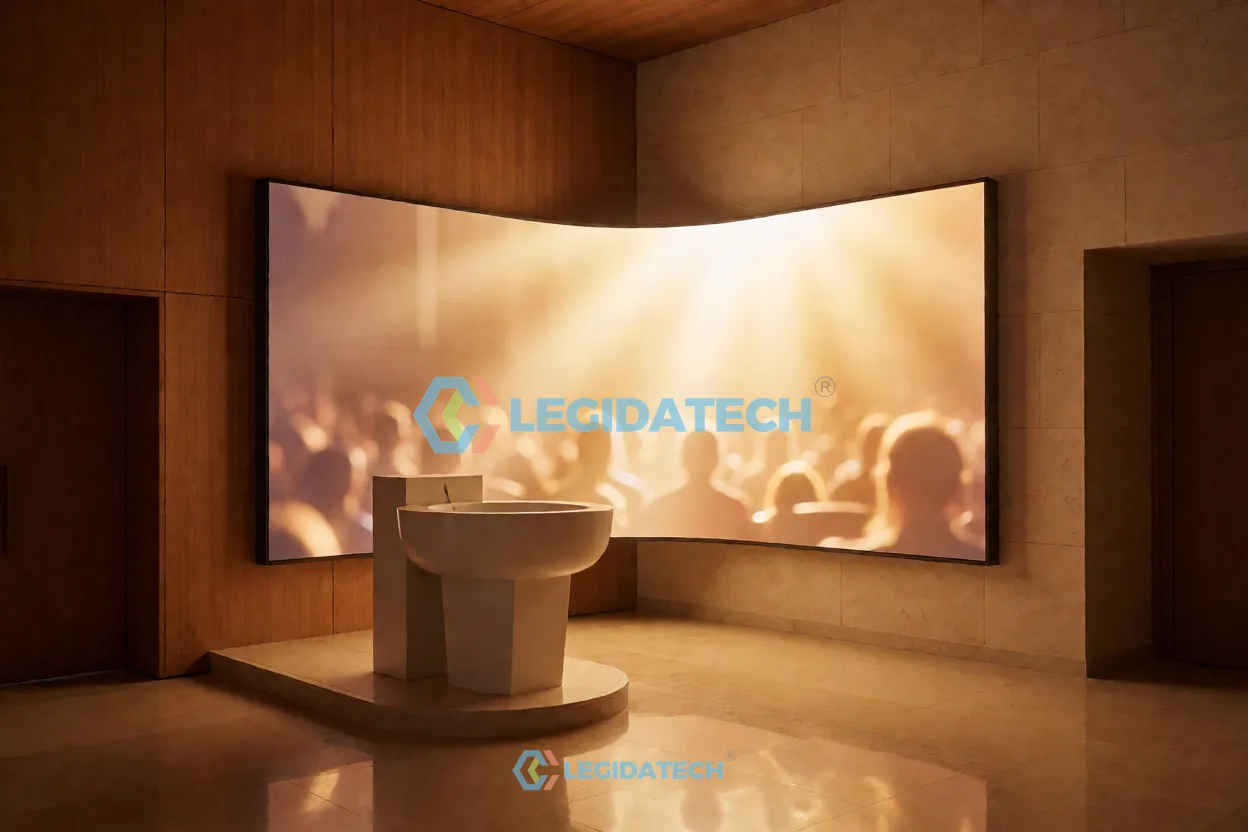
Rendered scene — corner and curve configurations; the wall follows the room, not the other way round
Designing around a baptistry or an angled wall? Send us a photo and the rough dimensions — we will return a cabinet map showing exactly how the curve or corner builds. Get a free design & budget quote.
Dual Power and Dual Signal: Engineered So Sunday Never Depends on One Part
Ask any LED technician what fails first on a video wall and the answer is almost always the same: power supplies and connectors — not LEDs. The PS Series is built around that reality:
- Dual power redundancy — wide-voltage (110–240V) power supplies run in parallel; when one fails, the other carries the cabinet and the wall keeps playing until the swap.
- Dual receiving cards with four network ports — signal path redundancy for 24/7-grade operation, so a cable or card fault degrades gracefully instead of blacking a section mid-service.
- Optional common-cathode energy-saving design — the platform’s typical draw is already a modest 165–185 W/m²; the common-cathode option reduces it further, with the configuration confirmed in your quotation.
For a church, that engineering shows up on the one morning you cannot reschedule. A redundant wall logs a fault; a single-path wall announces it to the whole congregation.
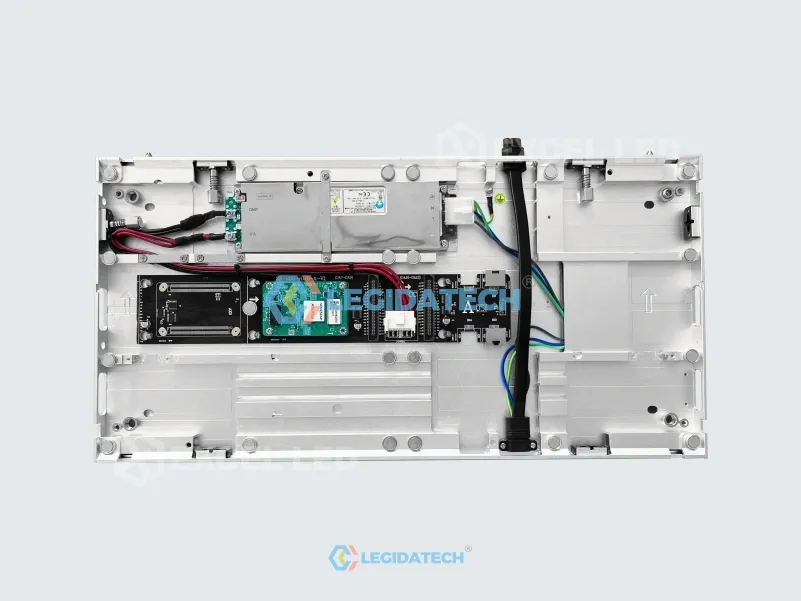
Inside the 20.6mm cabinet — power supply and receiving card carriers on a slim aluminum chassis
The GOB Option: A Protected Face for Youth Rooms and Busy Hallways
The PS Series ships as a standard SMD wall, or with a GOB (Glue-on-Board) coating on the module face — a transparent protective layer bonded over every LED (the PS Pro configuration). GOB is specified for exactly the environments where fine-pitch LEDs meet real life:
- Knock and scratch resistance — mic stands, gear carts, basketballs in the youth hall, and children at the welcome desk.
- Moisture stability — sealed against humidity swings in storage rooms and halls that heat up only on Sundays.
- Cleaning tolerance — the sealed face wipes down without exposing lamp beads.
If your wall sits where hands and equipment travel — youth rooms, corridors, children’s wings, multipurpose halls — budget for the GOB surface in the original order. It costs far less than replacing modules later, and it protects your warranty position.
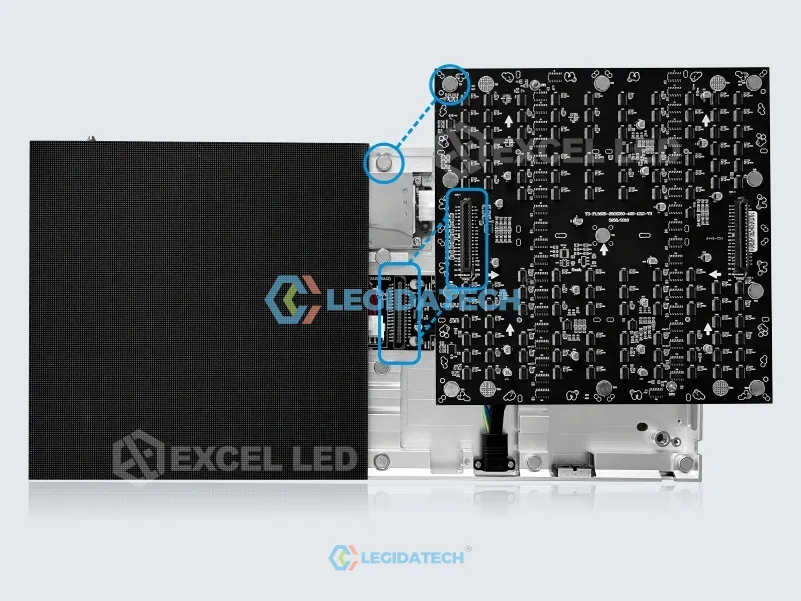
GOB-sealed module face — the anti-collision surface option for high-traffic church spaces
Where Churches Use the PS Series Slim LED Wall
Sanctuary lyric and IMAG wall
A flush lyric wall behind or beside the pulpit is the most common PS configuration. At P1.56–P2.6, lyrics and sermon points read cleanly from the middle rows of a typical sanctuary, and the 3840Hz refresh keeps the IMAG feed free of rolling bands. When the room is deep and the wall is far away, compare the wider-format options on our indoor fixed church LED screens page.
Lobby, welcome desk and fellowship hall
The slim profile suits the places people walk past at conversational distance: welcome walls, announcement boards, ministry highlights and event promotion. P1.95–P2.6 carries small text cleanly from two to three meters.
Baptistry and stage creative sets
Curves and 90-degree corners turn the baptistry or stage edge into a designed moment — the configuration churches tell us visitors remember. Pair the wall with your lighting designer; the 5000:1 contrast holds black levels under stage wash.
Columns, pillars and double-sided signs
The 500×250mm cabinet wraps structural columns, and the 20.6mm depth hangs as a double-sided wayfinding or welcome sign where a deep cabinet would obstruct the corridor.
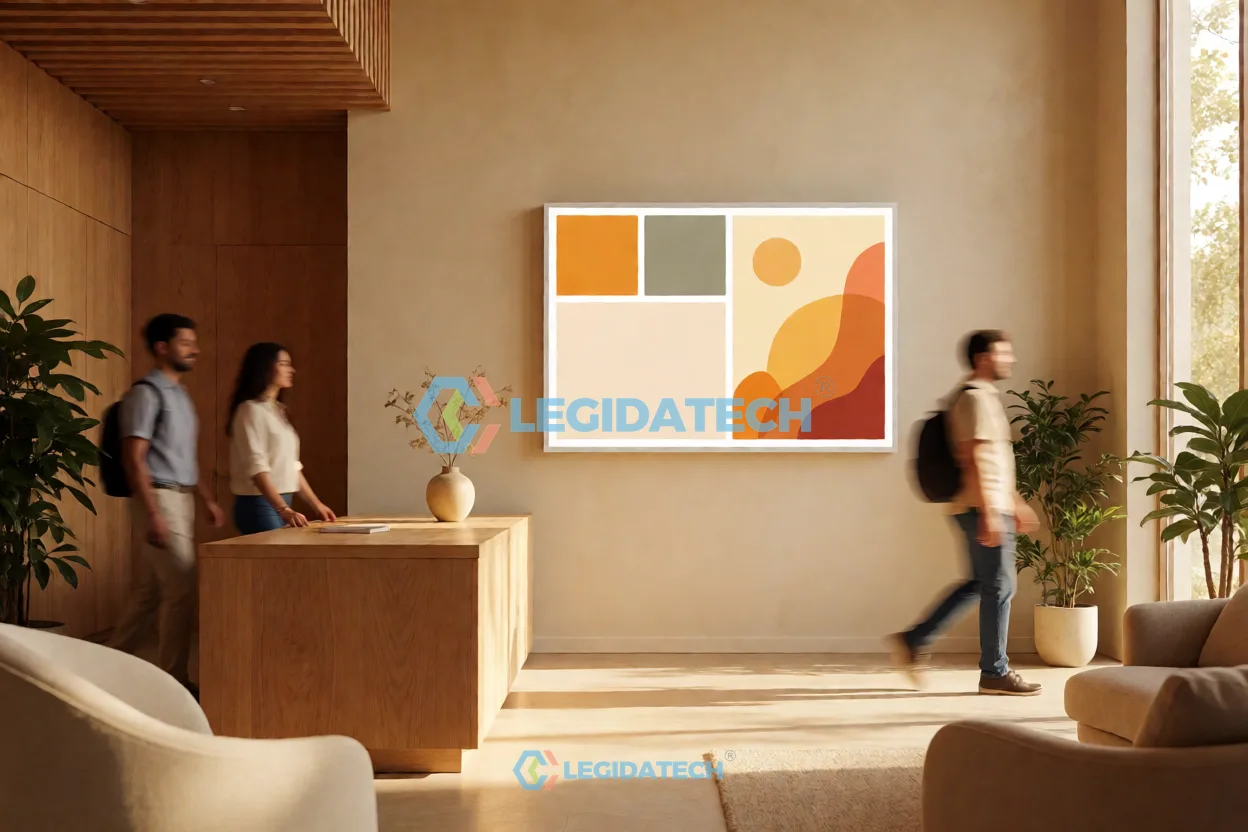
Rendered scene — welcome-area configuration at lobby viewing distance
LEGIDATECH Church Installations Across 12 Countries
LEGIDATECH’s project archive documents 44 church installations across 12 countries — among them a 9×3.75m indoor sanctuary wall in Port Harcourt, Nigeria, and a 5.12×1.92m Ehonor P2.5 wall at Warriors Chapel Worldwide in Kumasi, Ghana. Those documented projects run on the same indoor fixed platform family this series belongs to, and our team will happily match you with the reference closest to your room size and budget.
See the walls themselves: browse church LED screen case videos, the named House of Miracle Ministry installation in Accra, Ghana, and the 5.12×2.88m church screen project in Peru.
Want to talk to a church that already did this? Request a phone call and we will connect you with a reference project similar to yours — same region where possible, same room scale.
PS Series Specifications: 1000×250mm Slim Indoor LED Display
Five pixel pitches share one cabinet platform. Every value below is taken from the manufacturer’s specification sheet for the PS platform.
| Parameter | PS1.56 | PS1.95 | PS2.6 | PS2.97 | PS3.91 |
|---|---|---|---|---|---|
| Pixel Pitch | 1.56 mm (confirmed) | 1.95 mm (confirmed) | 2.6 mm (confirmed) | 2.97 mm (confirmed) | 3.91 mm (confirmed) |
| LED Type | SMD1212 | SMD1515 | SMD1515 | SMD2020 | SMD2020 |
| Module Size | 250×250 mm — bottomless design, 11 magnets + 2 copper positioning pins per module (confirmed) | ||||
| Cabinet Size (W×H×D) | 1000×250×20.6 mm (also 750×250×20.6 and 500×250×20.6) (confirmed) | ||||
| Cabinet Resolution | 640×160 px | 512×128 px | 384×96 px | 336×84 px | 256×64 px |
| Cabinet Weight | 4.8 / 3.6 / 2.4 kg for the 1000 / 750 / 500mm cabinets (confirmed) | ||||
| Cabinet Material | Aluminum profiles (self-cooling body) (confirmed) | ||||
| Pixel Density | 409,600 dot/m² | 262,144 dot/m² | 147,456 dot/m² | 112,896 dot/m² | 65,536 dot/m² |
| Brightness | ≥600 cd/m² (confirmed) | ||||
| Refresh Rate | 3840 Hz (confirmed) | ||||
| Grayscale | 14–16 bit | ||||
| Contrast Ratio | 5000:1 (confirmed) | ||||
| Color Temperature | 6500–9000 K | ||||
| Viewing Angle (H/V) | 140° / 120° (confirmed) | ||||
| Drive Mode | 1/40 | 1/32 | 1/32 | 1/28 | 1/16 |
| Power (max. / avg., W/m²) | 500 / 165 | 550 / 185 | 500 / 165 | 500 / 165 | 500 / 165 |
| AC Voltage | 110–240 V (confirmed) | ||||
| Ingress Protection | IP43 (indoor) (confirmed) | ||||
| Maintenance | Full front service — modules, power supplies, receiving cards (confirmed) | ||||
| Redundancy | Dual power supply + dual receiving cards, 4 network ports (confirmed) | ||||
| Geometry Options | 90° corner and curved cabinets; wall-mount, recessed, ceiling, column, double-sided | ||||
| Surface Options | Standard SMD, or GOB-coated module face (PS Pro configuration) | ||||
Specifications are manufacturer values for the PS platform as published on the group’s product documentation. Pitch availability, the GOB surface option and the common-cathode energy-saving option are confirmed with your quotation, as they affect price and lead time.
Which Pixel Pitch for Your Sanctuary? The Closest-Seat Rule
The industry rule of thumb is roughly 1mm of pixel pitch per meter of minimum viewing distance — the distance to the closest seat that can see the wall, not the furthest. Here is how the five PS pitches map to church rooms:
| Model | Pitch | Comfortable from | Typical church fit |
|---|---|---|---|
| PS1.56 | 1.56 mm | ≈1.6 m / 5 ft and beyond | Chapel and prayer-room walls; welcome desks where people stand close |
| PS1.95 | 1.95 mm | ≈2 m / 6.5 ft and beyond | Lobby walls and corridors at conversational distance |
| PS2.6 | 2.6 mm | ≈2.6 m / 8.5 ft and beyond | Most sanctuary lyric walls — balance of resolution and budget |
| PS2.97 | 2.97 mm | ≈3 m / 10 ft and beyond | Mid-size sanctuaries; stage side walls |
| PS3.91 | 3.91 mm | ≈4 m / 13 ft and beyond | Larger sanctuary walls viewed from a distance; creative set pieces |
If your furthest seat is more than 20 meters out, pitch matters less than wall size and brightness — at that distance the differences between fine pitches stop being visible and the budget is better spent on area. Send us your room dimensions and we will run the numbers with you.
Illustrative example: a 6m × 1.5m sanctuary lyric wall built from PS2.6 cabinets is 6 cabinets wide × 6 high — 2304×576 px, comfortable for lyrics and sermon points at typical sanctuary distances. (Illustrative sizing; verify against your seating plan and camera positions.)
How Much Does the PS Series Cost?
We do not publish factory pricing for the PS Series, because the honest answer depends on four things: pixel pitch, total area, the GOB surface option, and the control system. Fine pitches cost more per square meter; larger walls cost less per square meter than small ones.
For a real anchor point: our indoor fixed church LED screens page publishes complete P2.5 package pricing (panels, control system, spares, EXW) ranging from $2,245 for a 2.56×1.44m set to $5,100 for a 4.8×1.92m set — that is the price band where most church lyric walls land. The PS Series quotes in a similar per-project structure, with the slim-cabinet format and front-service hardware as the differences. For the wider budget picture — structure, processors, shipping, installation — read our church LED wall price quick guide.
What moves your PS quote: pitch (P1.56 to P3.91 spans a wide per-m² band), area, GOB surface, corner/curve cabinets, and whether you want the common-cathode energy-saving option. Request an indicative price with your wall size and closest-seat distance — we return a configuration with numbers, not a brochure.
When the PS Series Is NOT the Right Choice
No single screen family fits every church job. We would point you away from the PS Series in these situations:
- Strong stage-light wash across the wall. 600 nits is an interior-lit brightness. If your stage rigging throws significant light directly onto the screen wall, lyrics wash out — step up to the 800-nit CPS Series, or reposition the wall out of the wash.
- Huge sanctuary walls where slimness buys nothing. If the wall sits proud on a wide stage with room behind it, a standard-depth fixed cabinet series gives you more display area per dollar — compare the Ehonor Series.
- Outdoor or sunlit positions. IP43 is an indoor rating. Courtyard and exterior walls need the OK Series outdoor screens.
- Zero-maintenance expectations. Every LED wall needs a spares plan and occasional module swaps. If nobody on your team will ever own that, say so in your inquiry — we would rather design the support arrangement honestly than sell you a wall that decays.
Why we publish this list: a screen bought for the wrong job costs a church more than the price difference of the right one — in volunteer time, in board confidence, and in the workmanship reputation of everyone who approved it.
PS vs CPS vs Ehonor: Which Church LED Wall Series Fits Your Room?
All three ranges are indoor fixed-install LED walls from the same factory. The honest differences:
| Factor | PS Series (this page) | CPS Series | Ehonor Series |
|---|---|---|---|
| Cabinet | 1000/750/500×250mm, 20.6mm slim aluminum | 640×480mm die-cast aluminum, 65mm | 480×320mm standard cabinet |
| Pitches | P1.56–P3.91 | P1.25–P3.07 | P1.5–P2.5 (COB/HOB/SMD options) |
| Brightness | ≥600 nits | 800 nits | Model-dependent; confirm with quote |
| Maintenance | Full front, magnetic | Full front, magnetic | Full front, magnetic |
| Signature strength | Flush wall-mount, lightest, curves & corners | Fine pitch + 16:9 + 800 nits | The proven church workhorse |
| Choose it when | The wall must hug the building — shallow walls, pillars, baptistry curves, tight budget for structure | The first row sits close and the stage is bright — chapels, streaming backdrops, detail-heavy content | You want the range with the deepest church track record and standard sizes |
Still deciding? The CPS Series page and the Ehonor fixed screen page carry the same honest-boundaries section from their own angles — read all three and the right choice is usually obvious. Or simply send us your room dimensions and we will recommend one, including the option of not buying from any of them.
Delivery, Spares, and Who Looks After You in Year Three
What arrives: PS cabinets packed with protective foam and corner guards, mounting brackets, the control system (sending box and receiving cards), cabling, and a magnetic suction tool for module service. Production for typical church orders runs about seven working days before aging tests and packing; your quotation confirms the exact window and shipping mode (air, sea or express courier).
The spares block we recommend with every order: spare modules at roughly 5% of the wall, one spare power supply, one spare receiving card, and the magnetic tool that ships standard. Parts that ride the initial freight cost a fraction of what a year-three emergency shipment costs — this is the highest-value reliability decision in the whole project.
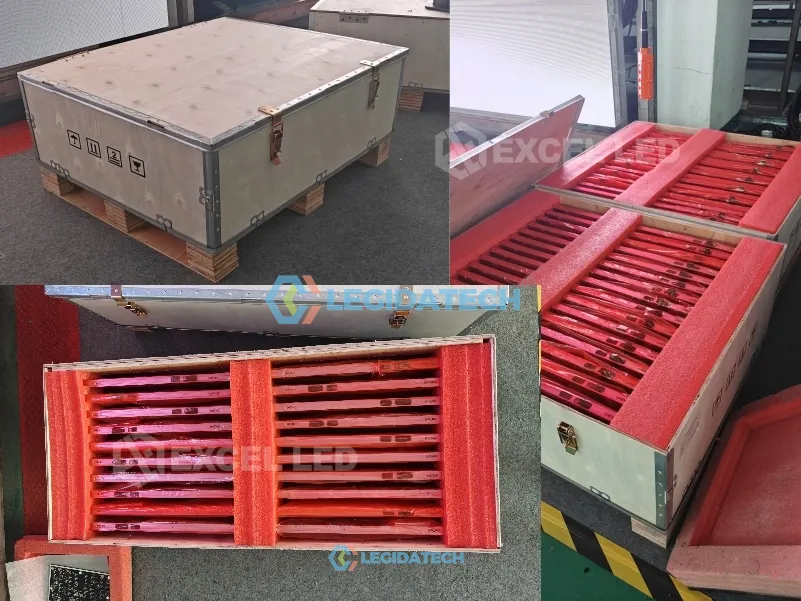
Export packing — cabinets, brackets and control system in one shipment
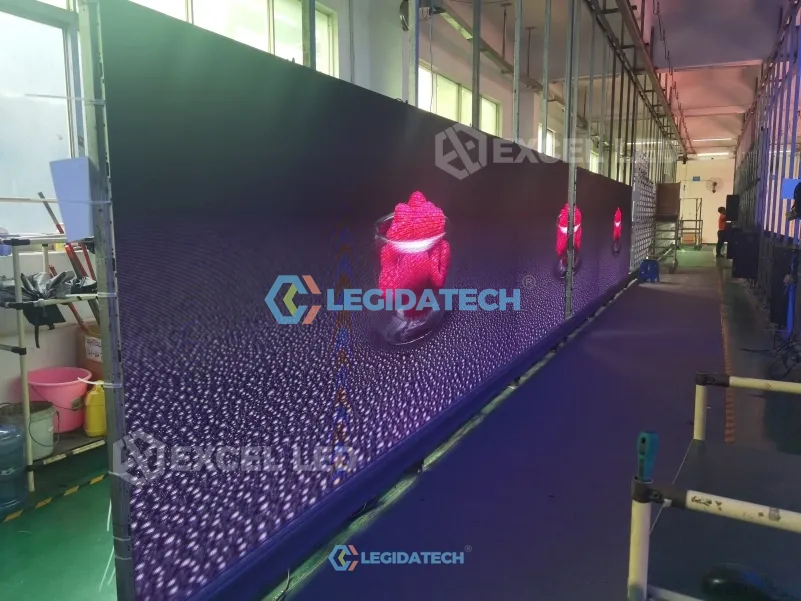
Cabinets through production and aging before packing
Year-three reality: LED walls rarely fail suddenly; power supplies and connectors age first, and modules can be knocked. With front service, your team handles the small stuff in minutes; our support line handles the rest — and our video library includes step-by-step module, power-supply and receiving-card replacement guides for this platform family. Warranty terms are confirmed in writing with your quotation — ask for current coverage before you commit.
Planning the install weekend? Every church order comes with a deployment checklist — mounting map, signal path, camera check and volunteer handover. Request it with your quote.
The PS Platform in Operation
Manufacturer footage of the slim indoor platform this series is built on:
For installed church projects worldwide, browse the church LED screen case videos — including installations across Nigeria, Ghana, Peru, South Africa and the UK.
Slim Church LED Wall: Buyer Questions Answered
Q1How much does an LED church screen cost?
Most church lyric walls land between a few thousand dollars for compact sets and the low tens of thousands for larger fine-pitch walls, depending on pitch, area, brightness and the control system. We publish complete P2.5 package prices on our indoor fixed page as a reference band, and we quote the PS Series against your exact size and pitch rather than a brochure number.
Q2Is 600 nits bright enough for our sanctuary?
For lobbies, chapels, fellowship halls and sanctuaries with moderate ambient light, yes — 600 nits reads comfortably. If strong stage lighting washes across the screen wall, choose the 800-nit CPS Series or reposition the wall out of the light path. Tell us your lighting plan when you request the quote and we will advise honestly.
Q3Can our volunteers replace a module without a technician?
Yes. Modules attach magnetically and come out from the front with a suction tool; the copper positioning pins align the replacement automatically. Our video library includes step-by-step module, power-supply and receiving-card replacement guides, and we walk new teams through a live swap on a video call.
Q4Will it flicker on our livestream cameras?
No. The 3840Hz refresh rate is above the threshold where LED walls produce rolling bands at normal camera shutter speeds, so IMAG, livestream and recording all stay clean. Do one camera test at rehearsal with your actual shutter settings — that is standard practice for any wall.
Q5Do we need a steel structure on the wall?
In most cases no. The heaviest 1000×250mm cabinet is about 4.8 kg, so a typical church wall carries the load on standard mounting brackets — comparable to a large commercial display. For listed or historic buildings, have your structural engineer confirm the wall; we supply mounting drawings for that conversation.
Q6Can the wall wrap our baptistry with a curve or corner?
Yes. The platform includes 90-degree corner and curved configurations. Send a photo and rough dimensions of the baptistry or stage, and we return a cabinet map showing exactly how the curve builds and what it adds to the quote.
Q7Which pixel pitch should our church choose?
Use the closest-seat rule: about 1mm of pitch per meter of distance to the nearest seat that sees the wall. P1.56 suits close-viewing chapels and desks, P2.6 is the most common sanctuary lyric wall, P3.91 suits walls viewed from further away. The viewing distance table above maps all five pitches to room types.
Q8What comes in the spares kit, and why does it matter?
We recommend spare modules at roughly 5% of the wall, one spare power supply, one spare receiving card, plus the magnetic tool that ships standard. Parts included with the initial shipment cost a fraction of a year-three emergency shipment — and modules can be discontinued after about eight years, which is exactly when your spares block pays for itself.
Q9Can we feed it from ProPresenter or our presentation laptop?
Yes. The wall runs through a standard LED control system with synchronous live input from your presentation machine — ProPresenter, Resi or any HDMI source through the processor. The control system model is specified with your quotation based on your content workflow.
Q10How long is the lead time, and how does shipping work?
Typical production runs about seven working days before aging tests and packing, confirmed exactly in your quotation. Shipping goes by air, sea or express courier depending on urgency and budget; slim cabinets pack densely, which keeps freight volume lower than deep-cabinet walls.
Q11What warranty do we get on the PS Series?
Warranty terms are confirmed in writing with your quotation — ask our team for current coverage before you commit, and put it in your board papers. Pair the warranty with the spares block above: together they are your year-three insurance policy.
Q12We are a small church — is a slim LED wall realistic for us?
Often yes: a single 1m × 1m or 2m × 1m PS wall beside the pulpit transforms lyric visibility without a construction project. Start with your room dimensions and closest-seat distance, request the indicative price, and compare it against your projector’s replacement-lamp budget over three years — the honest comparison surprises many small congregations.
The Complete Guide to Slim Indoor LED Walls for Churches
Everything below expands on the decisions between “we need a screen” and a purchase your board will approve with confidence.
Why cabinet depth changed the church LED wall decision
For years, an indoor LED wall meant a box: 80–100mm deep cabinets on a support frame, with a service corridor behind. Fine for a new build; awkward for a 19th-century sanctuary with shallow walls, or a multipurpose hall where every centimeter of stage depth matters. Slim-profile platforms like the PS Series moved the service to the front and let the aluminum body do the cooling, which collapsed the installation footprint to little more than a mounted display. The practical consequence: LED walls moved out of “construction project” territory and into “equipment purchase” territory for most churches — a different approval path, a different budget line, and a much shorter project calendar.
Wall loading: what your building actually needs to carry
Weight math for a slim wall is friendlier than most committees expect. A 4m × 2m wall built from 1000×250mm cabinets uses 32 cabinets; at 4.8 kg per cabinet (2.4–3.6 kg for the narrower widths), the wall mass lands in the low hundreds of kilograms including brackets and cabling — spread across the mounting lines. Compare that with the projection screens and trussing many churches already hang. The honest caveat: older or listed buildings deserve a structural engineer’s sign-off, and we supply mounting drawings sized for that conversation. If your wall cannot carry it, the recessed or floor-standing configurations are the fallback designs.
Front service, step by step: what a volunteer actually does
A module swap on a front-service wall is deliberately boring. Power the section down, press the suction tool onto the failed module, pull it free — the magnets release, the copper positioning pins mark the alignment — seat the replacement from your spares block, power up, and run a test pattern. Power supplies and receiving cards ride the same front-access principle on their carriers. The skills involved are “careful hands and a labeled spares shelf,” not electronics. Our support video library demonstrates each replacement type on this platform family, and we walk new tech teams through their first swaps on a call.
SMD or GOB surface: an honest decision guide
Standard SMD gives you the lower price-per-square-meter of the two options and is fine for walls that hands and equipment never touch. GOB coating adds a transparent protective layer over the LED face — worth it wherever the wall lives near people: youth rooms, corridors, children’s wings, multipurpose halls, baptistry alcoves where cleaning happens weekly. The cost delta is modest against the price of replacing modules, and the sealed face also stabilizes the wall against humidity swings between heated Sundays and cold weekdays. If you are unsure which side of the line your room falls on, describe the room in your inquiry — we will recommend one and say why.
Power planning for a slim sanctuary wall
PS Series walls draw 500–550 W/m² at maximum and 165–185 W/m² typical. A 12m² lyric wall therefore plans around 2–2.2 kW of peak capacity on the supply circuit — well within a standard dedicated circuit, but worth telling your electrician in advance. The optional common-cathode design reduces the typical draw further, which over a decade of services compounds into real money and less heat in a shallow wall cavity. Run the wall on its own circuit, label it, and put the breaker on your volunteer checklist — the lowest-cost reliability engineering you can do.
The five-question checklist before you request a quote
- Where exactly does the wall go — and what is behind it (wall depth, pillars, doors, windows)?
- How far is the closest seat that will read the wall? That number picks your pitch.
- What hits the wall — stage wash, sunlight through windows, HVAC vents?
- Who operates it — and does your content workflow run from ProPresenter, a media server or a volunteer’s laptop?
- What is the all-in budget — including freight, installation help, and the spares block?
Bring those five answers and your quote conversation becomes a configuration, not a sales call. Get a free design & budget quote — or keep researching with our pixel pitch explainer and the church LED wall price quick guide.
Why Choose the PS Series for Your Church
Because it solves the building problems that actually stall church screen projects — shallow walls, missing steel budgets, pillars in the wrong place — while keeping the image quality your congregation and camera expect: 1000×250mm indoor LED cabinets at 20.6mm deep, full front service, dual power and signal redundancy, and curves or corners where your architecture asks for them. That is a wall designed the way church buildings actually are.
LEGIDATECH supplies church projects across 12 countries from its factory base. Related reading: CPS Series small pitch LED display · Ehonor Series fixed church screen · indoor fixed church LED screens · foldable portable LED poster.